
Kajabi vs Paperbell: Which Is Better for Coaches? (2026)
Kajabi is the better choice for a coach building a course, membership, or funnel business at real scale, with a full funnel, email, and course system to configure, where 1:1 coaching is a secondary offer inside that bigger content business. Paperbell is the better choice for coaches whose business is 1:1 or small-group coaching: it includes a full coaching website, scheduling, payments, real e-signature contracts, and client management.
- Kajabi's entry price is $179/month, or $143/month billed annually, plus payment processing fees on every transaction on top of the subscription.
- For coaching specifically, Kajabi has no intake forms, checkbox acknowledgments instead of real e-signature contracts, and one shared availability schedule across all coaching products.
- Paperbell is $57/month, or $47.50/month billed annually, everything included: roughly a third of Kajabi's entry price.
Kajabi vs Paperbell at a glance
| Feature | Kajabi | Paperbell |
|---|---|---|
| Price | $179/month, or $143/month billed annually (Basic), plus payment processing fees | $57/month, or $47.50/month billed annually. No payment processing markup |
| Website included | ✓ 1 website on Basic and Growth, 3 on Pro. About 11 built-in templates; deep customization needs CSS | ✓ Full coaching website, fill-in-the-blanks setup, no coding |
| Scheduling | ✓ Native scheduler with Google Calendar sync, but one availability schedule shared across all coaching products | ✓ Two-way sync with Google, Outlook, or Apple calendars, buffers, time zone detection, per-package availability |
| Coaching packages with session tracking | ✓ 1:1 and group modes, client notes, progress tracking | ✓ Packages with remaining-session tracking and a full client history dossier |
| Payment plans and subscriptions | ✓ Session and package purchase flows, auto-generated invoices; 2.9% plus 30 cents processing on Basic, or a Kajabi platform fee of up to 2% with a third-party processor | ✓ Payment plans, subscriptions, pay-in-full discounts, set-up fees |
| Contracts and e-signature | ✗ Checkbox-acknowledgment automation, not a true e-signature tool | ✓ Real e-signatures via Dropbox Sign, unlimited contracts included |
| Client portal | Member login built around course content | ✓ Clients book, buy, sign, and access materials, no password required |
| Intake forms | ✗ Not part of the coaching product | ✓ Customizable surveys and intake forms built into onboarding |
| Courses and content | ✓ Full LMS: quizzes, certificates, drip content; cohort courses require Growth ($249/month, or $199/month billed annually) or up | Digital downloads and drip content, not a full LMS |
| Group coaching | ✓ Group coaching mode in the coaching product | ✓ Group programs, live workshops, mixed 1:1 and group packages |
| Mobile app | ✓ | ✗ No standalone app; runs in any mobile browser |
| Best for | Creators running a full course, funnel, and email operation at scale | Coaches selling 1:1 and small-group coaching |
Prices and features verified August 2026.
Kajabi vs Paperbell pricing
Kajabi's entry price is $179/month, or $143/month billed annually, after a January 2026 restructure that raised prices roughly 20 to 25% and removed the old $89/month entry tier from public pricing. Payment processing fees come on top of the subscription on every plan, and using a third-party processor adds a Kajabi platform fee of up to 2%.
Features many buyers assume are standard, including cohort courses, affiliates, advanced automations, video transcription, and removing Kajabi branding, are gated behind the Growth or Pro plans at $249 to $499 per month. For a coach, the realistic Kajabi bill depends heavily on which tier the business actually needs.
Paperbell costs $57/month, or $47.50/month billed annually. One plan, everything included, no per-client fees, no payment processing markup. That is roughly a third of Kajabi's entry price.
Every account gets unlimited clients, unlimited packages, and unlimited contracts, and payments go straight to the coach's own Stripe or PayPal account. There is a free account, no credit card required, and a 30-day refund policy on paid plans.
What Paperbell does better
Paperbell was built for one specific business: selling coaching. That focus shows up everywhere Kajabi treats coaching as one product type among many.
- Price, all-in. $57/month, or $47.50/month billed annually, versus Kajabi's $179/month entry point. Paperbell adds no payment processing markup; Kajabi charges processing fees on every transaction on top of the subscription.
- The website is the product. Every Paperbell account includes a full coaching website with fill-in-the-blanks setup: packages, prices, booking, and checkout land on a finished, branded site automatically. Kajabi includes a website too, but with about 11 built-in templates and meaningful customization requiring CSS, per multiple reviews.
- Scheduling built for multiple offers. Paperbell supports per-package availability, A/B schedules, buffer times, automatic time zone detection, and two-way sync with Google Calendar, Outlook, or Apple iCloud. Kajabi's scheduler allows only one availability schedule across all coaching products, so a coach running a discovery call, a 1:1 package, and a group program cannot set different hours for each.
- Real e-signature contracts. Paperbell includes true e-signatures through Dropbox Sign, baked into the checkout and booking flow, with unlimited contracts and no separate account needed. Kajabi's contract workflow is an automation that emails a document and collects a checkbox or typed-name acknowledgment.
- Client onboarding on autopilot. Intake surveys, contract signing, payment, and scheduling happen in one flow before the first session, and every client gets a portal (no password required) to book, buy, and access materials. Kajabi's client-facing experience is built around course content, not coaching admin.
- Setup in hours, not weeks. Kajabi reviewers describe a steep learning curve, an unintuitive automation system, and users who pay for months without launching. Paperbell is a fill-in-the-blanks setup aimed at coaches who are not tech-savvy.
- Human support. Paperbell offers email support from a live human Monday through Friday, no bots. Long-tenure Kajabi users report a shift to AI-chatbot-first support with multi-hour unresolved chats.
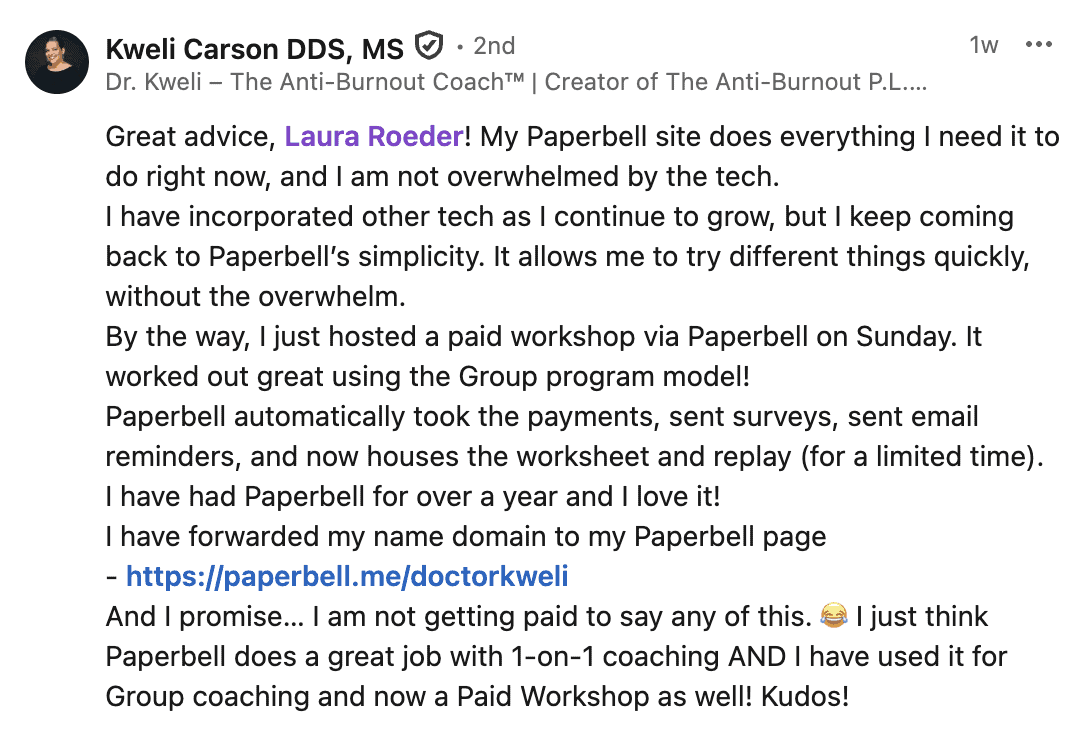
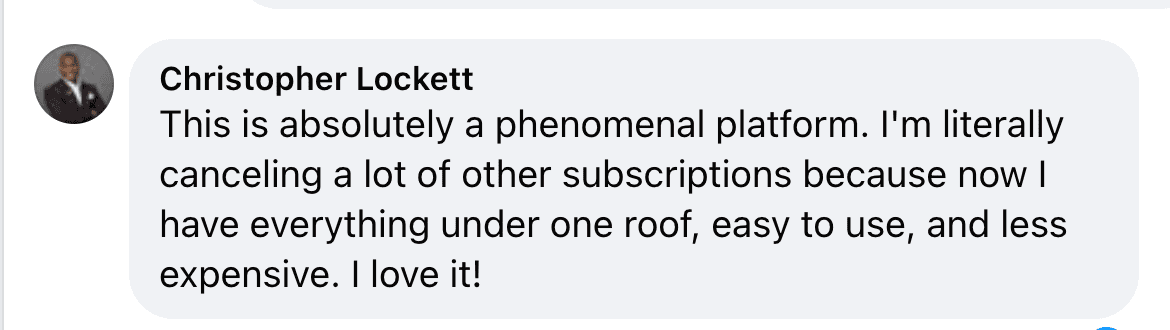
What coaches say after switching

Which is better for coaches: Kajabi or Paperbell?
It depends on what the business actually sells
A creator running courses, community, and funnels at scale, with a full content and email operation to manage, fits Kajabi better; its LMS, email marketing, and 100,000-contact ceiling have no equivalent in any coach-specific tool. But if coaching is the business, Paperbell covers the entire coaching workflow (website, scheduling, payments, real contracts, and client management) for about a third of Kajabi's entry price. Most working coaches never use the infrastructure that $179/month is paying for.
Kajabi vs Paperbell: frequently asked questions
Is Kajabi good for coaches or just course creators?
Kajabi was built for course creators first. Its coaching product now includes a native scheduler, built-in live video, and session tracking, but coaching still sits inside a platform designed around courses, funnels, and email lists. Coaches who mainly sell courses do well on Kajabi. Coaches who mainly sell 1:1 or small-group coaching usually get a better fit, at a much lower price, from a coach-specific platform like Paperbell.
What does Kajabi do better than Paperbell?
Kajabi is a full learning management system with quizzes, certificates, drip content, and cohort courses on Growth and up, where Paperbell offers digital downloads and drip content but not a full LMS. Every Kajabi plan also includes funnel and email infrastructure to configure: broadcasts, sequences, behavior-based tagging, and a pipeline builder that connects opt-in pages, sales pages, checkout, and email sequences, none of which Paperbell provides. And Kajabi Pro, at $499/month, or $399/month billed annually, scales to 100,000 contacts, unlimited products, and 3 websites for a business running courses, memberships, podcasts, and coaching at once.
Is Kajabi worth it in 2026?
It depends on what you sell. For a creator running courses, memberships, and funnels at scale, Kajabi replaces a separate LMS, funnel builder, and email tool. For a coach whose business is mostly coaching sessions, $179/month buys a lot of infrastructure that goes unused, and the January 2026 price increase made that math worse.
Is Kajabi too expensive for beginners?
For most beginner coaches, yes. Kajabi's cheapest public plan is $179/month, or $143/month billed annually, capped at 5 products and 2,500 contacts, and Kajabi removed its cheaper entry tier from public pricing in January 2026. A beginner coach can run a website, scheduling, payments, and contracts on Paperbell for $57/month, and can start with a free account, no credit card required.
How much does Kajabi actually cost with payment processing fees included?
More than the sticker price. On top of the subscription, Kajabi Payments charges 2.9% plus 30 cents per transaction on Basic, 2.8% plus 30 cents on Growth, and 2.7% plus 30 cents on Pro. Using a third-party processor instead triggers a Kajabi platform fee of 2% on Basic, 1% on Growth, or 0.5% on Pro. Paperbell adds no payment fees of its own; coaches pay only their own Stripe or PayPal processing.
Why did Kajabi raise its prices?
Kajabi restructured its pricing effective January 13, 2026, raising prices roughly 20 to 25% across the board, removing the old $89/month entry tier from public pricing, and cutting the Basic plan's contact limit from 10,000 to 2,500. New signups received a 50% introductory discount while existing customers did not, which triggered a Change.org petition and a spike in one-star Trustpilot reviews.
What happened to the Kajabi Kickstarter plan?
The Kickstarter tier, with 1 product and 250 contacts, no longer appears with a price on Kajabi's public pricing page, and third-party trackers describe it as a legacy plan with selective availability. Anyone budgeting for Kajabi today should plan around the $179/month Basic plan.
Does Kajabi have built-in scheduling for coaching sessions?
Yes. The Kajabi Scheduler books sessions up to 200 days out in 15-minute intervals, syncs with Google Calendar, and sends automatic confirmation and reminder emails. Its main limitation is that it supports only one availability schedule across all coaching products, so a coach with multiple offers cannot set different hours per package. Paperbell supports per-package availability.
Can Kajabi replace Calendly and Zoom?
Partly. Kajabi's native scheduler plus its built-in live video can replace both for a simple setup. But if a coach keeps using Calendly or any external scheduling link, the coaching product becomes ineligible for Kajabi's built-in live video. The choice is native but rigid, or flexible but fragmented, not both.
Does Kajabi support 1-on-1 coaching contracts and e-signatures?
Not with a true e-signature tool. Kajabi's contract workflow is an automation that emails a document and collects a checkbox or typed-name acknowledgment. It can be legally valid if assembled correctly, but it is a DIY workflow, not a packaged e-sign feature. Paperbell includes real e-signature contracts through Dropbox Sign as part of the checkout flow, with unlimited contracts included.
Is Kajabi's community feature any good?
It works, but reviewers describe it as a bolt-on. Basic and Growth include 1 community and Pro includes 3, but there is no native video conferencing inside the community, no gamification, limited moderation tools, and discussions cannot be embedded directly into lessons. Skool beats it decisively on community engagement.
What's the difference between Kajabi and Skool for community?
Kajabi is a full platform where community is one feature among many; Skool is a dedicated community product. Reviewers consistently rate Skool ahead of Kajabi on community engagement. Creators who care most about community often run Skool alongside another platform rather than relying on Kajabi's built-in community.
Is Kajabi's learning curve too steep for non-tech-savvy users?
It is a real hurdle. Reviewers note that meaningful customization requires CSS, describe the automation system as unintuitive, and report that some users pay for months without successfully launching. Kajabi rewards the time invested, but a non-technical coach should budget weeks, not hours, for setup.
Does Kajabi have a no-refund policy?
Effectively, yes. Kajabi's standard exception is a full refund within 30 days of the first payment; beyond that, refunds are generally refused. Roughly half of Kajabi's negative Trustpilot reviews center on this policy, often from users who forgot to cancel after Kajabi's 30-day free trial. Paperbell has a 30-day refund policy on paid plans.
How do I cancel my Kajabi subscription?
Cancel well before your renewal date and confirm the cancellation actually took effect, because some users report continued charges after canceling. Combined with the no-refund policy, a missed or failed cancellation usually means paying for another full billing cycle.
What is better than Kajabi?
It depends on the business. For online courses at scale, Kajabi covers that category itself. For community, Skool rates higher with reviewers. For coaches selling sessions and packages, a coach-specific platform like Paperbell covers the actual coaching workflow (website, scheduling, payments, contracts, and client management) at roughly a third of Kajabi's entry price.
What are the best Kajabi alternatives for coaches on a budget?
For coaching-first businesses, Paperbell is the most direct alternative at $57/month, or $47.50/month billed annually, with unlimited clients and packages and no payment processing markup. It includes a website, scheduling, payments, e-signature contracts, intake forms, group coaching, and digital downloads. It does not try to match Kajabi's course, funnel, or email marketing depth, so creators who need those should compare full course platforms instead.
Built for coaching, priced for coaches
Paperbell puts a coach's website, scheduling, payments, and contracts in one place, live in an afternoon, not after weeks of setup.
Try Paperbell Free