
You’ve likely heard the name Peter Hawkins come up in coaching circles more than once. Maybe it was in a certification program, a coaching supervision conversation, or a leadership development conference.
There’s a reason for that.
Professor Peter Hawkins didn’t just add a new model to the coaching world. He effectively created the discipline of systemic team coaching as we know it today. His frameworks are taught on every continent, and coaches who understand his work genuinely think differently about what’s possible when you coach teams rather than individuals.
This guide covers who Hawkins is, his most influential frameworks (including his Five Disciplines model and the Seven-Eyed Supervision Model), how to get certified in his approach, and how to start applying his thinking to your own practice. Whether you work with leadership teams or you’re just curious about what “systemic” actually means, there’s a lot here.
Who is Professor Peter Hawkins?
Professor Peter Hawkins is a London-based academic, practitioner, and author who has spent over three decades working at the intersection of leadership, organizational culture, and team development.
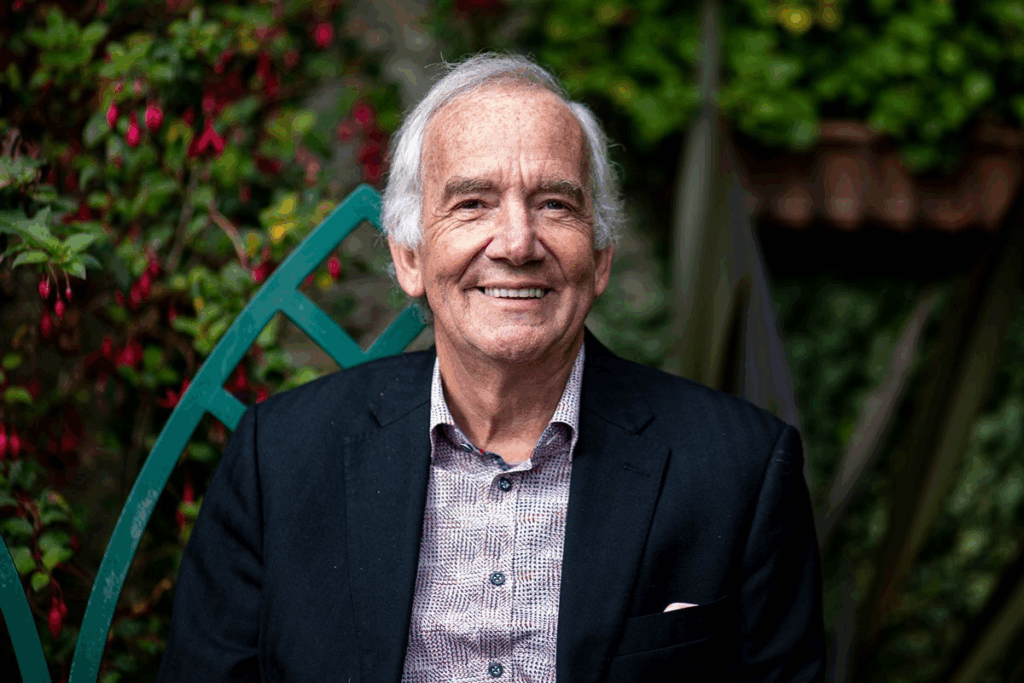
He’s currently Professor of Leadership at Henley Business School, University of Reading, and Emeritus Chairman of Bath Consultancy Group, two institutions that have shaped coaching and leadership thinking in the UK and beyond. He’s also a visiting professor at several other universities, including Bath and Oxford Brookes.
Hawkins founded Renewal Associates, a consultancy he runs with co-founder Nick Smith, focused on systemic team coaching, organizational transformation, and what he calls “eco-leadership”: a more recent expansion of his work into planetary and ecological systems thinking.
But what Hawkins is most known for (the thing that put him on coaching syllabi worldwide) is his insistence that coaching needed to move beyond the individual. Before his work gained traction, most coaching was one-on-one. Hawkins made the case, through research and practice, that coaching entire teams as systems could produce results no amount of individual coaching could replicate.
He didn’t just argue it. He built the frameworks to do it.
What Is Systemic Team Coaching?
The word “systemic” does a lot of work in Hawkins’ approach, and it’s worth understanding what it actually means before getting into the models.
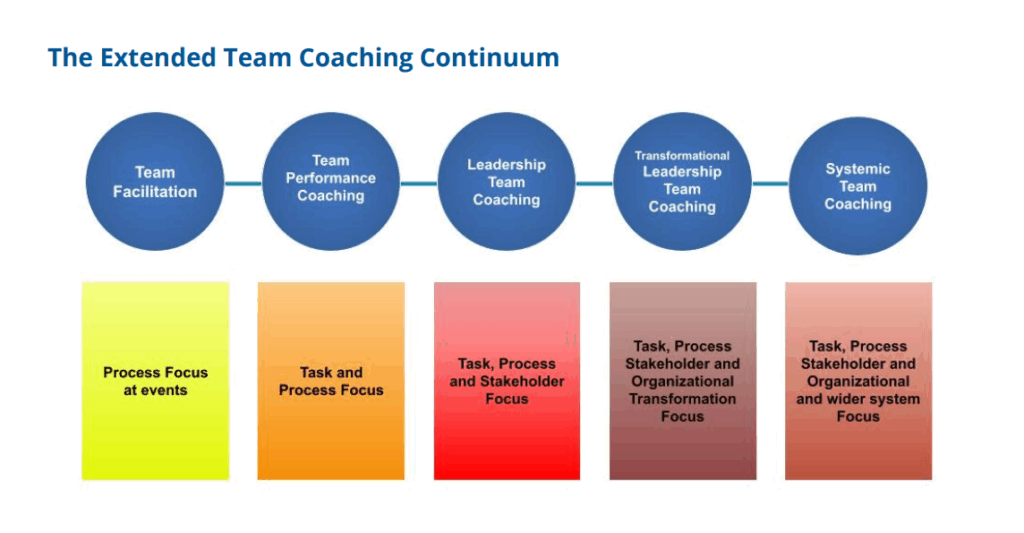
In regular team facilitation or even group coaching, you might focus on what’s happening inside the room: relationships, communication, trust, conflict. That’s important, but Hawkins argues it’s not enough.
Systemic team coaching treats a team as a living system embedded in a larger set of systems: its organization, its stakeholders, the market, the wider world. The team isn’t just a collection of people with roles. It exists to serve purposes beyond itself, and those external relationships shape everything happening internally.
So a systemic team coach isn’t just asking “how do you work together?” They’re asking “who do you exist to serve, what do those stakeholders actually need from you, and is your internal way of working helping or hindering that?”
This is why Hawkins’ Five Disciplines model starts with commissioning (the team’s external mandate) rather than jumping straight to team dynamics. The outside context comes first, always.
It’s also why systemic team coaching tends to be longer and more complex than individual coaching engagements. You’re not just helping people work better together. You’re helping a team understand its place in a system and how to lead from that place.
The Five Disciplines Model
This is Hawkins’ most widely taught framework, and it’s detailed in his book Leadership Team Coaching (now in its fourth edition, updated in 2022).
The Five Disciplines give you a complete map of where a team needs to develop. Most teams have some of these working well and others neglected, and the neglected ones are usually where their biggest performance problems live.
1. Commissioning
The first discipline is about understanding why the team exists. Not the org chart answer. The real answer. What are the key stakeholders expecting this team to deliver? Are those expectations clear? Does the team actually know them?
A surprising number of leadership teams have never explicitly worked through this. They know their functions. They don’t necessarily know their collective mandate.
2. Clarifying
Once the external mandate is clear, the team works to align on purpose, vision, and objectives internally. Clarifying is about building a shared understanding: not just of goals, but of roles, operating principles, and how decisions get made.
This discipline often surfaces unstated assumptions that have been quietly driving misalignment for months or years.
3. Co-creating
This is what most people think of when they picture “team coaching”: the internal work. How does the team function when they’re together? Are meetings productive? Is there psychological safety? Can difficult conversations happen?
Hawkins doesn’t dismiss this. But he’d argue that co-creating on its own, without commissioning and clarifying first, is like rearranging furniture in a house before you’ve decided what the house is for.
4. Connecting
High-performing teams don’t just manage their internal dynamics. They actively manage their relationships with key stakeholders outside the team. This discipline covers that external interface: who needs to be engaged, how the team communicates outward, and how it maintains alignment with the broader organization.
Teams that are great internally but poor at connecting often find their best work goes unnoticed or unsupported.
5. Core Learning
The fifth discipline is about building a learning culture within the team: the capacity to reflect, adapt, and continuously improve. A team that can do this well becomes self-coaching over time, which is ultimately the goal.
Think about it this way: if you only ever help a team perform better during your engagement, you’ve done good work. If you help them build the habits to keep improving after you leave, you’ve done Hawkins’ work.
How the Disciplines Work Together
The five disciplines don’t have to run in strict sequence, and Hawkins is clear about that. A team with severely fractured internal relationships might need to start with co-creating before any meaningful commissioning conversation can happen.
The skill as a coach is in reading which discipline needs attention first, and cycling back through as the engagement develops. You might clarify purpose in month one, only to return to commissioning in month four when a key stakeholder relationship shifts.
The Seven-Eyed Supervision Model
Hawkins’ second major framework is the one most searched by people in coaching supervision roles, and it’s completely absent from most introductory content about him.
The Seven-Eyed Model (introduced in his 1989 book Supervision in the Helping Professions, co-authored with Robin Shohet) is a framework for coaching supervisors. It describes seven different “modes of attention,” or “eyes,” that a supervisor can bring to a supervisory session.
Each mode focuses attention on a different part of what’s happening in the coach-client relationship:
- Eye 1 — The client’s situation: What is the client bringing? What are their patterns, resources, and challenges?
- Eye 2 — The coach’s interventions: What did the coach do? What choices were made? What was the effect?
- Eye 3 — The relationship between coach and client: What’s the quality of the working alliance? What dynamics are playing out?
- Eye 4 — The coach’s inner world: What is the coach noticing in themselves: reactions, countertransference, assumptions?
- Eye 5 — The supervisory relationship: What’s happening right now, in this supervision session, between supervisor and coach?
- Eye 6 — The supervisor’s inner world: What is the supervisor noticing in themselves as they work with this coach?
- Eye 7 — The wider context: The organizational, social, and systemic context surrounding the coaching engagement.
What makes this model useful isn’t just the list. It’s the discipline of noticing which eye you’re looking through at any given moment, and which ones you might be avoiding.
Most supervisors naturally default to Eye 1 and Eye 2 (the content of what happened). The Seven-Eyed Model prompts them to widen their perspective to include the relationship, the coach’s inner experience, and the broader systems at play.
If you’re developing a coaching supervision practice, or if you’re working toward any ICF credential that requires documented supervision hours, Hawkins’ Seven-Eyed Model is worth understanding in depth. It reframes supervision from “review and feedback” to something closer to reflective practice at a systems level.
The CLEAR Coaching Model
Before the Five Disciplines, Hawkins developed the CLEAR model: a five-stage framework for structuring individual coaching sessions. It’s one of the earlier models in the field and remains in active use today.
CLEAR stands for:
- Contracting: establishing what the client wants from this session and how coach and client will work together
- Listening: deep, active listening to understand the full picture
- Exploring: widening the client’s perspective, identifying options
- Action: supporting the client to commit to concrete next steps
- Review: reflecting on the session itself and what was learned
What distinguishes CLEAR from some other structured models is its emphasis on Contracting as the first stage. Hawkins sees the initial agreement between coach and client (not just about goals but about how they’ll work together) as foundational to everything that follows. Skip it, and you’re often coaching toward the wrong target.
The Review stage is also worth noting. Building explicit reflection into the session itself aligns with Hawkins’ broader emphasis on learning as a practice, not just an outcome.
Peter Hawkins’ Books
Hawkins has authored and co-authored a substantial body of work. These are the titles coaches are most likely to encounter:
- Leadership Team Coaching: Developing Collective Transformational Leadership: First published 2011, now in its 4th edition (2022). The definitive text on the Five Disciplines model. The 4th edition includes updated content on systemic coaching and post-pandemic leadership challenges.
- Leadership Team Coaching in Practice: A companion volume with case studies and practitioner perspectives from real engagements. Useful for seeing the models applied across different industries and team types.
- Creating a Coaching Culture: Focused on how organizations can build coaching capability at a systemic level, not just through individual coaches. Relevant for anyone working in organizational development or internal coaching programs.
- Systemic Coaching: Delivering Value Beyond the Individual (2019, co-authored with Eve Turner): The most accessible entry point to Hawkins’ broader systemic thinking. Covers how coaching creates value for stakeholders, teams, and organizations, not just the individual being coached.
- Supervision in the Helping Professions (co-authored with Robin Shohet, first published 1989, multiple editions since): The foundational text for the Seven-Eyed Supervision Model. Essential reading for anyone practicing or training in coaching supervision.
Getting Certified in Systemic Team Coaching
If you want to practice Hawkins’ approach credibly, a formal certification in systemic team coaching is worth considering. It’s not required. Experienced coaches can generally apply his frameworks without a certificate. That said, a certification does accelerate the learning significantly.
The Systemic Team Coaching Certificate, based on Hawkins’ methodology, is offered through several training organizations:
- The Academy of Executive Coaching (AoEC): one of the primary carriers of the certification
- Coaching.com: offers training programs referencing Hawkins’ models
- The International Coaching Federation (ICF): accredits programs aligned with systemic team coaching standards
A typical certification program involves:
- 10-13 weeks of coach training across modules
- Practice assignments between modules
- Supervision sessions throughout the program
- Investment in the range of $1,850 to $3,376 depending on location, format, and provider
That’s a meaningful investment. The case for it is straightforward: team coaching engagements command significantly higher fees than individual coaching. Certified systemic team coaches regularly charge $1,000 to $5,000 per person for a six-month engagement, and organizational-level engagements go much higher.
The certification also gives you a structured container for deepening your understanding of the frameworks. While reading the books is useful, being coached through the application of the models with supervision is a different experience.
Paperbell handles scheduling, contracts, payments, and client resources all in one place. Try Paperbell for free.
Implementing Hawkins’ Approach in Your Practice
You don’t need a full certification to start applying Hawkins’ thinking. Here’s how to start building these skills within your existing practice.
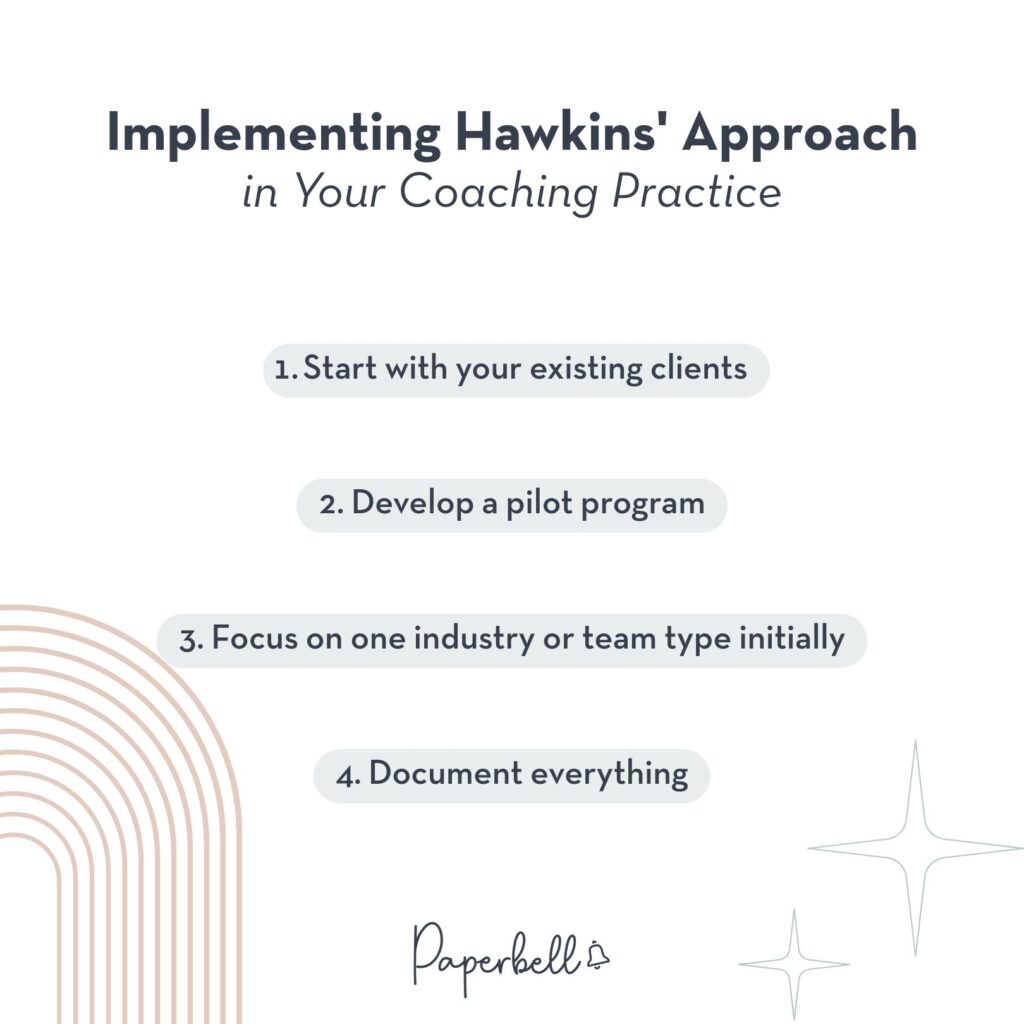
Start with your current clients
Look at the individual clients you’re already working with. Are any of them part of leadership teams? Are any of them bringing team dynamics issues into their individual coaching?
That’s an opening. You can introduce a systemic lens in individual coaching before you ever run a team session. Ask about stakeholder relationships, team mandate, how the team handles learning and review. You’re planting the seeds of the Five Disciplines framework without calling it that.
Build a pilot offering
Create a contained team coaching offering to test with. A half-day workshop on team purpose and stakeholder mapping (commissioning + clarifying) can serve as both a standalone product and a proof-of-concept that leads to longer engagements.
Price it as a project, not hourly. Team coaching is valued on outcomes, not time.
Pick a niche for your first engagements
Leadership teams, project teams, and startup founding teams each have different dynamics, different commissioning contexts, and different challenges. Starting with the type you know best lets you develop real expertise faster than trying to coach every kind of team from the beginning.
Document your observations
Team coaching generates rich data about group dynamics, recurring patterns, and what interventions work in which contexts. Keep detailed notes. Over time, those notes become your proprietary frameworks, case studies, and eventually, content that establishes your expertise publicly.
How to Structure Team Coaching Packages
Team coaching engagements typically run in three phases:
Discovery (1-2 months): Stakeholder interviews, team assessment, initial sessions with the full team, report and recommendations. This phase is about understanding the system before trying to change it.
Core Coaching (3-6 months): Monthly full-team sessions (half or full day), individual check-ins between sessions, stakeholder updates, and access to frameworks and resources. This is where the Five Disciplines work gets done.
Embedding (1-2 months): Transition planning, final team session, stakeholder review, and follow-up support. The goal is ensuring the team has internalized the learning so they can sustain the improvement without the coach present.
On pricing: $1,000 to $5,000 per person for a six-month engagement is a reasonable range, depending on the size and seniority of the team, the depth of the engagement, and your level of certification and experience.
Eco-Leadership: Hawkins’ Evolving Work
Hawkins’ most recent intellectual direction extends the systemic lens outward, past organizational systems into ecological and planetary ones.
His eco-leadership thinking argues that organizations can’t be truly effective if they’re operating in isolation from the wider natural and social systems they’re embedded in. Leaders, in his view, need to develop awareness not just of their organizational stakeholders but of their responsibilities to the planet and future generations.
This work is less directly applicable to everyday coaching practice than the Five Disciplines or Seven-Eyed Model, but it’s worth knowing about if you’re following his thinking seriously. It reflects a genuine evolution in his view of what “systemic” means: from organizational systems to ecological ones.
Much of this work is accessible through Renewal Associates, his consultancy at renewalassociates.co.uk.
FAQs About Peter Hawkins and Team Coaching
What is Professor Peter Hawkins best known for?
Professor Peter Hawkins is best known for pioneering systemic team coaching as a distinct discipline and for developing the Five Disciplines model of team coaching. His books, particularly Leadership Team Coaching, are standard reading in coaching certification programs worldwide. He’s also widely known in supervision circles for the Seven-Eyed Supervision Model, which he introduced in Supervision in the Helping Professions.
What is systemic team coaching?
Systemic team coaching, as defined by Hawkins, is a process where a coach works with a whole team (both when they’re together and when they’re apart) to improve their collective performance and how they work together. The “systemic” element means the coach treats the team as part of a larger system, including its stakeholders and organizational context, rather than focusing only on internal team dynamics.
What is the Seven-Eyed Supervision Model?
The Seven-Eyed Model is a framework for coaching supervisors that describes seven different modes of attention a supervisor can bring to a supervision session, ranging from the client’s situation (Eye 1) to the supervisory relationship itself (Eye 5) to the broader systemic context (Eye 7). It was developed by Hawkins and Robin Shohet and published in Supervision in the Helping Professions. The model encourages supervisors to widen their attention beyond just reviewing what the coach did, to include relational and systemic dimensions.
What is the CLEAR coaching model?
The CLEAR model is a five-stage framework for structuring coaching sessions: Contracting, Listening, Exploring, Action, and Review. Developed by Hawkins, it emphasizes setting a clear working agreement at the start of each session (Contracting) and building in explicit reflection at the end (Review). It’s one of several structured coaching models in use today and is particularly valued for its emphasis on the coach-client relationship as foundational.
What are the Five Disciplines of team coaching?
The Five Disciplines are: Commissioning (understanding why the team exists and what stakeholders need from it), Clarifying (developing shared purpose and aligned objectives), Co-creating (building strong internal relationships and working processes), Connecting (managing key relationships outside the team), and Core Learning (building the team’s capacity to continuously reflect and improve). Hawkins introduced this framework in Leadership Team Coaching.
Is a certification in systemic team coaching worth it?
For coaches who want to make team coaching a serious part of their practice, yes. A certification accelerates the learning, provides supervised practice, and gives you credibility with organizational clients who want to see formal training. That said, experienced coaches do apply Hawkins’ frameworks without a formal certificate. The certification is most valuable if you’re new to team coaching or you’re targeting corporate and leadership team clients who will ask about your credentials.
Build Your Team Coaching Practice
Peter Hawkins gave coaches something genuinely useful: a framework for working at the level where organizations actually make decisions. Not just with the person in the room, but with the team, the stakeholders, and the system those people are embedded in.
That’s a different kind of coaching, and it commands different fees, longer engagements, and deeper organizational relationships.
Getting your head around the Five Disciplines and the systemic lens is the intellectual work. The practical work is building the infrastructure to manage team coaching engagements: the scheduling, contracts, payments, and client resources that make the experience professional from the first contact.
That’s where Paperbell helps. Try Paperbell for free and see how much simpler it is to run a polished coaching practice when the admin side takes care of itself.