
Consulting Proposal Template + Guide (2026): 7 Sections That Win Clients
You just got off a great discovery call. The conversation flowed, the client’s problem is squarely in your zone, and they asked you to send over a proposal.
So now you’re staring at a blank document wondering what to actually put in it.
A bad proposal leaves the client with more questions than answers. A good one does the opposite: it makes saying yes feel easy and obvious. The difference usually comes down to structure. Knowing exactly which sections to include, in what order, and how to frame your value so the price makes sense before they even see it.
In this guide, you’ll get a free consulting proposal template you can copy and customize, a breakdown of every section (including the ones most consultants skip), real examples, and a list of proposal mistakes that quietly kill deals.
Free Consulting Proposal Template (2026)
A Google Doc you can copy, fill in, and send. Covers scope, timeline, pricing, ROI, and the sections that win deals.
Get the free template → Download as PDF
This button allows you to copy our Google Docs template
What Is a Consulting Proposal?
A consulting proposal is a written document you send a prospective client that outlines what you’ll do, how you’ll do it, what it costs, and what they can expect to get out of working with you. It’s the bridge between your discovery conversation and a signed agreement.
A proposal isn’t a pitch deck. It’s not a contract either (though it often travels alongside one). It’s specifically designed to answer the client’s unspoken question: “If I hire this person, what exactly am I buying?”
Done well, a proposal builds confidence before the client has to make a decision. Done poorly, it creates friction, ambiguity, or sticker shock. Either way, you lose the deal.
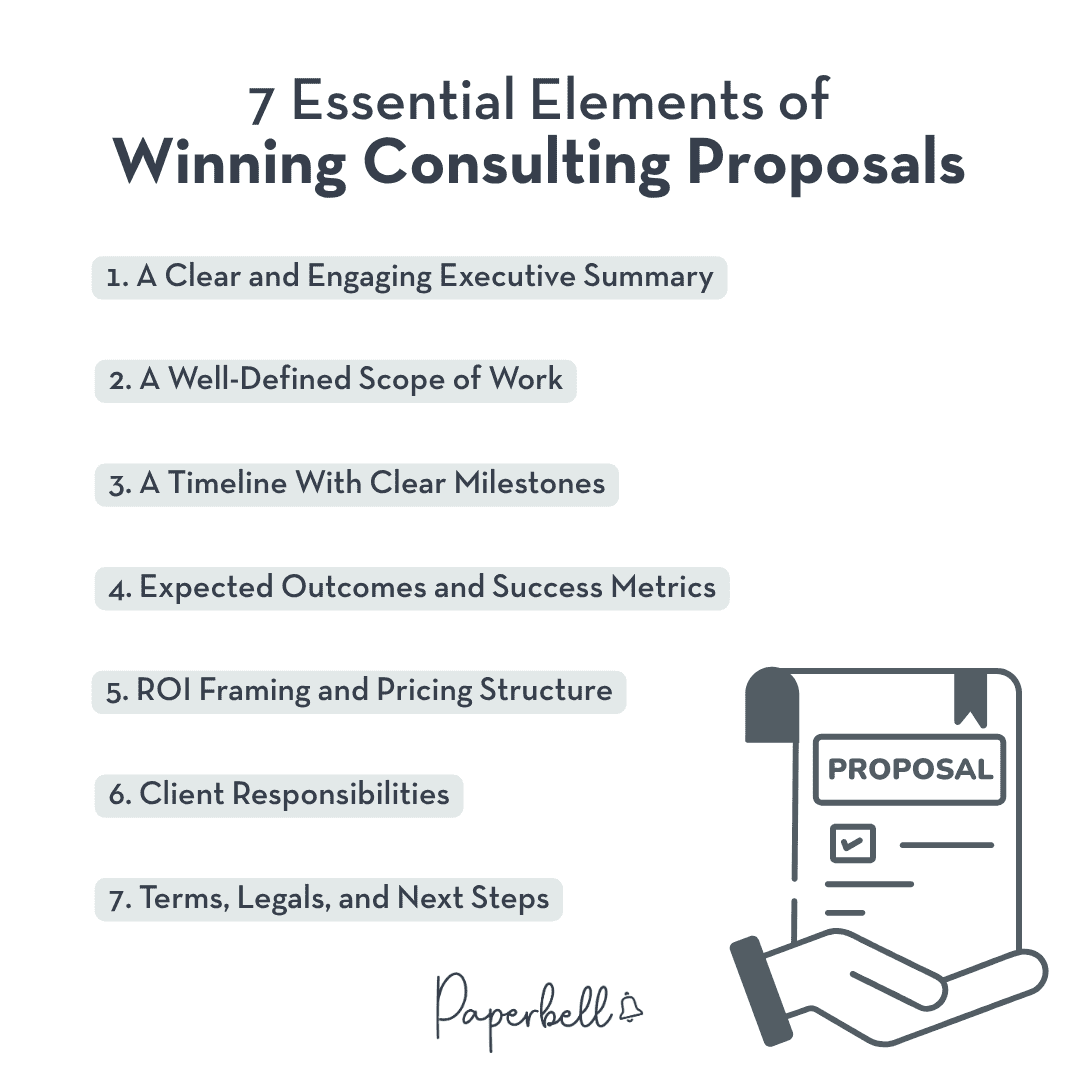
7 Essential Elements of a Winning Consulting Proposal
Not every proposal needs to look the same, but the best ones cover the same core elements. Here are the seven sections that belong in almost every consulting proposal, plus two that most consultants skip (at their own expense).
1. A Clear and Engaging Executive Summary
Start with a summary of what the client told you during the discovery phase. The goal isn’t to show off your research. It’s to make the client feel heard.
A strong executive summary says: “I understood your problem. Here’s what I believe is happening, and here’s what we’re going to do about it.” Keep it to one short paragraph. If the client reads nothing else, they should be able to glean the whole picture from this section.
One tip: mirror the client’s own language back to them. If they described their challenge as “getting our team aligned on priorities,” use that phrase. It signals that you were actually listening.
2. A Well-Defined Scope of Work
This is the most important section in your proposal, and the one that causes the most problems when it’s vague.
The scope of work spells out exactly what you will deliver, what format those deliverables take, and (just as important) what’s not included. That last part is what protects you from scope creep later. If you’re writing a market analysis report, specify whether that includes competitor research, customer interviews, and a slide deck. If it doesn’t, say so explicitly.
Be specific. “Strategic consulting support” isn’t a deliverable. “Three 60-minute strategy sessions plus a written action plan delivered within two weeks of the final session” is.
3. A Timeline With Clear Milestones
Clients want to know when things will happen. A timeline with specific milestones (kickoff call, first deliverable, review period, final delivery) gives them that certainty and also signals that you have a repeatable process.
For longer engagements, break the timeline into phases. Phase 1: Discovery (weeks 1–2). Phase 2: Analysis and recommendations (weeks 3–5). Phase 3: Implementation support (weeks 6–8). That kind of structure makes a multi-month retainer feel a lot less abstract.
4. Expected Outcomes and Success Metrics
What does success look like at the end of this engagement? Define it before the work starts, not after.
Good success metrics are specific and measurable: reduce customer acquisition cost by 15%, complete executive team alignment sessions by end of Q3, reduce churn rate below 5%. If you can’t define measurable outcomes, at least define observable ones: “The team will have a shared quarterly roadmap they can execute without external facilitation.”
This section also does something subtle but powerful: it shifts the conversation from “here’s what I’ll do” to “here’s what you’ll get.” That framing matters when you get to pricing.
5. ROI Framing and Pricing Structure
Price alone rarely loses deals. Price without context almost always does.
Before you list your fee, connect it to the value you described in the outcomes section. If the engagement is designed to improve your client’s lead conversion rate by 20%, and their average contract value is $50,000 with 10 deals per year, a 20% improvement means two additional deals: $100,000 in new revenue. A $15,000 consulting fee looks very different in that context than it does sitting alone on a page.
You don’t need to do the math explicitly for every engagement. But framing your price against the problem it solves (rather than the hours you’ll spend) changes how clients perceive the investment.
For pricing structure, be clear about what’s included: flat fee vs. monthly retainer, what triggers additional costs, and what the payment schedule looks like (deposit, milestone payments, or invoice on delivery).
Tip for consulting firms working with multiple tiers of clients: Consider offering two or three options (a base scope, a standard scope, and a premium scope with expanded deliverables). This isn’t upselling. It gives the client agency and often results in them choosing the middle option, which is usually your preferred scope anyway.
6. Client Responsibilities
This is the section most consultants leave out. It’s also the one that prevents the most project headaches.
For you to do your job, the client has to do theirs. That usually means: providing timely feedback (within X business days), giving you access to the systems or team members you need, attending scheduled calls, and making decisions promptly at key milestones.
Spelling this out in the proposal sets expectations before the engagement starts. It also gives you something to point to if the project stalls because the client keeps pushing back your review meeting. You’re not being difficult. You’re holding them to what they already agreed to.
Keep this section short and non-threatening. Something like: “This engagement works best when both parties move at the same pace. We’ll need your team available for a weekly 30-minute check-in and feedback delivered within two business days of each deliverable.”
7. Terms, Legals, and Next Steps
Your proposal should end with a brief terms section and a clear call to action.
The terms don’t need to be a full legal contract. A plain-language summary of the key conditions is enough. Cover the basics: payment terms (net 30, due on receipt, etc.), what happens if the engagement is paused or cancelled by either party, who owns the IP and deliverables, and how many revision rounds are included.
Then close with a clear next step. “To move forward, please sign and return this proposal by [date]. Once we receive your signed copy and initial deposit, I’ll send over the kickoff call booking link.” A deadline matters: proposals that sit open-ended often die quiet deaths.
For independent consultants doing smaller engagements, this section can be brief: two to three bullets. For consulting firms handling larger, multi-month retainers, it’s worth investing in a proper consulting agreement that travels alongside the proposal.
How to Write a Consulting Proposal That Converts
Step 1: Never Send a Cold Proposal
This is the biggest mistake in the list below, so let’s address it upfront: a proposal should confirm something you’ve already discussed verbally, not introduce it for the first time.
If you haven’t had a discovery conversation with the client yet, you’re not ready to write a proposal. Send one too early (before you understand the problem well enough to scope it) and you’ll either get a “this doesn’t quite fit what we need” response or silence.
The proposal is the summary of the conversation, not the conversation itself.
Step 2: Do Your Discovery First
Before you write a word of the proposal, get clear on: what the client’s actual goal is (not just the symptom they described), what success looks like to them specifically, what budget range they’re working with, who makes the final decision, and what timeline they’re working toward.
You won’t always get direct answers to all of these. But the more you know going in, the more your proposal will feel like it was written specifically for them. Because it was.
Step 3: Lead With Their Problem, Not Your Process
Most proposals start with a long description of the consultant’s methodology, credentials, and approach. Clients skim this section. What they actually read: the part where you describe their situation.
Lead with what they told you, use their language, and frame the rest of the proposal as your specific response to that situation.
Step 4: Be Specific About Deliverables
Vague deliverables create two problems: clients don’t know what they’re buying, and you have no protection when they ask for more than you intended to provide. If a deliverable is “strategic recommendations,” a client might expect a 40-page report. You might have planned a two-page summary. Spell it out.
Step 5: Frame Price Against Value Before Presenting It
As covered in the ROI section above: connect your fee to the outcome before listing the number. This is especially important for premium engagements. A $25,000 fee for “marketing consulting” lands differently than a $25,000 fee for “a 90-day lead generation program designed to increase your qualified pipeline by 30%.”
Step 6: Give It a Clear Expiration
Open proposals rarely close. Give your proposal a valid-until date, typically 14 to 30 days out. This creates a natural nudge without being pushy, and it gives you a reason to follow up: “I wanted to check in before the proposal expires on [date].”
Bonus Tip: Follow Up Twice
Most consultants follow up once. The deals that close often close on the second or third follow-up. Send a brief check-in three to five days after sending the proposal (“Any questions after reviewing?”), and again a day or two before the expiration date (“Just a reminder this is valid through [date], happy to jump on a quick call if anything came up”).
5 Consulting Proposal Mistakes That Cost You Deals
These aren’t hypotheticals. These are the patterns that show up over and over in proposals that get ignored, questioned, or rejected.
Mistake 1: Sending the Proposal Before Verbal Alignment
Already mentioned above, but worth repeating: proposals that introduce new ideas (scope, pricing, approach) that weren’t discussed in a call are almost always returned with objections. The proposal should feel like a recap, not a reveal.
Mistake 2: Writing a Generic Opening
Starting with “Thank you for the opportunity to submit this proposal” is the consulting equivalent of a cover letter that says “I am writing to express my interest in this position.” It tells the client nothing about whether you actually understood their situation.
Use the executive summary to show them you were listening. Name their specific challenge. Reference something from the discovery conversation. Make it feel custom even if parts of your process are templated.
Mistake 3: Presenting Price With No Context
A fee listed without any value framing forces the client to do the math themselves, and most people default to “is this expensive?” when they don’t have a comparison point. Frame first. Price second. Even a single sentence connecting the fee to the expected outcome changes how the number lands.
Mistake 4: Unclear Next Steps
Proposals that end with “let me know if you have any questions” put the burden on the client to figure out what happens next. Tell them exactly what to do: sign here, return by this date, and then this happens. The easier you make the yes, the faster it comes.
Mistake 5: The Wrong Format for the Engagement
A 12-page proposal for a one-day workshop is overkill. A two-paragraph email for a six-month retainer is under-selling. Match the depth of your proposal to the complexity and value of the engagement. Simple projects: one to three pages. Complex retainers or multi-phase work: five to ten pages with a proper structure. Enterprise-level: McKinsey-style with appendices, case studies, and formal legal sections.
3 Free Consulting Proposal Templates You Can Customize
You don’t have to build your proposal from scratch. Here are three real-world resources to use as starting points.
The Alan Weiss Proposal Method
Alan Weiss (author of Million Dollar Consulting) is well known for a simple, value-focused proposal format. His core principle: proposals should be brief and focused entirely on outcomes, not methodology. A Weiss-style proposal typically runs two to four pages and structures everything around the client’s business objectives. Alan Weiss’s proposal resources are available at alanweiss.com.
McKinsey Consulting Proposal Format
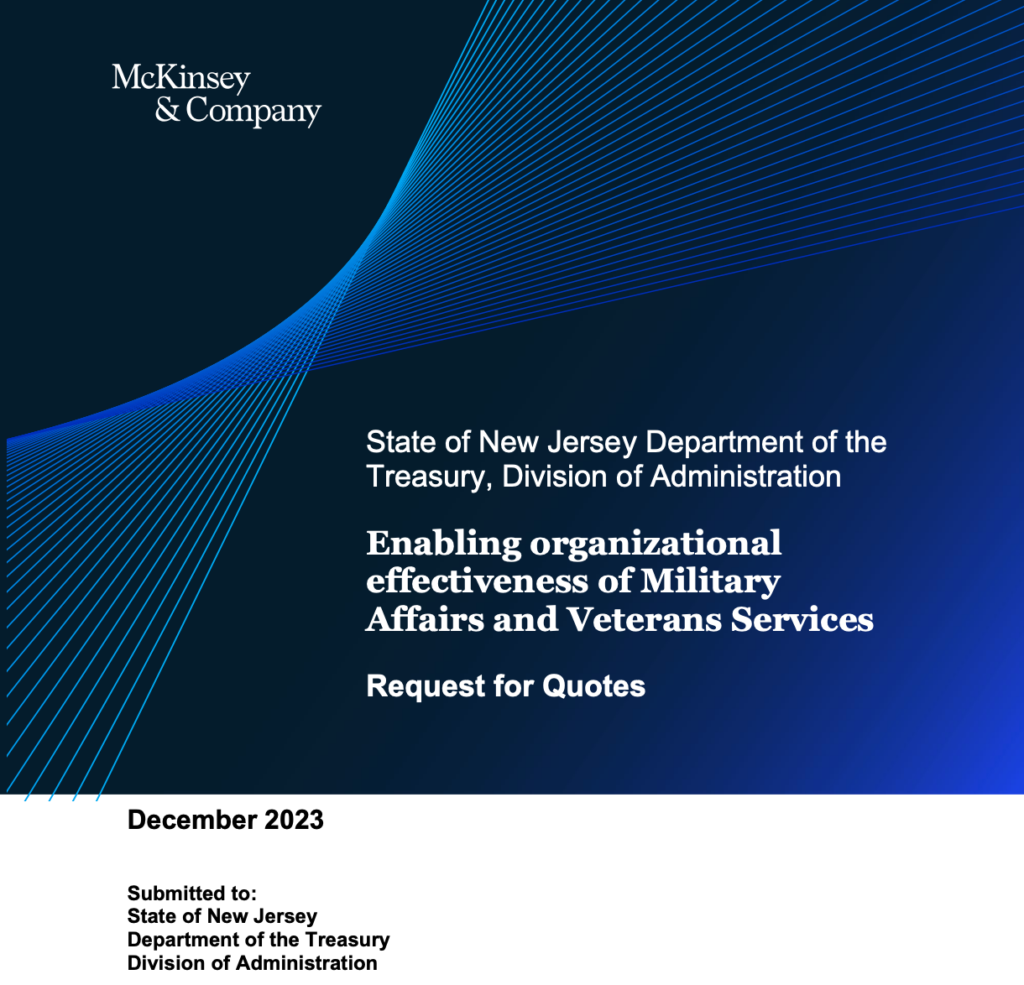
McKinsey proposals are structured slide decks: heavily visual, densely argued, and built around a clear problem-hypothesis-solution flow. For independent consultants, the format is probably overkill for anything under six figures. But studying the structure is valuable: they lead with “what’s the problem,” prove why existing approaches haven’t solved it, then present a specific engagement design with clear workstreams. See McKinsey’s published work at mckinsey.com for format reference.
Venngage Consulting Proposal Templates
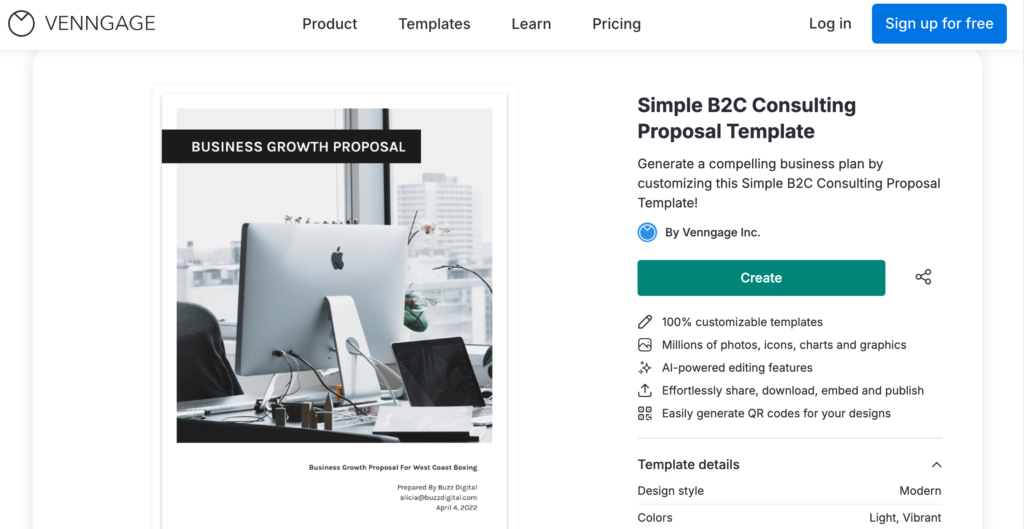
Venngage offers a range of visual consulting proposal templates you can edit in-browser. These are good options if your client expects a polished, designed document rather than a Word doc or Google Doc. Browse Venngage’s consulting proposal templates here.
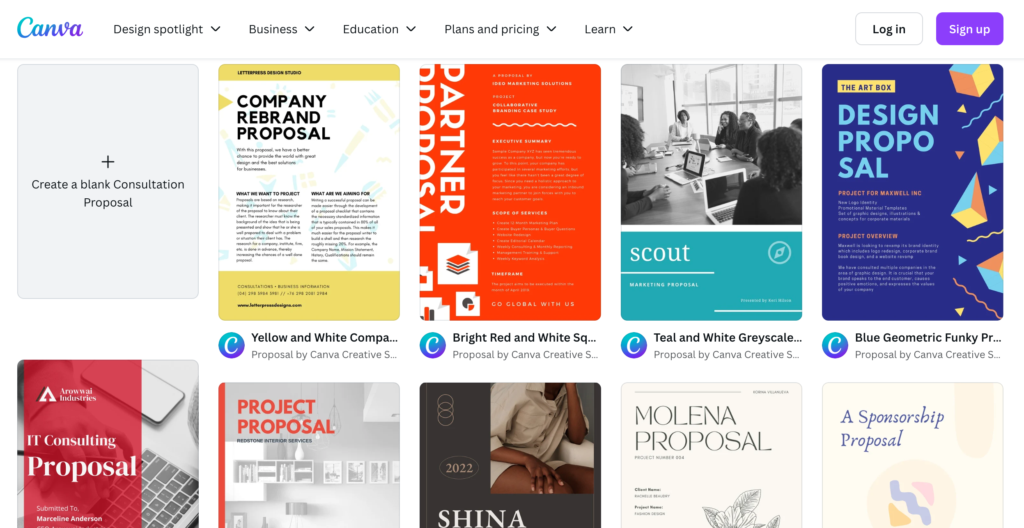
Canva also has a strong template library for proposals if you want full visual control. Either tool works. The format matters less than the content.
Consulting Proposal Template (Copy and Fill In)
Free Consulting Proposal Template (2026)
Google Doc format. Copy it, fill in your project details, and send.
Get the free template → Download as PDF
This button allows you to copy our Google Docs template
Simplify Your Consulting Business with Paperbell

Once the proposal is signed and the client says yes, that’s when the real admin work usually starts: sending the contract, collecting the payment, setting up the kickoff call.
If you’re a coach or independent consultant managing all of that manually, Paperbell handles it in one place. Your client books a session, signs the contract, and pays in a single flow, without chasing anyone. No separate tools for scheduling, payments, and agreements.
Try Paperbell for free. No credit card required to get started.
FAQ
What sections must a consulting proposal include?
At a minimum, a consulting proposal should include an executive summary, scope of work, timeline, success metrics, and pricing. The sections that make the biggest difference (and that many consultants skip) are client responsibilities and terms/legals. Without those two, you’re exposed to scope creep and payment disputes. A complete proposal covers all seven sections outlined in this guide.
How long should my consulting proposal be?
Match length to complexity. For a straightforward one-off engagement, one to three pages is usually enough. For a multi-phase retainer or complex organizational project, five to ten pages is more appropriate. Enterprise-level proposals (the McKinsey-style variety) run longer and include appendices, case studies, and team bios. Longer isn’t better. Clear is better. A one-page proposal that answers every client question beats a ten-page document that buries the point.
Should I include my rates in the proposal or discuss them separately?
Include them. Clients expect to see pricing in a formal proposal. Leaving it out creates friction and usually prompts an awkward back-and-forth. The key is framing: present the fee in the context of the expected outcome or ROI, not as a standalone number. That framing does the heavy lifting so the price doesn’t have to justify itself alone.
How do I handle scope creep in a consulting proposal?
Prevent it before it starts by being explicit in the scope section. List exactly what’s included and, importantly, what’s not included. When a client requests something outside the original scope, you can point directly to the proposal language. A change order process helps too: “That falls outside the current scope. I can send over a change order to add it (usually [X hours / $X]).” Clients generally accept this when the boundary was clear from the start.
How many revisions should I include?
One to two revision rounds per deliverable is standard for most engagements. Define what counts as a revision (a consolidated set of feedback, not multiple drips of comments) and include the limit explicitly in the terms section. Unlimited revisions might sound client-friendly, but in practice they lead to projects that never close.
What’s the best format to send my proposal in?
PDF is the safest option for finished proposals, as it preserves your formatting and can’t be accidentally edited. Google Docs work well for collaborative proposals where the client might add comments or questions. Proposal software like PandaDoc or DocuSign Rooms is worth considering if you send proposals regularly and want built-in e-signature and tracking. Avoid sending an editable Word doc unless the client specifically requests it, since it invites unwanted changes.
How do I handle objections to my proposal?
The most common objection is price. Before jumping to a discount, ask what specifically feels high. Sometimes the issue is cash flow (in which case a different payment structure solves it) rather than perceived value. Scope objections (“this is more than we need”) are best handled by offering a reduced-scope version. Timeline objections usually come down to urgency on the client’s end, so confirm the start date, and work backward to see if a modified scope can fit their window. When in doubt, ask: “What would need to change for this to work for you?” That one question opens up more solutions than any counter-offer you could prepare in advance.