

How to Become a Life Coach Without Certification (And Build Real Credibility) (2026)
You want to become a life coach. You know you have something to offer. But then you start Googling, and suddenly it seems like you need a $5,000 certification program before anyone will take you seriously.
Here’s the thing: that’s not actually true.
Life coaching isn’t a regulated profession in most countries. There’s no licensing board, no mandatory credential, no governing body that decides who gets to call themselves a coach. You could start coaching clients tomorrow (legally) without a single certification to your name.
But that raises a more honest question: should you? And if you go the no-cert route, how do you build credibility that clients actually trust?
That’s what this guide covers. Not a list of free certificate programs (if that’s what you’re looking for, check out this post on free coaching certifications). This is for coaches who want to start now, build real skills through real practice, and earn credibility the old-fashioned way: by getting results for clients.
Here’s what you’ll find below: why certification isn’t the credibility signal most coaches think it is, six concrete strategies for building a coaching practice without one, and the tools you’ll need to run it professionally once clients start saying yes.
Do You Actually Need a Certification to Be a Life Coach?
Short answer: no legal requirement exists in most places.
Unlike therapists, social workers, or financial advisors, life coaches aren’t regulated in the United States, Canada, the UK, or Australia. Anyone can legally offer life coaching services without completing any formal training program, passing any exam, or paying for any accreditation.
That’s the legal reality. The credibility question is a bit more nuanced.
Certification from an organization like the International Coaching Federation (ICF) does carry weight in some contexts, particularly if you’re coaching executives, working through corporate contracts, or targeting a clientele that researches credentials carefully. In those markets, a credential is a trust shortcut.
But most coaches, especially those building small niche practices through referrals and content, find that clients hire based on something else entirely: whether they believe the coach can help them. That belief gets built through specificity (a clear niche), evidence (testimonials and case studies), and fit (a resonant voice and approach).
None of those things come from a certificate. They come from doing the work.
So the real question isn’t “do I need certification.” It’s “what do I need instead?” Here’s what actually builds credibility when you don’t have credentials.
6 Strategies to Build a Life Coaching Practice Without Certification
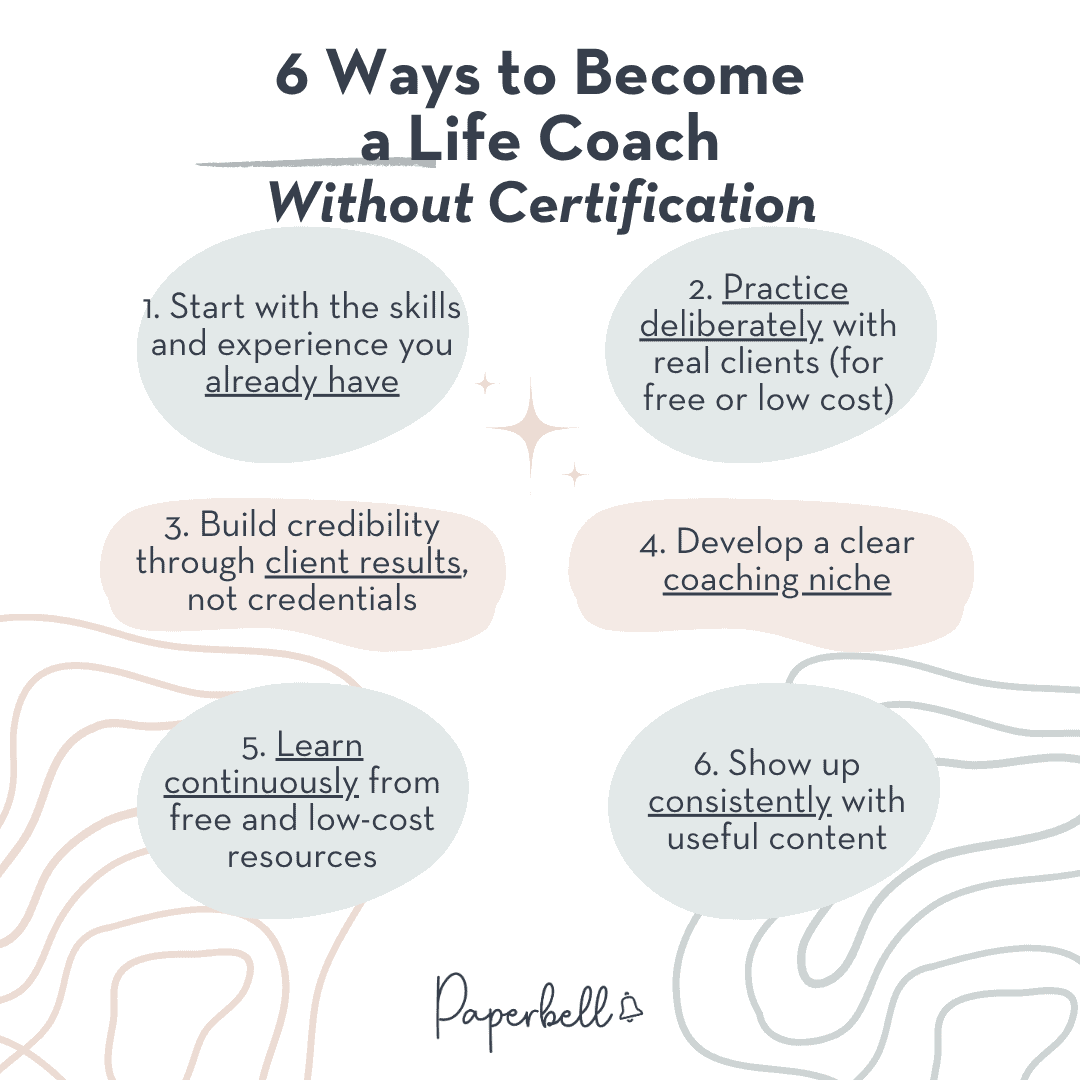
1. Start With the Skills and Experience You Already Have
The coaches who struggle without credentials are often the ones trying to coach everyone. The ones who succeed have a clear answer to: “Why are you the right person to coach on this?”
Your existing life experience is the most honest answer to that question.
Think about what you’ve been through: career pivots, building a business, burnout recovery, getting healthy, recovering a relationship, raising kids while working, dealing with anxiety. Think about what people in your life already come to you for. That’s often a signal pointing directly at your niche.
Your professional background matters too. If you spent 15 years in corporate HR, you understand workplace dynamics, difficult conversations, and career development better than most credentialed coaches fresh out of a training program. That expertise is real and valuable.
The move here isn’t to pretend you have training you don’t have. It’s to be specific about what you bring, and let that specificity do the trust-building work that a credential might otherwise do.
2. Practice Deliberately With Real Clients (For Free or Low Cost)
There’s no shortcut around this one. Coaching skills come from coaching, not from reading about coaching, watching coaching, or studying coaching frameworks.
The fastest way to build genuine competence is to start coaching as many people as possible, get feedback, and keep improving. And the fastest way to start coaching real people is to offer your sessions for free or at a very low cost while you’re building your skills.
A few ways to find practice clients:
- Your existing network first. Post in your personal Facebook or Instagram that you’re taking on a small number of pro bono coaching clients. You’d be surprised how many people say yes.
- Niche communities online. If you’re building a health coaching practice, spend time in health and wellness Facebook groups, Reddit threads, or online forums. Offer free calls. Build relationships first, offer later.
- A “founding clients” offer. Once you’ve done 5-10 free sessions, shift to a heavily discounted rate for your first paying clients (maybe $50-$75 a session instead of your eventual full rate). Frame it as an honest exchange: they get a reduced rate, you get testimonials and case studies.
Be transparent with practice clients that you’re in the early stages of building your practice. Most people appreciate the honesty. They often become your most loyal advocates because they were there since the beginning.
3. Build Credibility Through Client Results (Not Credentials)
Credentials are a proxy for trust. Client results are the real thing.
When someone hires a coach, they’re making a bet: “I believe this person can help me get from where I am to where I want to be.” A credential says “this person completed a program.” A testimonial says “this person helped me do the thing you’re trying to do.”
Which one is more persuasive?
After each client relationship (even your free ones), ask for a testimonial. Make it easy by giving them a prompt:
“Where were you when we started working together, and where are you now? What’s one thing that surprised you about the coaching process?”
That structure gets you a before-and-after story, which is infinitely more persuasive than “she was great!” testimonials. Collect these. Use them on your website, in your social content, and in your initial conversations with prospects.
Even better than a testimonial: a case study. A short written story (200-400 words) that walks through a client’s situation, what you worked on together, and what changed. You don’t need their real name, just their permission to share. These are gold for building trust without credentials.
4. Develop a Clear Coaching Niche
A generalist coach without credentials is a hard sell. A specialist coach without credentials, on the other hand, can be highly sought-after. There are far fewer of them.
Picking a niche is one of the most impactful moves you can make when building credibility from scratch. A clear niche does several things for you:
- It makes you immediately recognizable to the clients who need you most
- It lets you build deeper expertise faster (you’re coaching similar problems repeatedly)
- It makes your testimonials and case studies more powerful (they’re all about the same transformation)
- It sharpens your content so the right people find you
Some examples of strong niches: career coaching for women in their 30s returning after time off, life coaching for first-generation college students, productivity coaching for ADHD entrepreneurs, confidence coaching for new managers.
Notice that none of these niches require a specific credential. They require understanding the audience deeply, which you either already have from lived experience or can develop through targeted practice.
5. Learn Continuously From Free and Low-Cost Resources
Not having a certification doesn’t mean not having skills. Plenty of excellent free resources exist for coaches willing to put in the work to learn.
A few worth your time:
- YouTube: Established coaches like Brooke Castillo (The Life Coach School), Brendon Burchard, and Tony Robbins have years of technique-focused content available for free. Search for “coaching session demo” or “coaching techniques” to watch experienced coaches in action.
- Books: Co-Active Coaching by Henry Kimsey-House and Karen Kimsey-House is considered the definitive text on coaching methodology. The Coaching Habit by Michael Bungay Stanier is an excellent practical introduction. Both are available at most public libraries.
- Podcasts: The Life Coach School Podcast, Coaching for Leaders, and The One You Feed all offer models of coaching conversations and frameworks you can study and adapt.
- Free online courses: Platforms like Alison and Coursera offer introductory coaching and psychology courses at no cost. They won’t replace a full certification program, but they’ll give you frameworks and vocabulary.
- Peer practice groups: Find other coaches-in-training on Facebook or LinkedIn and set up regular peer coaching swaps. You practice coaching, get coached yourself, and give and receive feedback. It costs nothing and builds skill quickly.
The goal here isn’t to accumulate certifications of completion. It’s to build real, functional coaching skills (active listening, powerful questioning, goal-setting frameworks, accountability structures) through whatever learning works for you.
6. Show Up Consistently With Useful Content
Content is credibility. When you show up consistently with genuinely useful ideas for your target audience (LinkedIn, Instagram, a newsletter, a podcast) you build trust at scale without needing a credential to vouch for you.
The key word is useful. Not promotional, not generic inspiration, not recycled tips from other coaches’ posts. Content that makes your ideal client think “this person understands my situation exactly.”
A few formats that work well for coaches building credibility from scratch:
- Client transformation stories (with permission and anonymized if needed)
- Your own story: what you’ve been through, what you learned, how it connects to the work you do now
- Answers to questions your clients ask: if you hear the same question in three different discovery calls, that’s a content idea
- Behind-the-scenes of a coaching framework or approach you use and why it works
You don’t need a large following for this to work. You need the right 50 people seeing it and thinking “this is exactly who I’ve been looking for.”
What to Say When Clients Ask About Your Credentials
This is the question most uncertified coaches dread, and it’s worth having a genuine answer ready.
The worst move is to get defensive or vague. The best move is to be straightforward and redirect to what actually matters to the client: will you be able to help them?
Something like this works:
“I don’t hold a formal coaching certification. My background is [specific experience relevant to what you coach]. I’ve worked with clients on [specific results] and here’s what some of them have said [testimonials]. What matters most to you in a coaching relationship?”
This transparency builds trust. The pivot to their needs shows you’re client-focused, not credential-focused. And if your specific experience is genuinely relevant to what they need, that’s often more convincing than a general coaching certificate anyway.
The clients who will walk away because you don’t have a certification were likely looking for a specific credential type for a specific reason. That’s a signal you weren’t the right fit for them (useful information). The clients who are right for you will respond to your honesty, your specificity, and your track record.
Setting Up Your Practice Professionally (Without Spending Much)
Clients can’t hire you if there’s no clear way to hire you. Even at the early stages, you need a few things in place: a way for clients to book time with you, a way to collect payments, and a way to keep track of client information and session notes.
You can piece these together with free tools: Google Calendar for scheduling, Venmo or PayPal for payments, Google Docs for client notes. That works at the very beginning.
But as soon as you have more than a client or two, the manual coordination starts to eat time you’d rather spend coaching. The onboarding experience also matters more than most new coaches realize. A scattered, manual process signals “side project” to clients. A professional booking flow signals “I run a real practice.”
Paperbell is built specifically for coaches who want to run a professional practice without the administrative overhead. Your clients book, pay, sign their contract, and complete their intake form in one simple flow, all from a single link you can put anywhere. Sessions, packages, notes, and billing stay organized in one place.
You can try Paperbell for free and get your practice set up before your next discovery call. No credit card required.
If You Do Decide to Get Certified Later
Nothing in this post is meant to talk you out of certification. If you build your practice, start getting results for clients, and decide you want formal training to deepen your skills or open doors to corporate clients, that’s a completely reasonable path.
A few resources worth exploring when you get there:
- How to become a certified life coach — a full walkthrough of the certification process
- What life coach certification actually costs — so you know what you’re comparing against
- Free life coach certification programs — if you want credentials without the price tag
The point of starting without certification isn’t to stay uncertified forever. It’s to start now, build real skills with real clients, and make the certification decision from a position of experience rather than anxiety.
Start Coaching, Build Credibility, Grow From There
You don’t need a certification to become a life coach. You need a specific niche, genuine skills, a few early clients who can speak to your results, and a professional way to run your practice.
None of those things require a certificate. They require showing up, doing the work, and giving clients something worth talking about.
The coaches who struggle without credentials are usually the ones waiting until they feel “ready.” The ones who build successful practices are the ones who start before they feel ready, learn from real clients, and let their results do the credibility work.
Ready to set up your practice the right way from day one? Try Paperbell for free. It’s the simplest way to run a coaching business professionally, without the administrative chaos that buries most coaches in their first year.
Frequently Asked Questions About Becoming a Life Coach Without Certification
Do I need certification to charge for life coaching?
No. There’s no legal requirement to hold a coaching certification before charging clients for life coaching services in most countries, including the United States, Canada, the UK, and Australia. Life coaching is an unregulated profession. You can legally charge for sessions without any formal credential. Whether clients will pay you is a separate question, and that depends on your demonstrated skills, your niche, and the trust you’ve built through results and testimonials.
What should I tell clients about my credentials?
Be straightforward. Tell them you don’t hold a formal certification, then explain your relevant background and direct them toward your results: client testimonials, case studies, and the specific experience that makes you the right person to coach them. Clients generally respond better to honest specificity than vague deflection. If a client’s primary requirement is a specific credential, they’re probably not the right fit. That’s useful to know early.
Is life coaching regulated?
In most countries, no. Life coaching is not a regulated profession in the United States, Canada, the UK, or Australia. There’s no government licensing board, no mandatory exam, and no legal consequences for coaching without a credential. This is different from licensed mental health professions like therapists, counselors, and psychologists, which are strictly regulated. The ICF and other coaching bodies offer voluntary credentials that carry weight in some markets, but they’re optional, not legally required.
How long does it take to become a life coach without formal training?
You can start coaching clients within weeks if you focus on building skills through practice rather than waiting for formal training to finish. Most coaches who go the self-directed route say it takes 6 to 12 months of consistent coaching practice before they feel genuinely confident in their skills and have enough testimonials to support a full-time or part-time practice. The timeline is almost entirely determined by how many coaching hours you accumulate, which is why starting with free and discounted clients early is the fastest path.
What’s the difference between a life coach and a therapist?
Therapists are licensed mental health professionals who diagnose and treat mental health conditions. They work with people dealing with depression, anxiety disorders, trauma, and other clinical issues, and they’re regulated by licensing boards in every state and country. Life coaches are not therapists and should not work with clients on clinical mental health issues. Coaches work with generally well-functioning clients on goals, transitions, clarity, and performance. If a coaching client is struggling with mental health concerns, the right move is to refer them to a licensed therapist. Understanding this distinction matters for practicing ethically, with or without a certification.
Can I become a life coach entirely online?
Yes, and most coaches do. Online coaching via video call (Zoom, Google Meet) is the norm now, not the exception. It removes geographic limits, lets you work with clients anywhere in the world, and means you never need an office. Your online presence (a simple website, consistent social content, and a professional booking system) is your practice’s front door. Many successful coaches build their entire practice without ever meeting a client in person.
What’s the difference between having no certification and having a bad certification?
Interestingly, no certification is often more credible than a questionable one. The coaching space has a lot of weekend certificate programs and low-bar “certified coach” credentials that experienced buyers recognize as thin. If you’re honest about being self-taught with real client results, that tends to land better than a credential from a program no one has heard of. Focus on substance (skills, niche, results) rather than chasing credentials just to have something to show. If you do eventually certify, choose a well-respected program recognized by the ICF.