
What is the BCC Certification?
The Board Certified Coach (BCC) certification is a professional credential administered by the Center for Credentialing & Education (CCE). CCE is a nonprofit organization that has been credentialing professionals in counseling, coaching, and related fields since 1992. It is a well-established body in the behavioral health space, not a new or niche organization. The BCC credential was developed specifically because of CCE’s deep roots in counseling credentialing and the recognized overlap between counseling and coaching.

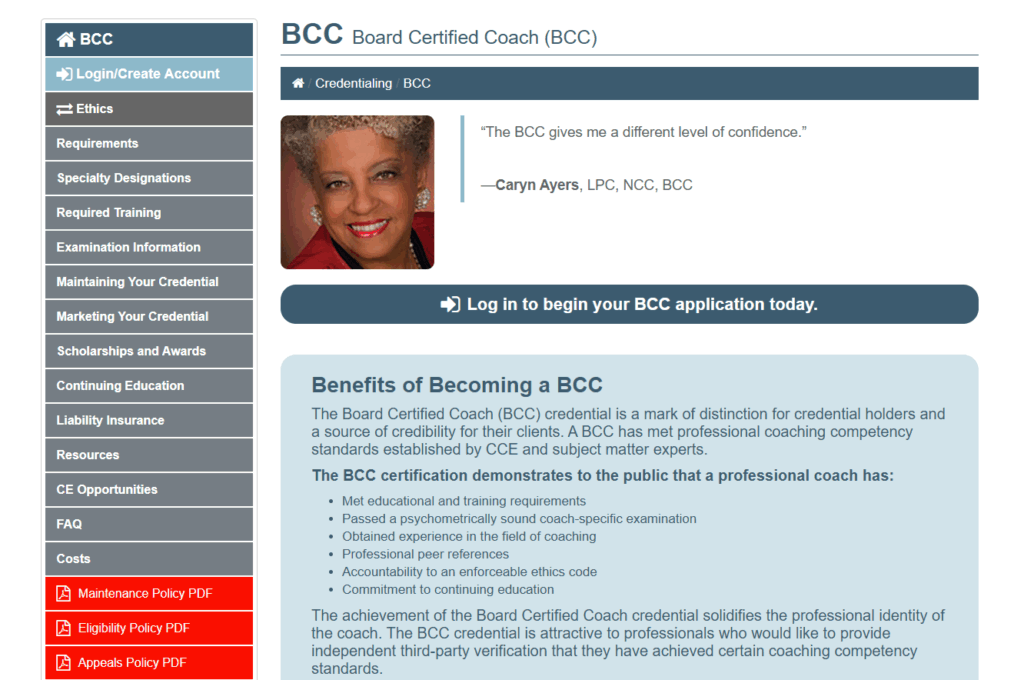
The BCC independently verifies that a coach has met specific competency standards through education, training, experience, and examination. It was created to solve a real problem: anyone can call themselves a coach, regardless of training or expertise. The BCC gives potential clients a reliable way to verify you are actually qualified.
When clients see the BCC designation after your name, they know you have:
- Met educational and training requirements set by industry experts
- Passed a comprehensive, psychometrically sound examination
- Gained real coaching experience with clients
- Received professional peer endorsements
- Committed to following an enforceable code of ethics
- Agreed to ongoing continuing education
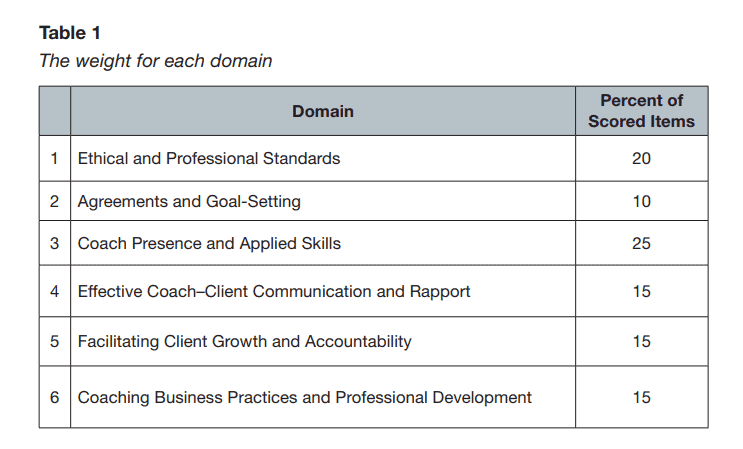
The BCC certification covers 6 primary competency areas:
- Ethical and professional standards
- Agreements and goal-setting
- Coach presence and applied skills
- Effective coach-client communication and rapport
- Facilitating client growth and accountability
- Coaching business practices and professional development
One feature that sets the BCC apart from other credentials is how it accounts for your existing education. CCE performed a “gap analysis” between counseling and coaching skills and found significant crossover. As a result, coaches with backgrounds in counseling or the behavioral sciences need fewer training hours than coaches starting from scratch. Your existing education counts toward the credential.
Who Should Get the BCC Certification?
The BCC is not the right fit for every coach, but for certain backgrounds it is one of the most natural credentialing paths available. These are the groups who tend to benefit most.
Licensed counselors and therapists adding coaching. If you hold an LPC, LMHC, LCSW, or similar license, the BCC recognizes your existing training. You may qualify with as few as 30 hours of coach-specific education rather than starting a 60 or 120-hour program from scratch. The CCE was built with this audience in mind.
Coaches with master’s degrees in social or behavioral sciences. A graduate degree in psychology, social work, counseling, sociology, or a related field puts you on the shorter training pathways. If you have been wondering how to translate your academic background into a recognized coaching credential, the BCC is one of the clearest options.
Executive coaches and corporate practitioners who want independent verification. Corporate clients and HR departments increasingly ask for credentialed coaches when hiring. The BCC’s exam-based model carries weight in professional environments because it requires demonstrated competency, not just course completion. If you are selling coaching to organizations rather than individuals, a recognized board certification strengthens your positioning against competitors who simply completed a weekend training.
Career coaches wanting mental-health-adjacent credibility. Career coaching often overlaps with the emotional and behavioral side of professional transitions. The BCC’s roots in counseling and behavioral science give career coaches a credential that signals they understand both the practical and psychological dimensions of their work.
Experienced coaches with 2,500+ hours who qualify through the experience pathway. If you have been coaching for five or more years and have accumulated 2,500+ client hours, there is a specific BCC pathway that requires only 30 hours of coach-specific training. This is a relatively fast route to board certification for seasoned practitioners who have not yet pursued formal credentialing.
BCC vs. ICF Credentials: A Direct Comparison
The most common question coaches have when researching the BCC is how it compares to ICF credentials. Both are respected, both require an exam, and both have ongoing maintenance requirements. But they come from different philosophies and suit different backgrounds.
The ICF is the larger, more globally recognized organization. It does not require a degree, which makes it accessible to coaches from any background. Its pathways focus heavily on coach-specific training hours and demonstrated coaching hours with real clients. ICF credentials are widely recognized across North America, Europe, and beyond.
The BCC, by contrast, was designed for professionals who already come from counseling, social work, or behavioral science backgrounds. It requires a bachelor’s degree at minimum and gives credit for academic and professional experience outside of coach training. If you have a graduate degree or active professional license, the BCC pathway is often significantly shorter than ICF’s.
A side-by-side comparison of the key differences:
| BCC (CCE) | ICF ACC | ICF PCC | |
|---|---|---|---|
| Issued by | Center for Credentialing & Education | International Coaching Federation | International Coaching Federation |
| Degree required | Yes (bachelor’s minimum) | No | No |
| Training hours | 30-120 (depends on background) | 60 | 125 |
| Coaching hours | Varies by pathway (30 hours minimum experience) | 100 | 500 |
| Exam | Yes (case-based scenarios) | Yes | Yes |
| Renewal period | Every 5 years | Every 3 years | Every 3 years |
| Annual fee | $40 | Check icf.com | Check icf.com |
| Best for | Counselors, behavioral science grads adding coaching | New coaches building credentials | Experienced coaches with significant hours |
You can hold both a BCC and an ICF credential at the same time. The two are not mutually exclusive, and some coaches pursue both to signal credibility to different client audiences.
BCC Requirements: Which Pathway Fits Your Background?
Getting your BCC requires meeting four categories of requirements: a degree, coach training hours, coaching experience, and passing the exam. The specific training hours depend on your background.
General Requirements (All Applicants)
Every BCC candidate must meet these baseline requirements regardless of background:
- Bachelor’s degree minimum from an accredited institution. Official transcripts are required.
- 30 hours of post-degree coaching experience (performing actual coaching sessions with clients, not studying coaching). A professional colleague or supervisor verifies this using the CCE Coaching Experience Form.
- Professional peer reference from a work colleague, coaching professional, or supervisor who can speak to your professionalism and integrity. This person cannot be a family member.
- Pass the Board Certified Coach Examination (BCCE).
Training Hour Pathways
Your required coaching training hours depend on your educational and professional background. The full breakdown of all pathways:
| Your Background | Training Hours Required |
|---|---|
| NCC (National Certified Counselor) or state-licensed counselor (LPC, LMHC, etc.) | 30 hours |
| Master’s or higher degree in counseling | 30 hours |
| Doctoral degree in social or behavioral sciences | 30 hours |
| 2,500+ coaching hours over 5+ years, plus a bachelor’s degree | 30 hours |
| Master’s degree in social or behavioral sciences (no active license or NCC) | 60 hours |
| National or regional coaching credential (such as ICF ACC or higher) plus a bachelor’s degree | 60 hours |
| Bachelor’s degree only (all other candidates) | 120 hours |
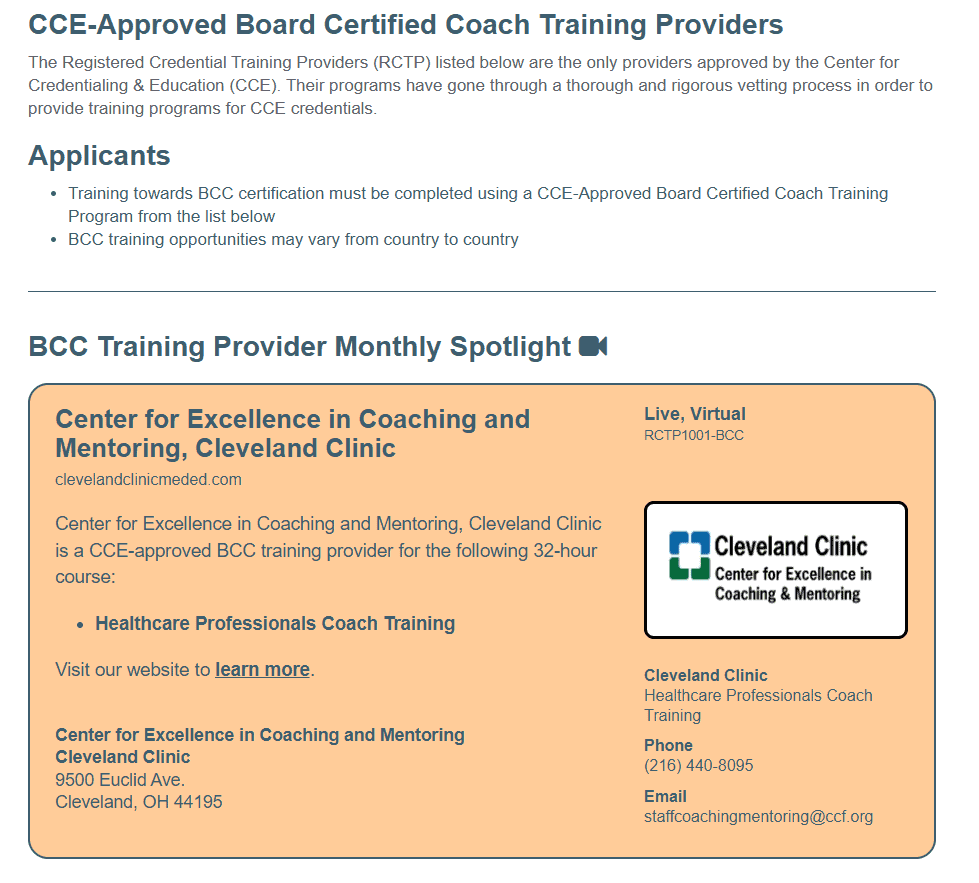
All training must be completed through a CCE-approved Board Certified Coach Training Provider. A full list of approved training providers is available on the CCE website.
The 2,500-hour experience pathway is worth highlighting because it is often missed. If you have been working as a coach for five or more years with a substantial client base, you may qualify for board certification with just 30 hours of additional training. This is one of the most direct routes available for experienced coaches who have been coaching without formal credentials.
One thing that trips people up: coaching experience means actually performing sessions with clients. Studying coaching theory, attending workshops, and observing other coaches do not count. Real client hours are the metric. Peer coaching during a training program may count if it meets the CCE’s verification standards, but confirm this with CCE directly before submitting your application.
The BCC Examination
The Board Certified Coach Examination (BCCE) is a computer-based test. You can take it in person at a Pearson VUE testing center worldwide or online through the OnVUE platform from a private location.
The exam consists of 12 case studies. Each case study presents a coaching scenario followed by 10 multiple-choice questions, for a total of 120 items. Of these, 100 are scored and 20 are field-test questions that do not affect your score. You have 3 hours to complete the exam.
Rather than testing abstract coaching theory, the exam is scenario-based. You review a coaching situation and select the most appropriate response from the options given. This format tests practical judgment, not just textbook knowledge.
The examination covers all 6 BCC competency areas, weighted across the scored items like this:
If you do not pass on your first attempt, you can retest 90 days later. You are allowed up to 2 additional attempts within 2 years of your original application date. If you fail 3 times or 2 years go by without a pass, you will need to submit a new application.
Because the exam is scenario-based rather than fact-based, cramming definitions won’t help much. The better approach is deeply understanding each of the 6 competency areas and thinking through how they play out in actual coaching situations. CCE provides a candidate handbook with the exam structure details and sample questions. It’s important to read it before you schedule your test date.
BCC Certification Cost
The complete breakdown of BCC certification costs:
Initial Certification Fees:
- Application and examination fee: $279
- Application and examination fee for National Certified Counselors (NCCs) or state-licensed counselors: $229
- Specialty designation review fee: $30 per designation (optional)
Ongoing Maintenance Fees:
- Annual maintenance fee: $40 per year
- Late fee: $15 if your annual fee is not paid by the due date
- Reinstatement fee: $50 plus any past-due balance (if your certification lapses)
These figures are for the application and examination only. They do not include the cost of your coach training program, which you will need to complete through a CCE-approved provider before applying.
You will receive an annual maintenance fee notice about 6 weeks before your credential anniversary date. Be sure to pay it on time – a lapsed credential means losing your right to use the BCC designation until you reinstate.
Maintaining Your BCC
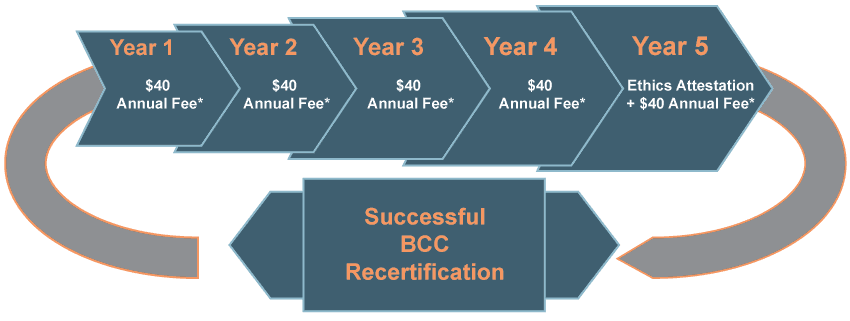
Your BCC credential is valid for 5 years. To keep it active, you must meet the following requirements during each 5-year cycle:
- Pay the $40 annual maintenance fee each year
- Complete 70 continuing education clock hours
- At least 4 of those 70 hours must be in coaching ethics
- If you hold specialty designations, at least 10 hours must be in each specialty area
- Continue adhering to the BCC Code of Ethics
- Report any criminal, civil, or professional disciplinary matters within 60 days
The CCE conducts random audits to verify compliance. If you are selected, you will need to submit documentation for all your continuing education activities. Keep your certificates of completion, transcripts, and verification records for at least 5 years after each maintenance cycle ends.
What Comes With BCC Certification
Earning your BCC gives you more than a certificate. Here is what comes with it:
- Professional recognition: You can use the BCC designation after your name and display the official BCC logo on your coaching website, business cards, and marketing materials.
- Access to the CCE Credentialing Gateway: This secure online portal lets you manage your certification, update your information, track continuing education credits, and access professional resources.
- Directory listing: BCC credential holders are listed in the public CCE Credential Holder Search directory, making it easier for potential clients to find and verify your certification.
- Ongoing professional development: As a BCC, you will have access to approved continuing education opportunities and specialty designation options to further develop your expertise.
- Professional standards and ethics support: You will have clear guidance on ethical coaching practices through the BCC Code of Ethics and access to resources when ethical questions arise.
Pro tip: Once you’re certified, you can launch your coaching website with scheduling, payments, and messaging built right in using Paperbell. Try it for free to get your practice set up in minutes.
Pros and Cons of the BCC Certification
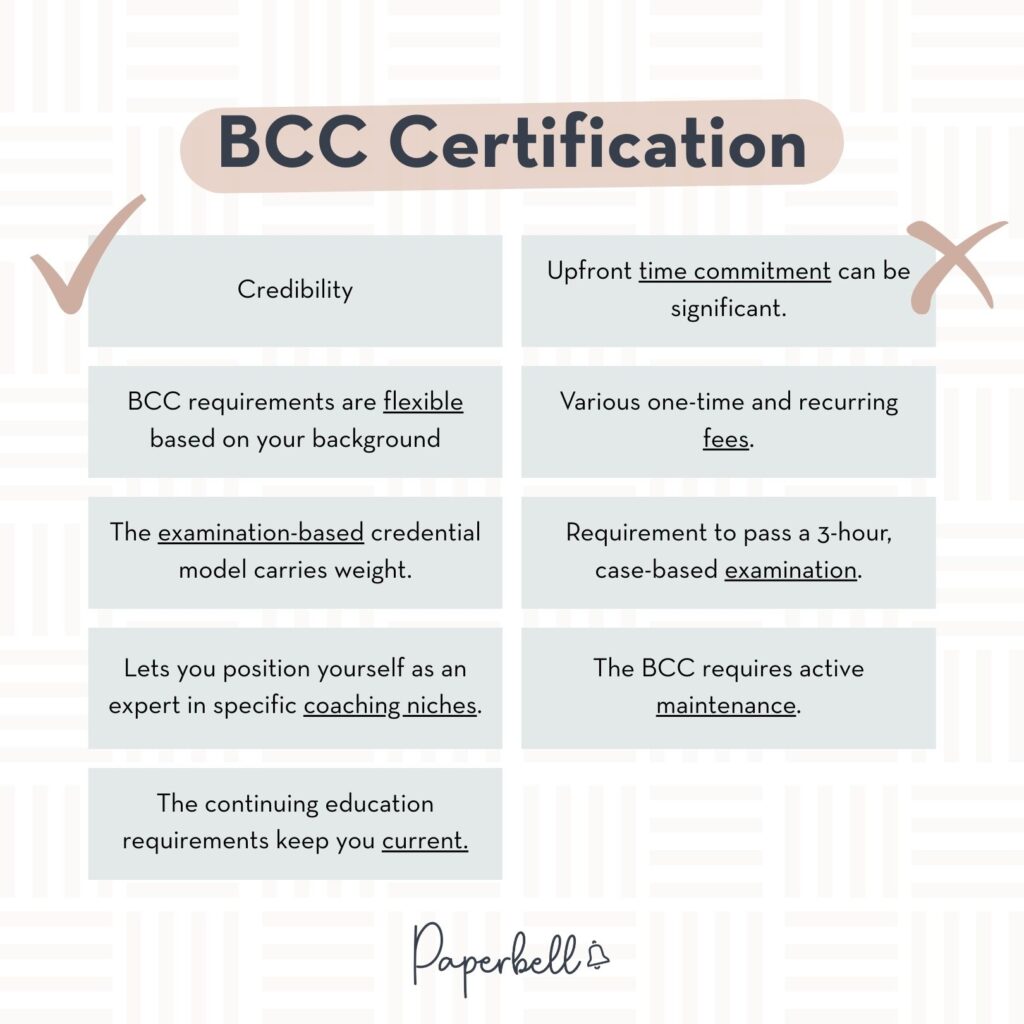
The BCC has real advantages and some genuine limitations. Here is an honest look at both.
Pros
Third-party credibility. Anyone can call themselves a coach. The BCC designation tells clients you have met independent verification standards – education, training, experience, and a passing exam. For clients who research their coaches before booking, that matters.
Flexible pathways based on your background. If you are already a licensed counselor, social worker, or mental health professional, you can build on that existing education and experience rather than starting from scratch. The CCE recognizes the overlap between coaching skills and other helping professions.
Exam-based legitimacy. Unlike certifications earned simply by completing a course, the BCC requires you to prove your knowledge through a comprehensive scenario-based exam. That examination component adds weight to your credential in professional settings.
Specialty designations. After earning your BCC, you can add specialty designations to position yourself as an expert in specific coaching niches, whether that is executive coaching, wellness coaching, career coaching, or another area.
Continuing education keeps you sharp. The 70-hour requirement every 5 years ensures you stay current with evolving coaching methodologies and best practices.
Cons
Training can be a significant time commitment. Depending on your background, you need anywhere from 30 to 120 hours of approved coach training before you can apply. For coaches without relevant graduate education or licensure, 120 hours is a substantial investment before you even sit for the exam.
Costs add up. The application fee alone is $279 ($229 for NCCs and licensed counselors), and you still need to pay for an approved training program on top of that. The ongoing $40 annual maintenance fee means the credential has a real cost every year, not just upfront.
Training provider restrictions. You cannot use just any coach training program. All training must come from CCE-approved providers, which limits your options compared to credentials that accept training from a wider range of schools and programs.
The exam is a genuine barrier for some. A 3-hour, 120-item, case-based exam is a real test. If you are not a confident test-taker, that can feel daunting. You get 3 attempts, but failing all 3 means starting the application process over.
Active maintenance is required. Unlike a degree you earn once, the BCC requires ongoing tracking of continuing education hours, annual fee payments, and occasional audits. You are not done once you pass the exam.
BCC vs. Other Credentials
The BCC is not the only professional coaching credential available. Depending on your goals and background, here are the main alternatives worth considering.
International Coaching Federation (ICF)
The International Coaching Federation (ICF) is the most recognized coaching organization globally. They offer 3 individual credential levels:
- Associate Certified Coach (ACC): Requires at least 60 hours of coach-specific training and 100 hours of coaching experience with at least 8 clients.
- Professional Certified Coach (PCC): Requires 125 hours of coach-specific training and 500 hours of coaching experience with at least 25 clients.
- Master Certified Coach (MCC): The highest level, requiring 200 hours of training and 2,500 hours of coaching experience with at least 35 clients.
ICF credentials are globally recognized and especially valuable if you coach internationally or want to be part of the largest global coaching community. However, ICF does not require an academic degree, which means its pathways focus entirely on coach training hours and demonstrated coaching experience rather than prior academic or professional background.
For coaches without graduate degrees or professional licenses, ICF’s lack of a degree requirement can make it a more accessible starting point than the BCC. For coaches who already have relevant graduate education, the BCC’s academic credit system can make it the faster route.
European Mentoring & Coaching Council (EMCC)
The European Mentoring & Coaching Council (EMCC) is another globally recognized credentialing body, though more prominent in Europe and the UK than in North America.
EMCC offers four levels of individual accreditation:
- Foundation: For new coaches and mentors just starting their practice.
- Practitioner: For coaches and mentors with at least two years of experience.
- Senior Practitioner: For experienced practitioners with advanced competencies.
- Master Practitioner: For highly experienced coaches working at the highest level.
The EMCC credential process is competency-based and includes portfolio assessment rather than examinations. You demonstrate your coaching abilities through documented evidence, case studies, and sometimes recorded sessions.
One unique aspect of EMCC is its focus on both coaching and mentoring. If your practice includes mentoring, or if you work primarily in European markets, EMCC may be a strong fit. If you are based in North America, however, the EMCC credential may carry less recognition than the BCC or ICF credentials in your local market.
Applying for the BCC: What the Process Looks Like
The BCC application is submitted through the CCE Credentialing Gateway. Before you sit for the exam, CCE reviews your application to confirm you meet all eligibility requirements. The sequence looks like this:
- Gather your documentation. You will need official academic transcripts verifying your degree, a completed CCE Coaching Experience Form signed by a professional colleague or supervisor, and contact information for your professional peer reference.
- Complete your training hours. All required training hours must be completed through a CCE-approved provider before submitting your application. Keep certificates of completion from each training program.
- Submit your application and pay the fee. The application fee ($279, or $229 for NCCs and licensed counselors) is paid at submission. CCE will review your materials and notify you of your eligibility status.
- Schedule the exam. Once approved, you will receive information to schedule your exam through Pearson VUE, either at a testing center or via online proctoring.
- Pass the BCCE. After a passing score is confirmed, CCE will issue your BCC credential and you will gain access to the Credentialing Gateway to manage your certification going forward.
Processing times vary, so submit your application well before you need the credential. If you are unsure which pathway fits your background, CCE’s staff can help you figure that out before you apply.
Start Your Coaching Practice the Right Way
Earning your BCC is the hard part. Running a coaching business doesn’t have to be.
Paperbell handles the admin side of things: scheduling, payments, contracts, and client management, all in one place, so you can spend your time actually coaching.
Try Paperbell for free and see how easy it is to turn your board certified coach credential into a fully operational coaching business.
FAQs About BCC Certification
What is BCC certification?
BCC stands for Board Certified Coach. It is a professional coaching credential administered by the Center for Credentialing & Education (CCE) that verifies you have met specific education, training, experience, and examination requirements. Coaches use the BCC designation after their name to signal independent, third-party verification of their competency.
How much does the BCC certification cost?
The application and examination fee is $279, or $229 for National Certified Counselors (NCCs) and state-licensed counselors. After certification, there is a $40 annual maintenance fee. Optional specialty designations cost $30 each. These figures do not include the cost of your required coach training program.
How many training hours does the BCC require?
It depends on your background. Coaches with an NCC, state counseling license, or a master’s in counseling need 30 hours. Coaches with a master’s in social or behavioral sciences (without a license), or those with an existing ICF credential and a bachelor’s degree, need 60 hours. All other candidates with a bachelor’s degree need 120 hours. There is also an experience pathway: if you have 2,500+ coaching hours over 5+ years plus a bachelor’s degree, you qualify for the 30-hour pathway.
What is the difference between BCC and ICF credentials?
The BCC is issued by CCE and requires a bachelor’s degree at minimum. It gives credit for existing academic and professional backgrounds in counseling or behavioral science, which can reduce training requirements significantly. ICF credentials do not require a degree and focus more heavily on coach-specific training hours and documented coaching experience with clients. Both require passing an exam and ongoing maintenance. Coaches can hold both credentials at the same time.
Is the BCC harder than ICF ACC?
They test different things. The BCC exam is a 3-hour, 120-item, case-based scenario exam that draws on coaching competencies across 6 areas. The ICF ACC exam tests ICF’s core competencies through a similar format. Neither is universally considered harder than the other. Difficulty tends to depend on your background: coaches from counseling often find the BCC content more familiar, while coaches who trained exclusively through ICF-accredited programs may find the ICF format more natural.
Can I hold both BCC and ICF credentials?
Yes. The BCC and ICF credentials are issued by different organizations and are not mutually exclusive. Some coaches pursue both to demonstrate competency to different audiences: the BCC signals academic and behavioral science foundations, while ICF credentials are more broadly recognized across the global coaching community.
What is the BCC in education?
In the coaching context, BCC refers to Board Certified Coach certification. It is an educational credential that demonstrates you have completed approved coach training and passed a competency examination administered by the Center for Credentialing & Education.
How do I become a BCC?
To become a BCC, you need a bachelor’s degree minimum, between 30 and 120 hours of CCE-approved coach training depending on your background, 30 hours of coaching experience with clients, a professional peer reference, and a passing score on the Board Certified Coach Examination. The application is submitted through the CCE Credentialing Gateway.