

You’ve done your research on coaching certifications and the Co-Active Training Institute keeps coming up. ICF-accredited, highly regarded, with a long track record. But also one of the steeper investments in the space.
So is it actually worth it? And how does it hold up against other programs?
In this review, you’ll get a clear picture of how CTI’s programs work, what they cost in 2026, what real students say (good and bad), and who it’s the right fit for.
What is the Co-Active Training Institute?
Founded in 1992, the Co-Active Training Institute (CTI) is one of the oldest and most recognized coaching schools in the world. It’s headquartered in San Rafael, California, but offers programs globally, with its coach training now delivered online.
CTI built its reputation around a specific coaching philosophy: co-active coaching. The basic idea is that the coach-client relationship is collaborative, and that clients already have the inner resources they need. The coach’s job is to help them access those resources, not to hand over a set of answers.
At CTI, students learn through an experiential process that combines:
- Classroom instruction
- Group discussions
- Hands-on coaching practice with real clients
It’s worth knowing that CTI has trained over 150,000 coaches across 120+ countries since its founding. That kind of alumni community can matter a lot, especially early in your career.
The 3 Core Principles of Co-Active Coaching
The co-active model is built around three principles that shape how CTI trains its coaches:
- Fulfillment: Helping clients identify and pursue what’s truly meaningful to them.
- Balance: Guiding clients to make choices that align with their values, not just their circumstances.
- Process: Staying fully present with the client in the moment, not just moving toward a goal.
These principles are baked into every part of the curriculum. If they resonate with you as a coaching philosophy, you’ll probably find CTI’s approach a natural fit. If you’re looking for a more structured, goal-focused coaching model, you might want to compare it with some of the alternatives we cover below.
ICF Accreditation and What It Means for Your Credentials
CTI is accredited by the International Coaching Federation (ICF), the main global standard-setter for the coaching profession. That accreditation is a meaningful mark of quality.
Under the ICF’s current designation system, CTI holds both Level 1 and Level 2 Accredited Education Provider status (Level 2 was formerly called ACTP under the old system, which was retired in 2022-2023). Level 2 is the highest tier of ICF accreditation for coaching schools.
Here’s why that matters for your credentials:
- Each course carries its own bank of ICF-accredited coaching education hours: 8 hours in Co-Active Foundations, 52 hours toward the ACC in Ignite the Practice, and 96.5 total training hours (including 10.5 mentor coaching hours) in Deepen the Work
- Taking Ignite the Practice with the ICF-ACC pathway prepares you to apply for the ACC (Associate Certified Coach) credential through the ICF
- Deepen the Work earns you the CPCC and satisfies the ICF education and mentor-coaching requirements to apply for the PCC (Professional Certified Coach) credential
The CPCC certification you earn through CTI is CTI’s own designation (Certified Professional Co-Active Coach). It’s well-recognized in the coaching world, but it’s separate from your ICF credential. The ICF credential requires additional steps beyond the CPCC.
The ICF accreditation is the credential that matters most for working with corporate clients or building a serious coaching practice.
The Programs at Co-Active Training Institute
CTI offers three types of training: coach training, leadership training, and organizational training. This review focuses on the coach training track.
A note on region: content on Co-Active’s site is region-specific, so you might not see every product or course referenced in this article. Rest assured, all offerings are equally rigorous and complete. They’re simply packaged to best serve each region. Interested in the progressive pathway? Reach out to an advisor.
CTI delivers its coach training as a step-by-step pathway. You move through it in order, and you can stop at the level that fits your goals:
- Co-Active Foundations: your entry point into the model
- Ignite the Practice: real coaching competence and your practitioner designation
- Deepen the Work: full certification (CPCC) and PCC preparation
CTI also offers an optional Co-Active Leadership: Distributed Leadership course as an add-on, but the three stages above are the core coaching-certification path.
Co-Active Foundations
This is your entry point into the co-active model. Foundations runs as a single intensive day, delivered virtually, and carries 8 ICF-accredited coaching education hours. You walk away with practical tools and insights you can use right away. A lot of coaches take it as a standalone first, to get a feel for CTI’s approach before committing to anything bigger.
Ignite the Practice
This is where you build real coaching competence. Ignite the Practice runs over 5 days (in a 3+2 structure) virtually and carries 52 ICF coaching education hours toward the ACC credential. You practice intensively with expert mentorship and earn the Co-Active Coach Practitioner (CAP) designation. There’s also an option to take it with the ICF-ACC pathway built in, if applying for that credential is part of your plan.
Deepen the Work
This is the full certification stage, and where you earn the Certified Professional Co-Active Coach (CPCC) credential. Deepen the Work covers five advanced modules, each co-led by two Co-Active faculty, with practice pods of 9 to 10 coaches plus individual and group supervision. It carries 96.5 total training hours (including 10.5 mentor coaching hours), which satisfies the ICF education and mentor-coaching requirements to apply for the PCC. CTI now offers it in two formats with the same curriculum and the same credential: a Fast Track (a fixed 5-month cohort schedule) or a Flex Track (self-directed, with up to 18 months to finish the courses and up to 2 years to complete your 100 coaching hours and certify). The prerequisite is Co-Active Foundations plus Ignite the Practice.
Time Commitment: Full Program Overview
| Course | Format | Duration |
|---|---|---|
| Co-Active Foundations | Virtual | 1 day |
| Ignite the Practice | Virtual (3+2 structure) | 5 days |
| Deepen the Work | Fast Track (fixed cohort) or Flex Track (self-directed) | 5 months (Fast Track) |
| Total to CPCC | ~5-8 months on the Fast Track (longer if self-paced) |
Co-Active Training Institute Cost (2026)
This is where a lot of coaches pause. CTI is a significant investment, so here’s how the numbers break down. CTI packages its coach training into three main options:
- Foundations Only: $490. The single-day entry point, for testing the waters before you commit to more.
- Foundations + Practitioner Bundle: $3,490. Bundles Foundations with Ignite the Practice and earns you the Co-Active Practitioner (CAP) designation. Add the ICF-ACC Supervision Package (mentor coaching, ICF exam prep, and application support toward the ACC credential) for $5,280.
- Complete Certification Journey: $10,470. The full path from Foundations through CPCC certification, bundled for maximum savings, with interest-free payment plans available.
Deepen the Work, the certification stage, is $8,490 on its own. If you’re set on the full CPCC, the Complete Certification Journey bundle at $10,470 is the most cost-effective route: buying Foundations, Ignite the Practice, and Deepen the Work separately ($490 + $3,490 + $8,490) comes to $12,470, so the bundle saves you around $2,000.
A couple of costs that don’t always show up in the headline price:
- ICF application fees: Applying for your ICF credential (ACC, then PCC) once you’ve earned the relevant hours has its own cost, paid directly to the ICF.
- The ICF-ACC pathway add-on: If you want ACC credential preparation built into Ignite the Practice, that’s the $5,280 option rather than the $3,490 practitioner-only price.
One thing that has changed: CTI now delivers its coach training virtually, so you no longer have to budget for the travel and lodging the old in-person intensives required.
CTI: Pros and Cons
| Pros | Cons |
|---|---|
| Level 2 ICF accreditation (highest tier) | Full CPCC certification is a five-figure investment ($10,470) |
| ICF-accredited with 30+ years of track record | Full certification is a multi-month commitment |
| Real client coaching built into the curriculum | ICF credential application fees are separate from tuition |
| Cohort model builds genuine community | Strong co-active philosophy (not ideal if you want a different model) |
| Flexible, self-paced virtual courses with multiple start dates | Little focus on business development or client acquisition |
| 150,000+ alumni network across 120+ countries | A big jump in cost between the $490 entry course and full certification |
Co-Active Training Institute Reviews
What do real students actually say about CTI? The picture is largely positive, with some recurring honest caveats.
CTI has over 370 reviews on FindCourses, where it holds a strong aggregate rating. Across platforms (Google, their Facebook page, and third-party review sites), students consistently highlight the depth of the learning experience.
Several students described moments like:
- “Blown away.”
- “The knowledge I have gained in such a short period of time is truly accessible and applicable to daily and professional life.”
- “I was challenged and supported to understand myself better and to develop a plan to move forward.”
- “An experience in my life that will serve me from now, immediately onwards.”
The cohort model comes up in a lot of positive reviews. Students mention that coaching alongside the same group of people over several months creates a level of trust and depth that self-paced programs can’t replicate. The peer practice component (coaching and being coached by classmates) is something many graduates say had a bigger impact than they expected.
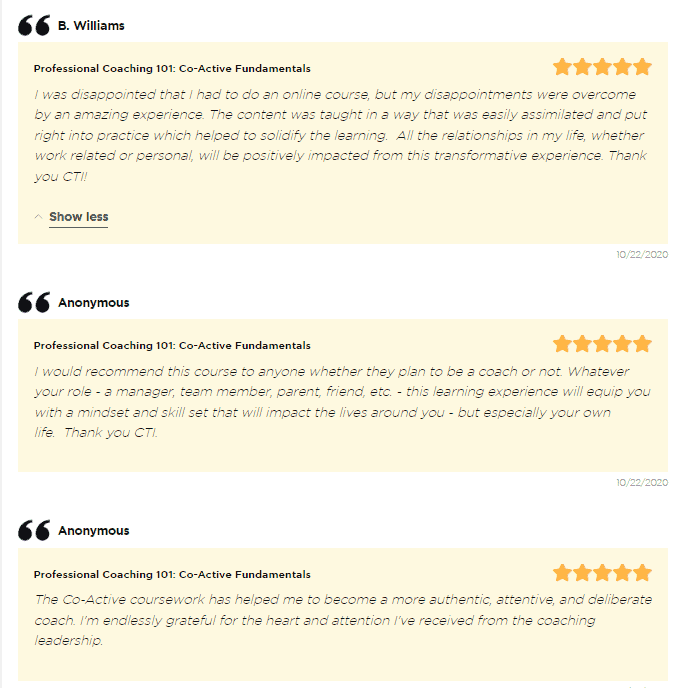
Here are more examples of student reviews from the program:
What critics say
The most honest reviews also flag a few consistent pain points. They’re worth knowing before you commit.
The intensity is real. CTI’s program is designed to challenge you, and a number of graduates describe the experience as emotionally demanding, not just academically rigorous. One graduate put it plainly:
“The Co-Active Training Institute was one of the most challenging things I’ve ever done. But it was also one of the most rewarding. I learned so much about myself and my coaching style, and I feel like I’m a much stronger coach as a result.”
The cost is a genuine barrier. Even coaches who loved the program acknowledge that the price is a stretch. As one reviewer wrote:
“I loved the program, but I wish it was more affordable. It was a big investment for me, and I had to make some sacrifices to make it work.”
The co-active model is specific. Some coaches find the co-active philosophy fits naturally with how they already think. Others find it constraining if they were hoping for a more eclectic or goal-focused approach. If you’re not sure the co-active model is the right fit, taking the Co-Active Foundations course as a standalone first is a smart way to test it before investing in the full pathway.
No business development training. CTI teaches you to coach extremely well. It does not teach you how to get clients, set your rates, or build a practice. That gap is worth planning around before you finish the program.
CTI vs. Other ICF Coaching Programs
CTI isn’t the only strong option in this space. If you’re comparison-shopping, here’s a quick look at how it stacks up against a few well-known alternatives:
| Program | ICF Level | Total Cost (approx.) | Duration | Best For |
|---|---|---|---|---|
| CTI (Co-Active) | Level 2 | ~$10,470 | ~6-8 months | Coaches wanting a deep, experiential, relationship-focused model |
| iPEC | Level 2 | ~$14,000+ | ~12 months | Coaches with a business or corporate focus |
| ICA | Level 1 | ~$5,000 | 6-12 months | Budget-conscious coaches or those newer to the field |
| Erickson | Level 2 | ~$8,000-$12,000 | 6-12 months | Coaches who need more scheduling flexibility |
Note: Competitor prices are approximate and change regularly. Verify before making any decisions. ICF Level 2 is the highest accreditation tier. Programs at Level 1 still qualify you for ICF credentials but with different pathway requirements.
Is the Co-Active Training Institute Worth It?
Here’s the honest answer: for the right kind of coach, yes. For others, there are better-fit options.
CTI is probably worth it if:
- You’re drawn to the co-active philosophy and want to go deep into one well-developed model
- ICF accreditation matters to you (for working with corporate clients or for personal credibility)
- You learn best through practice and community, not self-study
- You have (or can access) the budget, and you see this as a serious career investment
- You want real coaching experience built into your training, not just theory
CTI might not be the right fit if:
- The ~$10,470 cost of full certification isn’t realistic right now
- You want flexibility to learn at your own pace without a set cohort schedule
- You’re more interested in a different coaching approach (goal-focused, cognitive, positive psychology, etc.)
- You need business development training included (CTI won’t give you that)
One thing worth knowing: if you want to test the waters before committing, CTI’s Co-Active Foundations course is available as a standalone for $490. It’s a much smaller investment and gives you a genuine feel for the co-active model and how CTI teaches.
Is the Co-Active Training Institute Right for You?
This comes down to your goals, your learning style, and what kind of coach you want to become.
CTI has a strong track record for a reason. The experiential model, the cohort community, and the Level 2 ICF accreditation set it apart from most programs. But so does the price tag and the time commitment. Neither of those should be glossed over.
The coaches who get the most out of CTI tend to be the ones who go in knowing exactly why they chose the co-active approach, and who are ready to put in the work it takes.
Start Your Coaching Practice the Simple Way
No matter which coaching certification you choose, you’ll need to run your coaching business once you graduate. Paperbell makes that side of things simple: scheduling, payments, client portals, contracts, and more, all in one place.
Try Paperbell for free and see how much easier the business side of coaching can be.
Editor’s Note: This post was originally published in May 2023 and has been updated in June 2026.