
You’ve just finished a full day of hygiene checks and crown preps, and now you’re sitting in your office, Googling ‘dental business coaching’ because production has been flat for 11 months and you’re tired of guessing.
Somewhere in those search results is a firm promising to ‘transform your practice’. There’s no price anywhere on the page and no specific plan.
Now, dental business coaching can be incredibly useful. It can also be an expensive way to hear things you already know. The difference comes down to what you truly need and who you hire.
In this post, you’ll learn what dental business coaching is, what it costs, and how to pick someone worth the investment. And if you’re a coach reading this wondering whether dentists are a niche worth building around, the second half is for you.
What Is Dental Business Coaching?
Dental business coaching is a type of coaching focused on the business side of running a dental practice. That includes production, team management, patient experience, and profitability, or, in short, the part you never learned in dental school.
Coaching for dentists is distinct from clinical training and continuing education. A course on implant placement makes you a better clinician, while a business coach will help you figure out why your schedule has holes in it or why your collections don’t match your production.
The following themes tend to show up often in this type of coaching:
- Production and scheduling optimization
- Case acceptance and treatment plan communication
- Team performance, culture, and leadership
- Financial management and profitability
- Patient experience and satisfaction
- Practice transitions, acquisitions, and exit planning
- Multi-location and dental service organization (DSO) coaching
There’s also a blurry line between dental consulting, practice management firms, and dental business coaching. Plenty of firms do both coaching and consulting under the same roof, and some people who call themselves coaches do work that looks a lot like consulting.
What Does Dental Business Coaching Cost?
Many coaches in the dental business space don’t publish their pricing publicly, so it’s hard to get exact figures. That being said, a couple of providers do publish numbers, but these are only examples.
Dental Mastery Dynamics, for instance, offers monthly retainer plans that start at $299 for AI-powered guidance, run $599 for its most popular blend of human and AI support, and go up to $1,499 for premium support.
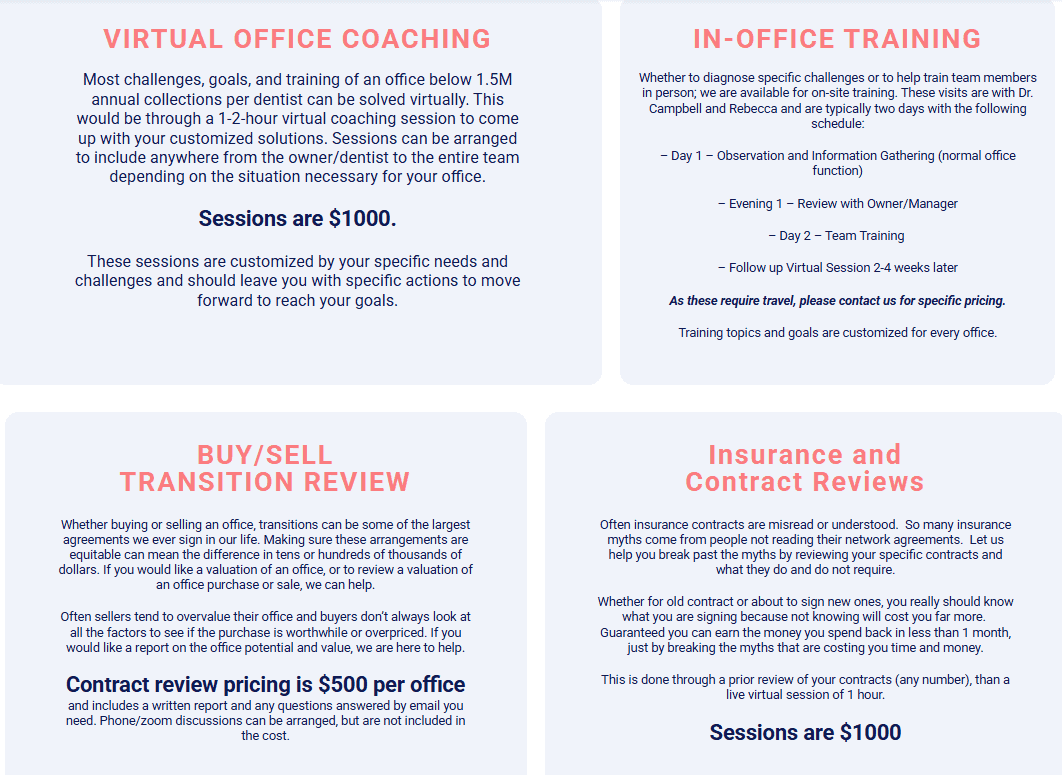
Practice Whisperer prices by session instead of by month. Sessions range between $500 and $1000 depending on the type:
For a broader range, one industry roundup from Dentist Decoded puts most dental business coaches from $1,500 to $4,000 per month. You’ll get separate numbers from this source when it comes to consulting averages, with initial assessments typically in the $2,500 to $10,000 range and ongoing engagements between $3,000 and $15,000 per month.
In general, the investment you’ll pay to hire a dental business coach will depend on:
- How much support you’re looking for
- How many areas of business you need help with
- The coach's (or firm’s) level of experience and/or coaching credentials
Please note that these types of roundups present figures based on industry experience, not cited research, so treat it as an informed estimate, not strict benchmarks.
How to Choose a Dental Business Coach
The Dentist Decoded roundup lays out 6 criteria worth considering before you sign a coaching contract. It advises you to make sure you’re compatible with a coach’s style, verify their experience with practices like yours, and clarify expectations around goals, metrics, and timelines:
- Direct dental practice experience. Has this person or firm actually worked inside a dental office, or are they applying generic business frameworks to a clinical environment they’ve only read about?
- Proven coaching methodologies and track record. Is there a repeatable approach behind the coaching, and can they point to practices similar to yours in their client roster?
- Strength of accountability and support systems. Coaching without follow-through is just expensive advice. Ask potential coaches what happens between calls.
- Alignment with your goals and values. A coach optimizing for a DSO sale is running a different playbook than one helping you build a fee-for-service practice you’ll own for the next 20 years.
- Accessibility and communication style. How often do you meet, who do you actually interact with, and how fast do they respond when something breaks on a Tuesday morning?
- Transparent pricing. If you can’t get a straight answer about cost and what’s included (or at least an approximation), it could be a red flag.
The market is varied enough that different coaches and firms clearly serve different practice profiles.
For example, Next Level Practice and ACT Dental both run structured coaching programs for practice owners and teams. Productive Dentist Academy, All-Star Dental Academy, and LCP Coaching each publish their own material on what dental business coaching involves. Davis & Cole comes at practice consulting from the dental accounting side.
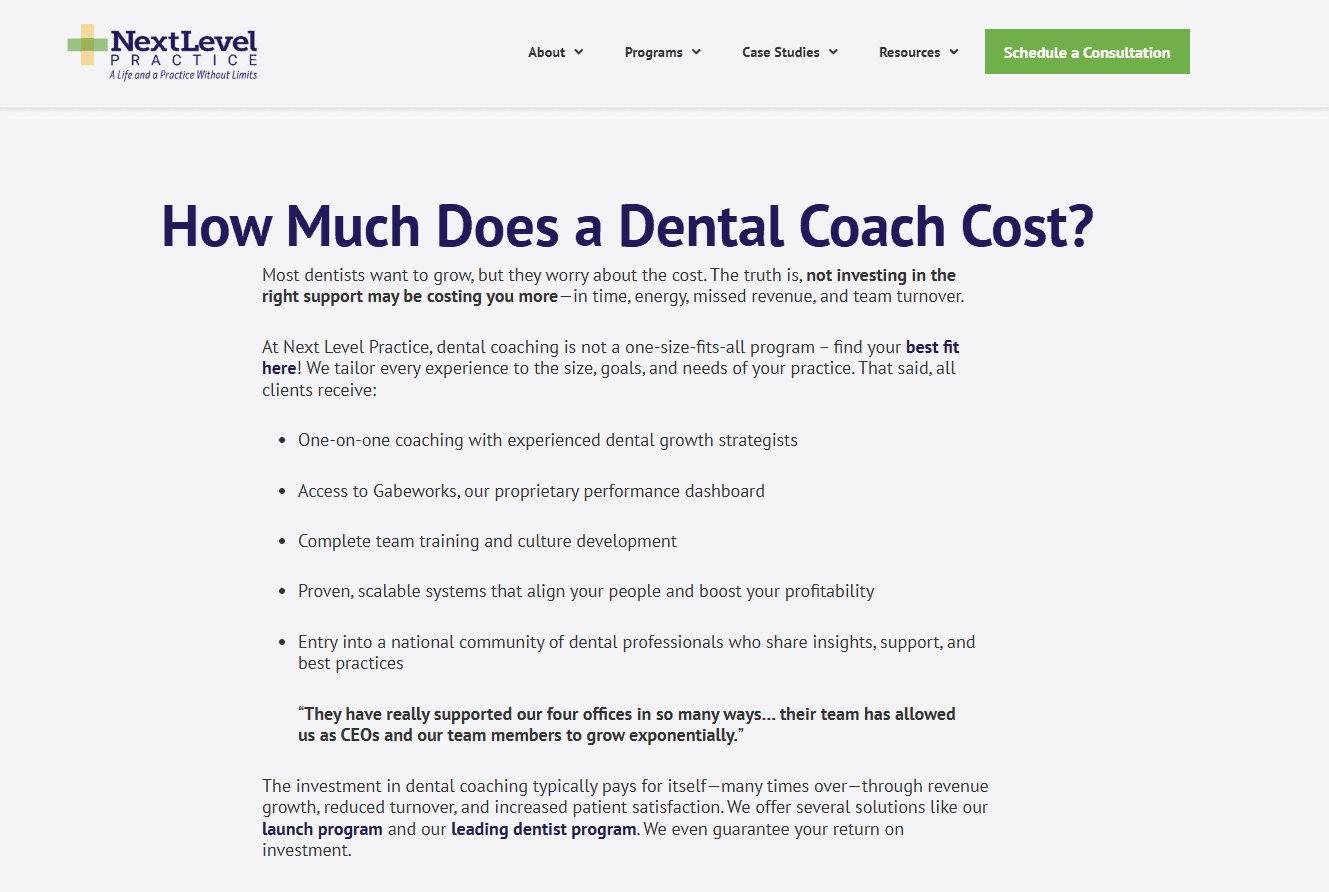
None of these firms publish pricing on their sites, so you’ll need to ask throughout the sales process. On the other end, Dental Mastery Dynamics shows what a lower-cost, technology-assisted tier looks like when a provider does put numbers on the page.
5 Signs It's Time to Hire A Dental Business Coach
Not every dental practice needs a coach. The following 5 signals can communicate when it’s time to act.
- Your production or growth has stalled. You’ve plateaued for a year or more and have tried the fixes you knew about, but nothing has improved. An outside set of eyes is worth real money at that point.
- Case acceptance is low. Even though you’re diagnosing patients well, they keep declining treatment. That’s typically not a clinical problem and may be linked to communication and systems issues a coach can help with.
- There are team turnover or culture problems. If you’re rehiring for the same position every 8 months or there’s tension in the office, this isn’t usually a problem that goes away on its own.
- You’re wearing every hat and burning out. You’re the dentist, but also the HR department, the marketing team, the billing department, and more. If your evenings are spent on payroll and insurance appeals, something structural needs to change.
- You’re feeling competitive pressure from DSOs in your market. Group practices with huge marketing budgets and centralized operations just opened nearby, and you’re feeling it in new patient numbers.
If you can relate to any of the above points, it may be worth considering getting help from an experienced coach.
How to Build a Coaching Practice Serving Dentists
Let’s switch gears now. If you’re a coach and you’ve read this far, you’ve probably noticed that dentist business coaching is a niche with real budgets, urgent problems, and clients who are used to paying for expertise.
Dentists are business owners with revenue, staff, overhead, and almost no formal business training, which means there’s a coaching market with a real gap in it. Here’s how to approach it if you want to start coaching dentists in your coaching practice.
Do You Need Dental-Industry Experience?
There isn’t a single certification that gatekeeps this niche, or any license needed to call yourself a dental business coach.
What you do need is credibility. That tends to come from one of two directions.
The first is having a dental industry background. You could either be a former practice manager, a hygienist, an office administrator, or a dentist yourself. Either way, you’ve lived inside the environment, and you speak the language.
The second is having a general coaching credential, such as an International Coaching Federation (ICF) certification, paired with demonstrated expertise in this niche. This means taking it upon yourself to learn the metrics that matter to dentists, how to understand how dental insurance and collections work, and how to hold a conversation about hygiene reappointment rates and other industry-specific topics.
One credential you’ll come across is the Michigan Dental Association’s Certified Dental Business Professional (CDBP). However, if you’re considering this, make sure to read the fine print. This certification is a continuing education credential for dental office staff, not coach training.
This makes it useful context for a coach who’s curious about learning the ins and outs of the dentistry world, but you won’t learn how to actually coach, since it has nothing to do with coaching.
What a Starter Package Might Look Like
The pricing data we’ve covered above is useful for practice owners, but as a coach, you can learn what the market is already ready to pay.
A monthly retainer model mirrors what’s already out there. Below are some examples:
- A lighter tier around $300 to $600 a month with monthly calls and async support between them
- A core tier around $1000 to $1500 per month with biweekly calls
- Higher tiers with in-person visits, team training, and deeper financial reviews
You can also skip retainers early on and price by the session to get some experience, just like Practice Whisperer does. A focused 2-hour working session with the owner and key team members, priced as a standalone offer, is an easier first “yes” than a 12-month, 5-figure commitment.
Session-based pricing has advantages when you’re new. You get reps, testimonials, and case studies without having to ask someone to bet a year on you.
Our guide on how to price your coaching services walks you through examples of what both session-based pricing and retainer-based pricing can look like and how to establish your packages, and the executive coaching packages breakdown is a useful parallel since the buyer profile is similar.
Where to Find First Clients
Dentistry is a tight, referral-driven world. That’s inconvenient for new coaches, but it’ll become enormously helpful once you’ve built your books. You can look for your first client using these strategies:
- Join dental professional communities, where practice owners talk about their problems every single day. Show up and answer business questions in a helpful way to build your network.
- Attend local dental society meetings, which put you in a room with owner-dentists in your area.
- Build relationships with Dental CPAs (accountants who specialize in the dental industry). They see the financial problems first, but often have nobody to hand the reins to.
- Use LinkedIn to find practice owners, office managers, and DSO operations people. You can try manual, thoughtful outreach, or start creating helpful content on your feed.
To make those conversations count, we’ve put together a free Dental Practice Discovery Call Questionnaire you can grab and start using right away. It covers current production numbers, case acceptance rates, team size and turnover, biggest pain point, and any prior coaching and consulting experience your potential client may have.
Free Dental Practice Discovery Call Questionnaire (2026)
The questions to ask a dental practice owner on a discovery call: production numbers, case acceptance, team turnover, biggest pain point, and prior coaching experience, plus a fit-check section for after the call.
Get the free template → Download as PDF
This button allows you to copy our Google Docs template
If you’d rather build your own version of this discovery questionnaire, our life coach intake form guide covers how to do this the easy way.
How to Set Up The Operational Side of Your Coaching Business
Once you’ve got one or two dental clients, the admin side of coaching will catch up with you, fast.
You’ll need packages with dental-specific pricing tiers so that a solo practice owner and a 3-location group aren’t looking at the same offer. You’ll also need a coaching contract that gets signed before the first session instead of chased afterward.
Then, you’ll need scheduling that works around a dentist’s day, which means self-booking into the windows you’ve made available, synced with your external calendar so nothing double-books. And you’ll need to get paid automatically, on a recurring basis, without invoicing anyone by hand each month (and sending reminders by email).
That’s the whole reason Paperbell exists. In Paperbell, you get packages, contracts, scheduling, and payments all in one place, built for coaches, by coaches. If you want a look at how another niche practice is structured, our guide on becoming a mental health coach follows a similar path.
Start Your Dental Business Coaching Practice Today
If you own a practice, dental business coaching is worth it when you have specific problems you need solved by someone with real dental experience and a clear methodology.
If you’re building a coaching practice, dentists are a strong niche with real budgets and painful, expensive problems they’re willing to pay to solve. Just know that niche credibility compounds slowly, and it’s not an overnight speciality.
Your first dental client comes from a conversation, your fifth comes from a referral, and the gap between them is usually measured in months, not weeks.
When you’re ready to set up your packages and start booking clients the simple way, try Paperbell for free.
FAQs about dental business coaching
What is dental business coaching?
Dental business coaching is a type of coaching focused on the business side of running a dental practice. This includes production, scheduling, team culture, case acceptance, and profitability, not clinical technique or continuing education.
How much does a dental business coach cost?
Published pricing is rare in this space, but one provider's tiers run $299 to $1,499 a month depending on the level of support, and another charges $500 to $1,000 per session. A broader industry estimate puts ongoing coaching at $1,500 to $4,000-plus a month, though that figure comes from one source's industry experience rather than independently confirmed data.
Do I need to be a dentist to become a dental business coach?
No. Dental-industry experience helps a lot, but it isn't required if it's paired with a real coaching credential and demonstrated niche expertise.
What's the difference between a dental coach and a dental consultant?
Coaching tends to be ongoing and relational, built around leadership, accountability, and culture. Consulting tends to be project-based, like a practice transition or a systems implementation. In practice, the two often overlap.
Is dental business coaching worth it?
There's no independently verified ROI figure for dental business coaching. One industry source cites a 10-30% profitability improvement over 12 months, but that figure comes from industry experience rather than confirmed research, so treat it as a data point, not a guarantee. Look at the concrete signals instead, such as stalled production, low case acceptance, team turnover, or growing local competition.