
It’s 9:40 pm on a Tuesday night in March. You’re finishing a return that should’ve gone out Friday, and this is week 6 of something like 70 hours. Revenue is technically fine, but margins aren’t.
Somewhere in the middle of all that, a thought shows up. Would a business coach actually help with any of this?
Burnout in accounting has its own specific shape. Instead of a slow drift, it’s a cliff you dive into starting in January and only manage to climb back out of in May, every single year. Underneath the seasonal crunch lies another issue: the hourly-billing ceiling. When revenue is capped by the number of hours you and your team can physically bill, it means putting in more hours is the only way to grow.
Here’s the thing. There’s a specific group of people who can help you through both of these issues at once. They’re called business coaches, and if that term alone intimidates you, don’t worry!
In this post, we’ll walk you through what business coaching for accountants actually involves, what it realistically costs, and how to pick the best one for your needs. And, for anyone reading this who’s an accountant but wondering about becoming the coach, we’ll also guide you on how that path works.
What Is Business Coaching for Accountants?
Business coaching for accountants is a type of coaching focused on the business side of running an accounting or Certified Public Accountant (CPA) practice, such as pricing, systems, staffing, and growth. They can guide you through the stuff nobody covered in your CPA exam prep.
Business coaching is distinct from technical training. For instance, a tax update seminar teaches you the new rules. Compliance consulting keeps you on the right side of those rules.
A business coach helps you develop your firm. You’ll work on how it makes money, who does the work, and whether the firm can run without you in the room.
Most coaching programs circle the following themes:
- Moving away from hourly billing toward value-based or advisory pricing
- Building systems and delegating so the firm isn’t completely dependent on you
- Hiring, retaining, and leading a team
- Growing beyond whatever referrals happen to come in
- Managing the identity shift from “I file your taxes” to “I help you run your business”
There’s a real difference between coaching and consulting here. A consultant typically comes in, solves a defined problem, and leaves. A coach works with you over months and holds you accountable while you change how the firm operates, which tends to matter more than the plan itself.
It’s worth flagging that accounting firms have an extreme and predictable annual workload spike. A generic weekly coaching cadence designed for a business with a flat calendar doesn’t account for tax season, so ask any prospective coach whether their cadence adjusts for it.
Why Accounting Firm Owners Are Turning to Coaches Right Now
Three converging dynamics are causing accounting firm owners to seek out business coaches.
First, the advisory shift is accelerating. According to the 2025 Intuit QuickBooks Accountant Technology Survey, 79% of accountants expect strategic advisory work to grow over the next year. Firms are projecting an average volume increase of 38%.
That’s a lot of firms trying to build a service line they’ve never sold before.
Next, busy-season burnout is, unfortunately, a near-universal experience. A 2022 survey from FloQast and the University of Georgia, using the Maslach Burnout Inventory, found that 99% of accountants suffer from burnout. And 24% report medium-high to high levels. Even if this is 2022 data and not fresh 2026 numbers, nothing about the last few busy seasons suggests this has improved dramatically.
Finally, most accountants were never trained to price on value. You were trained to track time. Raising prices on a client you’ve had for 11 years, or quoting a monthly advisory fee instead of an hourly rate, is an uncomfortable conversation most accountants aren’t equipped to navigate.
It’s also the single change most likely to fix your margins.
The above combination is why coaching demand in this niche keeps climbing.
What Does Business Coaching for Accountants Cost?
Now, accounting-specific coaches almost never publish their pricing.
Of course, there are exceptions. The CPA Coach, Future Firm, CoachFirm, and AMB Performance Group all describe their coaching offers in detail. Some, like Future Firm, offer pricing details deeper within their sales funnel:
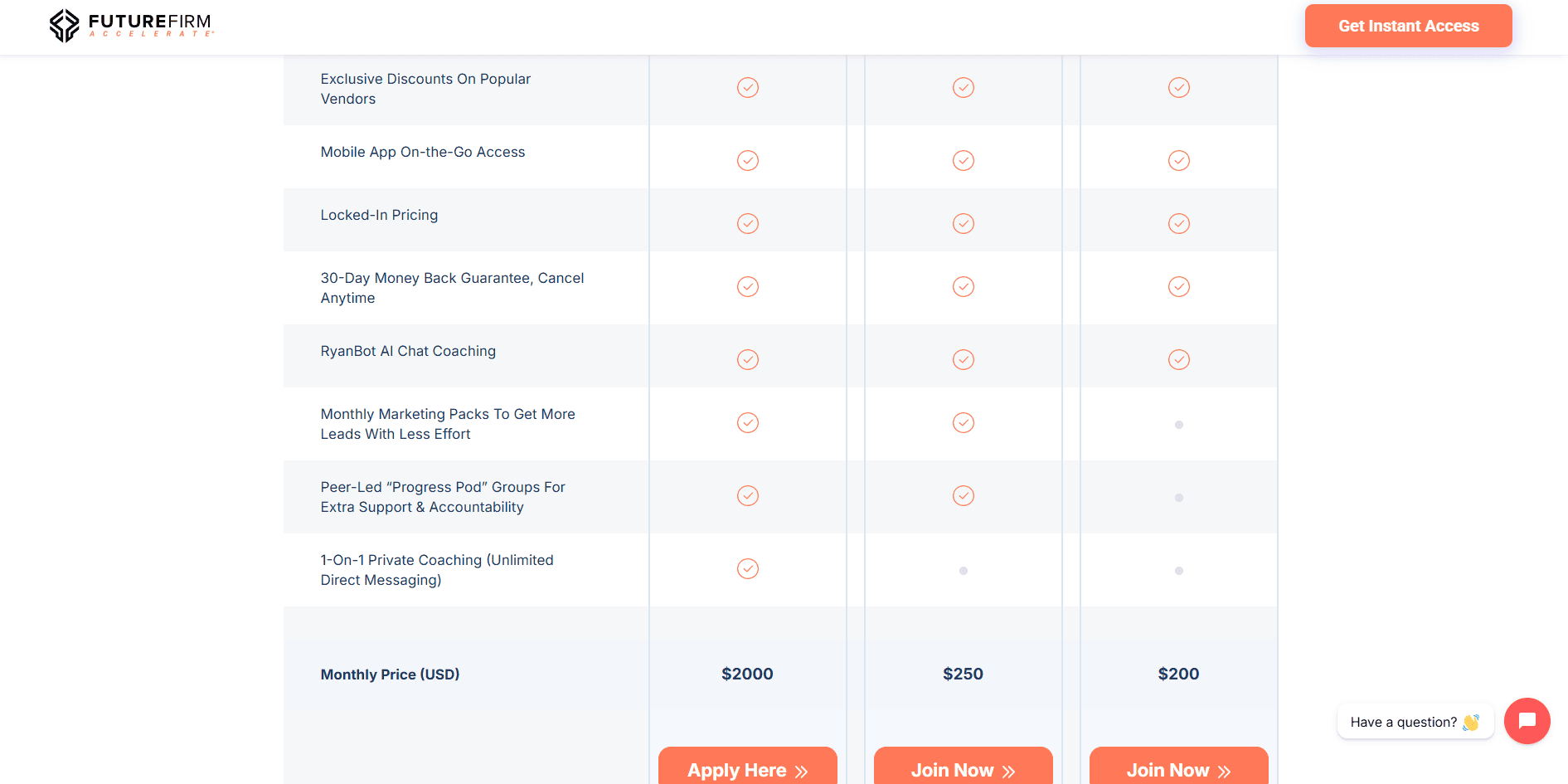
Most, though, don’t put any numbers on the page at all.
So, what can you expect in this market on average? The following benchmarks are for general-market business coaching, not just accounting business coaching:
- Monthly retainers: From $500 to $5,000 depending on the coach’s expertise and service level
- Hourly rates: $272 per hour
- High-end programs: From $10,000 to $100,000 per month
Don’t evaluate these numbers against your current comfort level. Instead, evaluate them against one repriced client relationship.
Here’s an example. If coaching costs you $2,000 a month and helps you move a single mid-sized client from a $4,000 annual compliance fee to a $1,200 monthly advisory retainer, that one change covers the year. Everything after that is margin you weren’t going to get by billing more hours.
This math for coaching pricing is worth doing before the sales call, not during it. Even if you don’t know what the potential coach is charging, you should have numbers on what pricing will be worth it to you.
If you’re curious how coaches themselves arrive at these numbers, our guide on how to price your coaching services breaks down the logic from the other side of the equation.
How to Choose the Right Business Coach for Your Firm
This coaching niche is small enough that you can properly evaluate your options instead of just picking whoever ranks first. Below is what to look for to make the right choice for you.
1. Direct accounting/CPA firm-running experience
The ideal coach will have actually run, led, or worked inside a professional services firm, not just coached one. They’ll understand billable-hour culture, Work-in-Progress (WIP) write-offs, staffing around deadlines, and client renewal cycles.
A generalist may need to spend the first two months getting up to speed on your industry without that insider knowledge.
2. A specific plan for the pricing conversation
Most of the coaching value lives here, and it’s where a lot of coaches go vague. Ask your potential coach what their process looks like for repricing an existing client.
If the answer is mostly about confidence and mindset, keep looking. You want scripts, sequencing, and a plan for the client who says no.
3. Willingness to plan around busy season
A coach who proposes the same weekly call every week of the year hasn’t thought about your accounting calendar. Good coaches front-load the work into the fall, go light in February through April, and use the post-deadline window for bigger structural changes.
4. Referenceable outcomes from a firm your size
A coach who’s transformed 40-person firms may not be the right fit for a 3-person practice, and vice versa. Ask to speak with a client whose firm looks like yours.
5. Transparent about cost before the sales call
You don’t need a published price list, since, as we’ve covered before, those are hard to find. But you do need a ballpark when you ask about pricing.
A coach who refuses to give any range until you’ve sat through a 60-minute call is running a sales process, not a consultation.
6. Prices their own coaching the way they'll teach you to price
This can be revealing. If a coach is going to teach you value-based pricing and packaged retainers, but bills you by the hour, something isn’t lining up.
Here are a couple of reference points as you research. Future Firm’s Ryan Lazanis posted a list of qualities to look for in a CPA coach, which is a useful comparison against your own criteria. Also, CoachFirm uses a structured framework that spans sales, operations, money, and employees, which gives you a sense of what a defined methodology looks like compared to an open-ended conversation.
To make this search process easier, we’ve put together a free resource: Should You Hire a Business Coach? Self-Assessment Checklist for Accounting Firm Owners. It walks you through where your time is actually going, what’s still not delegated, your current pricing model, team and systems gaps, a budget check, and a list of red flags when interviewing potential coaches.
Free Self-Assessment: Should You Hire a Business Coach? (2026)
A fill-in checklist for accounting firm owners: where your time goes, what’s not delegated, your pricing model, team and systems gaps, a budget check, and red flags to watch for when interviewing coaches.
Get the free template → Download as PDF
This button allows you to copy our Google Docs template
Signs It's Time to Hire a Business Coach
The following 4 patterns tend to come up when accountants need a business coach:
- Revenue has stalled, despite long hours. That’s a structural problem, not a lack of effort on your part.
- You’re still billing hourly with no real path to raise prices. You know your rates are too low, but nothing has changed because you don’t know the path forward.
- Your team turns over, or there’s no delegation at all. Either way, no one’s trained to own what you own, so you’re stuck holding the ball.
- You’re dreading the next busy season, but have no plan to make things different. If next January is going to look exactly like the last one, and that makes your stomach drop, that’s the clearest signal on this list.
If you can relate to most of the above, it may be time to find your coach.
How to Become a Business Coach for Accountants
Now, what if you’ve been reading this and thinking, “Hey, I could do this coaching thing”? Well, you’re not wrong. Business coaching for accountants is a small, underserved niche with a clearly motivated buyer, so let’s walk you through it.
Paperbell is the simplest way to start selling your coaching online. Try Paperbell for free to launch your accounting business coaching practice today.
Do You Need to Have Run Your Own Firm?
There isn’t a single gate on business coaching, accounting or otherwise.
Credibility in this niche comes from one of two directions, ideally both. The first is direct accounting or CPA firm experience. The second is a recognized coaching credential, like one from the International Coaching Federation (ICF) or equivalent, paired with true industry knowledge.
Firm ownership helps, but it isn’t required. What’s required is that your clients believe you understand their world, because they’ll test that in the first 10 minutes of a discovery call.
A Real Example: Casey Chung
Before starting Casey Chung Coaching, this expert spent years in external audit and staff training/performance-management at a Big 4 firm. He then became ICF-certified through the University of British Columbia’s coaching certification program to obtain coaching-specific training.

He now provides CPA career and life coaching to accountants from a range of backgrounds, and his path is a great example of what’s possible. Get your years in the industry first, then obtain coach training, and finally, open a focused practice.
Why Become a Business Coach for Accountants Now
Let’s look back at that advisory statistic we discussed earlier. When 79% of accountants expect strategic advisory work to grow, a very large number of firm owners are actively trying to make a transition they’ve had no training for.
That’s a real opening for someone who has solid experience in the industry.
Also, LinkedIn Talent Insights found 10.4% one-year hiring growth for tax roles within the “professional training and coaching” sector, as cited by Intuit. This indicates hiring growth in that sector, and you can read this as a signal of movement between accounting and training work, not necessarily how many accountants are leaving their practice to coach.
What a Starter Package Might Look Like
You can use the pricing data from earlier as your benchmark, not an exact rule.
For this niche, a monthly retainer is the most natural fit. This generally runs from $500 to $5000 per month, and you can set your pricing depending on how much experience you have as well as the level of support you’ll provide.
Session-based models can work, too, especially if you’re coaching individual accountants on career and leadership instead of coaching entire firms. Just know that per-session pricing caps your income the same way hourly billing caps accountants.
Whatever you choose, build the seasonality into it. A 12-month retainer with a lighter cadence from February to April will make more sense (and be more sellable) than wishing your CPA clients can do deep work in the middle of tax season.
As you grow, high-end coaching packages and executive coaching packages are useful models for how specialized niches structure their higher tiers.
Get Started as a Business Coach for Accountants
Becoming a business coach for accountants is a real specialty that takes time to build, and not an overnight pivot. But once you’ve landed your first client or two, the work becomes logistical, and fast.
You’ll need coaching packages someone can buy without a back-and-forth email thread. You’ll need a coaching contract that covers scope, cancellation, and what happens when a client goes dark for 6 weeks in tax season. You’ll need scheduling that respects a CPA client’s own calendar. And you need to get paid automatically instead of chasing invoices.
Paperbell handles that entire workflow in one place: packages, contracts, scheduling, payments, and more. When you’re ready to put those pieces into place, try Paperbell for free and set up your first accounting-focused package before your first client even asks how to pay you.
FAQs about business coaching for accountants
What's the difference between a business coach and a consultant for an accounting firm?
A consultant usually solves one specific problem and then leaves, like implementing new software or restructuring a service menu. A business coach works with you over months, holding you accountable as you make changes, which is often why the changes actually stick once busy season hits again.
How much does business coaching for accountants cost?
Accounting-specific coaches rarely publish their pricing (Future Firm is one exception, with numbers a step into its sales funnel), so there's no clean industry number to point to. General business coaching runs roughly $500 to $5,000 a month depending on the coach's experience, according to a 2025 business coaching cost guide. If a coach won't give you even a ballpark before a sales call, it's worth asking directly.
Can a coach actually help during busy season, or is it a bad time to start?
Most firms get more out of coaching when they start before their next busy season, not in the middle of it, so pricing changes and systems are already in place before the crunch hits. A good coach should ask about your firm's seasonality upfront rather than expecting the same weekly cadence all year.
Do I need a coach who's a CPA themselves?
It's not required, but it helps a lot. A coach who's actually run an accounting or CPA firm understands things like billable-hour culture, client renewal cycles, and staffing around tax deadlines in a way a generalist business coach usually doesn't. It's one of the first things worth asking about.
Is business coaching worth it for a small firm, not just a big practice?
There's no independently confirmed return-on-investment figure specific to accounting-firm coaching, so we won't promise a number here. Look instead at the concrete signals: is growth stalled, is there still no path off hourly billing, is the team turning over? If those apply, coaching is worth exploring regardless of firm size.
Can an accountant become a business coach themselves?
Yes, and there's a real path here. Accountants who've run their own firm, or led a team through one, already have the credibility and industry-specific insight to coach other accountants. There's no single certification that gates this: it usually comes down to direct accounting experience, a coaching credential like the International Coaching Federation (ICF), or both.