
Figuring out what to charge can feel like the most awkward part of launching a coaching business.
You’re searching around, seeing wildly different numbers, and wondering whether the $150/hour you saw on someone else’s website is realistic, or if you’re leaving thousands of dollars on the table by even considering it.
The good news? There are real patterns in how coaches price their services. And once you understand where you fit in, setting your rates gets a lot less stressful.
In this guide, we’ll cover the most common pricing models, share real 2026 rate benchmarks from Paperbell sales, and walk you through a simple strategy for getting your pricing right at every stage of your business. We’ll also touch on group coaching pricing, what to do when it’s time to raise your rates, and how to set up your packages so clients can actually book and pay you without the back-and-forth.
2026 Coaching Rate Benchmarks From Real Sales
Before getting into strategy, let’s answer the question most coaches are actually Googling: what do other coaches charge?
We looked at every coaching package sold through Paperbell over the last 12 months to see what clients actually paid. Here’s how package prices spread out across 704 coaches who sold a package of two or more 1:1 sessions, paid in full (more on why packages beat hourly below):
| Where a coach sits | What their typical package sold for |
|---|---|
| Lower quarter | Under $367 |
| Middle half | $367–$1,500 |
| Typical coach (the median) | $736 |
| Top quarter | $1,500 or more |
| Top 10% | $3,000 or more |
A typical package was 6 sessions of 60 minutes, which works out to about $147 an hour. Rates vary by niche: leadership and executive coaches typically sold packages for $1,250, while life and health coaches sat nearer $500 and $450. You’ll find the full breakdown by niche, package size and payment type in our 2026 coaching rates data.
Not sure where you fit? Don’t worry. The sections below will help you figure that out.
Want to get your pricing set up so clients can book and pay without you chasing anyone? Try Paperbell for free.
Types of Coaching Services
How you package your coaching affects your pricing, so it helps to be clear on what you’re actually selling before you decide what to charge.
Most coaches offer some combination of:
- One-on-one coaching packages: a set number of sessions over a fixed period (most common)
- Group coaching programs: coaching multiple clients at once, usually at a lower per-person price
- Intensives or VIP days: a single high-touch session, often half-day or full-day
- Ongoing retainers: monthly access, often including async support between sessions
- Digital courses or self-study products: not coaching directly, but often sold alongside it
The pricing models below apply to all of these, though package pricing is the most common structure for one-on-one work.
Types of Pricing for Coaching Services
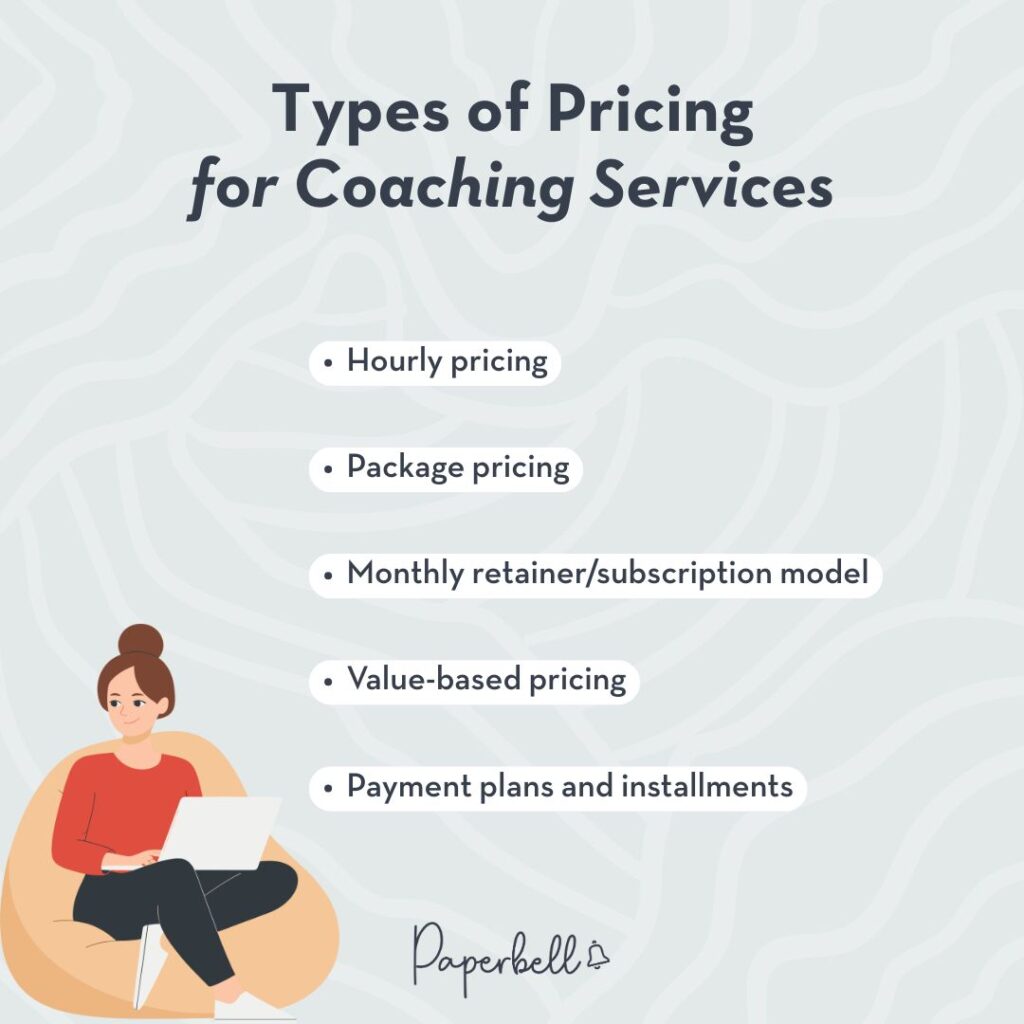
1. Hourly pricing (and why most coaches should avoid it)
Charging by the hour is intuitive. It’s how most services are priced. But it creates a problem for coaches specifically.
When you charge hourly, you’re selling your time. And that creates a weird dynamic where clients start counting minutes and wondering whether each session is “worth it.” It also caps your income, because the only way to earn more is to take on more hours.
Most experienced coaches recommend moving away from hourly pricing as quickly as possible. It’s fine when you’re just getting started (or for a very specific, time-boxed service), but package pricing is almost always a better long-term model.
If you do charge hourly: in Paperbell’s sales data, a single coaching session typically sold for $140, and the middle half of coaches charged between $75 and $200. Business and leadership coaches earn more per hour than most.
2. Package pricing (recommended for most coaches)
Package pricing bundles a set number of sessions into a fixed-price program. Think “6 sessions over 12 weeks” or “8 sessions over 3 months.”
This is the gold standard for most coaches for a few reasons:
- Clients get a clear outcome, not just a collection of sessions
- You can price for the transformation you deliver, not just your time
- It creates commitment on both sides: better results, better testimonials
- It’s easier to fill your calendar with 5 package clients than 20 hourly sessions
Looking at 2026 package pricing (see the table above), the typical multi-session 1:1 package sold for $736, and the top 10% of coaches sold packages for $3,000 or more.
3. Monthly retainer/subscription model
A retainer gives clients ongoing access to you for a fixed monthly fee. This might mean a set number of calls per month plus async messaging, or a single monthly call with email check-ins in between.
Retainers work well for clients who want ongoing support (rather than an intensive program) and for coaches who prefer predictable recurring revenue. Typical monthly retainers run $500–$2,500+, depending on what’s included.
The downside: scope creep. Make sure your retainer agreement is crystal clear about what’s included and what isn’t.
4. Value-based pricing
Value-based pricing means setting your rate based on the outcome you help clients achieve, not the number of hours you spend with them.
Think about it this way: if a business coach helps a client add $200,000 in revenue, charging $5,000 for the program isn’t “expensive.” It’s a very good ROI. The coach’s time might be 20 hours. But the value delivered is massively higher than what hourly math would suggest.
Value-based pricing works best when you:
- Have a clear, specific outcome (revenue growth, promotion, weight loss, a finished manuscript)
- Have testimonials and case studies to back it up
- Work with clients who understand ROI thinking
It’s not a fit for every coach or every niche. But when it clicks, it’s the model that tends to get coaches to the premium tier fastest.
5. Group coaching pricing
Group coaching is one of the most effective ways to increase your income without adding hours. Instead of coaching clients one at a time, you coach a small group together. Each person pays a lower rate than 1:1, but your total revenue per hour goes up significantly.
A quick example: a $3,000 1:1 program for one client earns $3,000. A $1,500 group program with 12 participants earns $18,000. Same content, same time investment on your end.
Group coaching programs typically price at a 40–70% discount from your 1:1 rate. So if your 3-month 1:1 package is $3,500, a group program version might run $1,200–$2,000 per person. Group size matters: the smaller and more intimate the group, the closer it can be priced to 1:1.
What makes group coaching work:
- A focused topic where peer learning adds value (not just 1:1 work split across a group)
- A clear cohort start date and end date to create urgency
- A capped group size, usually 6–15 people, to keep the coaching quality up
Paperbell handles group coaching packages natively, so you can set your group size, price, and payment plan in one place without needing separate tools.
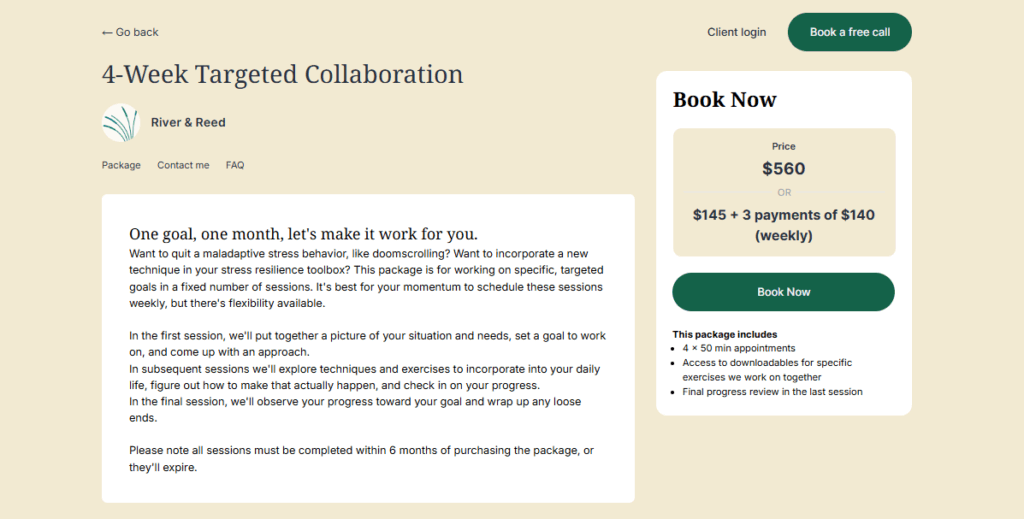
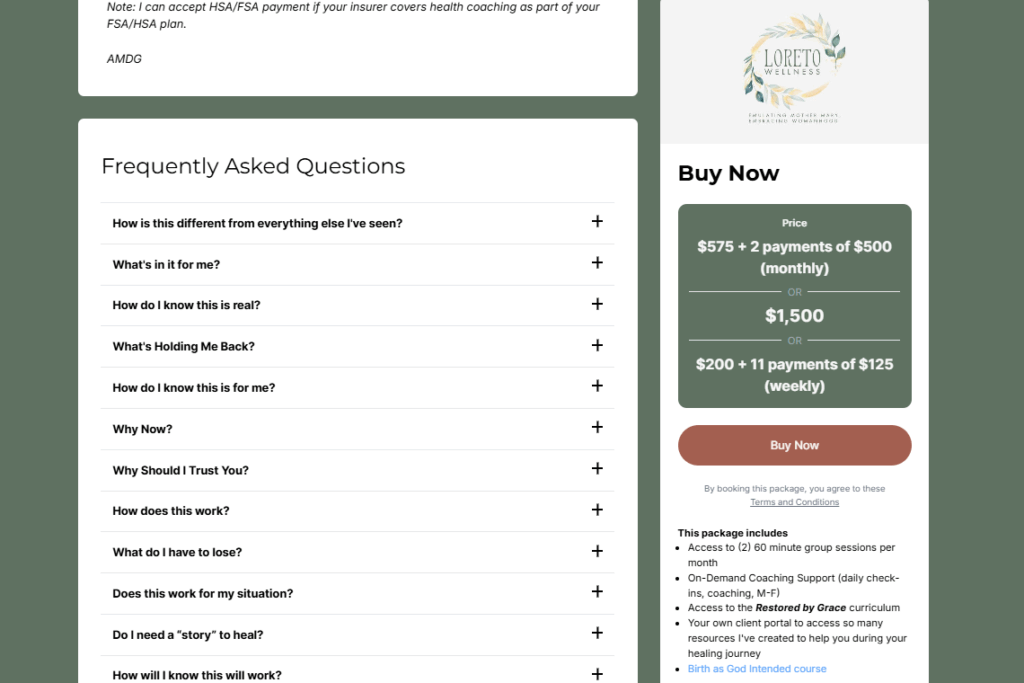
6. Payment plans and installments
Payment plans aren’t a pricing model on their own. They’re a way to make any pricing model more accessible.
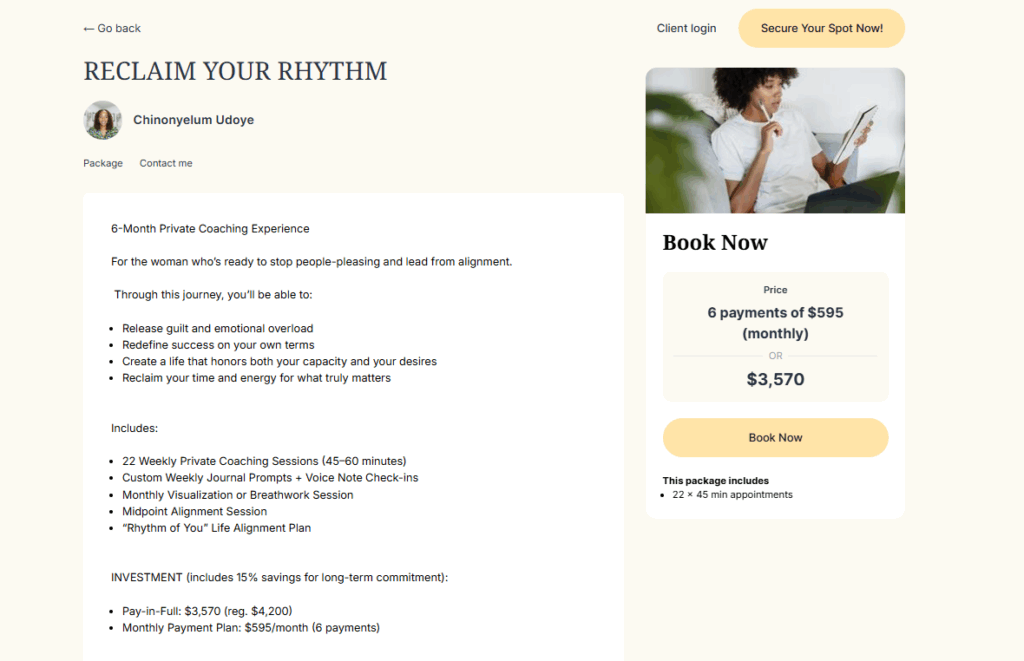
Instead of paying $4,000 upfront, a client might pay $1,500/month for 3 months. The total price is the same (sometimes slightly higher to account for the added flexibility); the barrier to entry is much lower.
Offering payment plans almost always increases conversions. The clients who need 3 months to pay $4,000 are often just as committed as the ones who pay upfront. They just have a different cash flow situation.
Factors That Affect Your Pricing Strategy
1. Your experience level and credentials
New coaches often undercharge because they feel like they haven’t “earned” higher rates yet. But your price isn’t just about your credentials. It’s about the transformation you’re helping clients achieve.
That said, experience and certifications do affect what the market will bear. Entry-level coaches building testimonials naturally start lower. As you accumulate results and referrals, your rates can (and should) go up.
2. Your niche and target market
Niche matters enormously for pricing. A general life coach and an executive leadership coach might deliver similarly transformative experiences, but the market rates are completely different because the client’s ability and willingness to pay differs.
Business coaches, executive coaches, and career coaches working with high-earning professionals typically command higher rates than wellness or general life coaches. This isn’t a value judgment. It’s a reflection of who the client is and what the outcome is worth to them financially.
3. Geographic location and target audience income
This matters less than it used to, since most coaching is now done virtually. But it still comes into play if you primarily serve clients in a specific region or industry.
A coach working with tech executives in San Francisco has a different pricing ceiling than one working with schoolteachers in rural areas. Know your market.
4. The transformation you provide (not just your time)
This is the most underused lever in coaching pricing.
When coaches say they don’t know what to charge, they’re often thinking about their time: “I can’t charge $5,000 when I’m only spending 10 hours with someone.” But the right question is: what is the outcome worth to the client?
A client who goes from $80K to $150K in salary after a career coaching engagement didn’t just buy 10 hours of your time. They bought a $70,000 annual raise. Framing your pricing around that outcome, not your hourly cost, is what gets coaches out of the entry level tier.
5. Market rates in your coaching specialty
You don’t need to price below market to compete, but you do need to know what the market looks like. Research coaches in your niche who are one or two tiers above you and see what they charge. That’s your roadmap.
Our 2026 coaching rates data breaks down what coaches actually sold packages for by niche, if you want real benchmarks to reference.
6. Your business goals and desired income
Work backward from what you actually want to earn. If you want $100,000 a year and you’re working with 10 clients at a time, your average package price needs to be $10,000. If that feels too high right now, either adjust the income goal or figure out what needs to change for you to credibly charge $10K.
Most coaches find this exercise clarifying. The math doesn’t lie.
7. Confidence level (and how it grows with experience)
Confidence isn’t just a soft skill. It shows up in how you price, how you present your packages, and how you handle pricing conversations. Undercharging often isn’t about what the market will bear. It’s about not fully believing in the value you provide yet.
The fix? Get client results, get testimonials, and raise your rates. Then repeat. Confidence follows evidence.
The Simple Strategy to Get You Started With Your Coaching Prices
Here’s a practical framework that mirrors how most successful coaches price through the different stages of their business.
Phase 1: Penetration pricing
When you’re brand new, your job isn’t to charge top-of-market rates. It’s to get clients, get results, and get testimonials.
Start lower than you think you should. Not free (free devalues what you do), but at a price that’s easy for early clients to say yes to. Think $500–$1,500 for a package. You’re buying testimonials, not making your fortune yet.
The goal of this phase is to build your case study library. You can’t charge premium rates without evidence of premium outcomes.
Phase 2: Necessity pricing
Once you have a few clients and some testimonials, raise your rates to a level that covers your costs and pays you a reasonable salary. This is where most coaches sit for the first few years of their business.
At this stage, you’re no longer just buying testimonials. You’re running a real business. Mid-tier rates ($2,500–$6,000 for a 3-month package) are typical here. You should also have a clearer niche and a repeatable way to get clients.
Phase 3: Premium pricing
Once you have a track record, a full client roster, and people on a waitlist, you’ve earned the right to raise your rates significantly. Premium coaches charge what would have felt ridiculous when they started: $8,000, $15,000, $25,000 for a program.
How do you know when you’re ready? When you can fill your roster at your current price without trying very hard, it’s time to raise it. Scarcity is the signal.
When (and How) to Raise Your Coaching Rates
Raising rates makes most coaches anxious. They worry existing clients will leave, new clients won’t sign on, and the whole thing will fall apart.
Here’s what actually tends to happen: nothing dramatic. Most clients who are getting results don’t leave over a 20–30% rate increase. And new clients at the higher rate are often more committed, not less.
A few signs it’s time to raise your rates:
- Your roster is consistently full
- You’re getting referrals without asking for them
- You haven’t raised your rates in 12+ months
- Your results with clients have gotten significantly better since you set your current prices
How to do it without drama:
- Give existing clients plenty of notice (30–60 days)
- Grandfather them at their current rate for one renewal if you want to reward loyalty
- Start charging the new rate immediately for all new clients
- Don’t apologize for it. Just announce it matter-of-factly
Rate increases are normal. The coaches who avoid them are the ones who wake up years in, still charging what they charged when they were just starting out.
What tools can I use to sell my coaching packages once they’re priced?
For coaches selling multi-session or group packages, Paperbell puts the payment, your signed coaching contract and the first booking into one checkout, and it can split the price into a payment plan if you connect Stripe. If you only need to collect a one-off payment, a Stripe payment link is simpler. A scheduler like Acuity Scheduling or Calendly fits when you mostly sell single sessions, and HoneyBook or Dubsado suit coaches who’d rather send each client a proposal and an invoice.
Paperbell
In Paperbell, you sell packages (a single session, a multi-session program or a group program) that clients buy through a checkout. Inside that checkout, your client can sign your contract before paying and book their first session in the same flow.
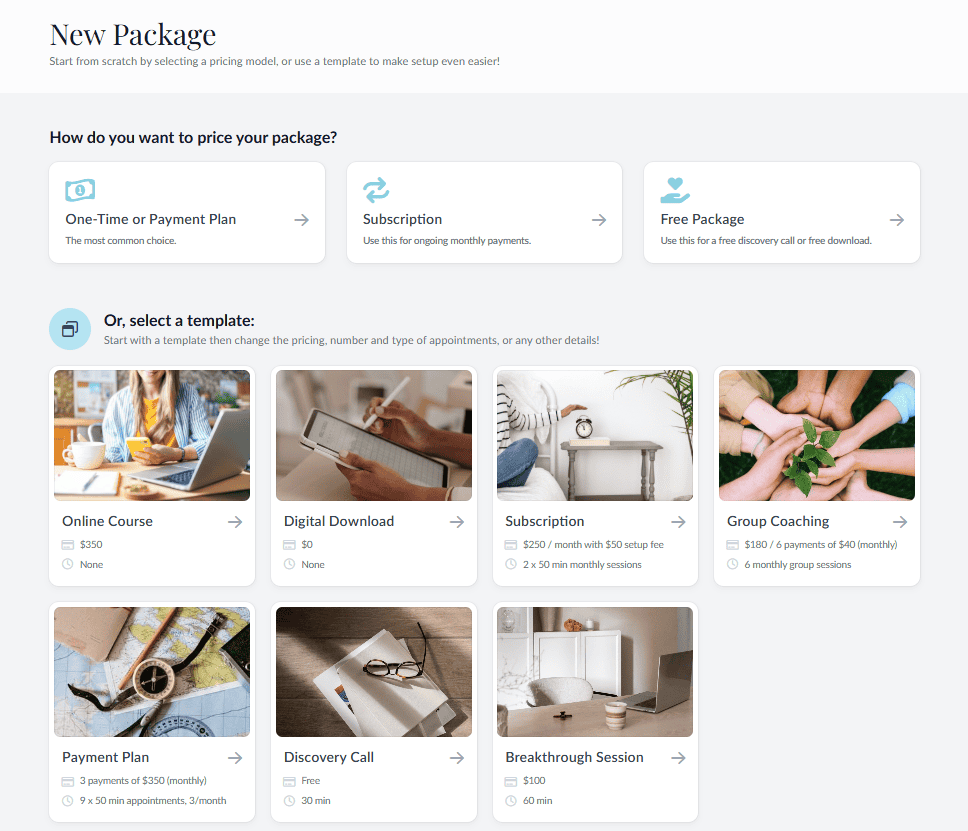
You connect your own Stripe or PayPal account to collect the money. A group program can be capped at the size you want, and you can put more than one price on a package, like a pay-in-full price next to a payment plan, with each installment charged to the client’s card automatically.
Best for: Coaches running group programs or multi-session packages, often on a payment plan, who’d like the sale, the contract and the first booking to happen in one sitting.
The catch: Payment plans, subscriptions and coupons all depend on Stripe, and with PayPal connected you can only take one-time payments. There are no invoices either, so it’s an awkward fit if most of your clients pay a custom amount.
Stripe Payment Links
Sometimes the only job is collecting the money. Stripe Payment Links turn a price into a shareable checkout link for a one-time or recurring payment, with no website or code needed. You can paste it into an email, a text or anywhere else your client will see it.
Best for: A brand-new coach selling a single session or a pay-in-full package to a handful of clients.
The catch: It takes the payment and nothing else. Stripe’s page doesn’t mention contracts, scheduling or installment plans, so you’ll book the sessions and collect the signed agreement separately, then keep track of who’s done what.
Acuity Scheduling (or Calendly)
Acuity Scheduling starts from the calendar. Clients pick a time and pay upfront (or leave a deposit) through Stripe, Square or PayPal, and you can sell appointment packages and subscriptions, add intake forms and offer discount codes. If you already book through Calendly, it can also collect payment at booking through Stripe or PayPal.
Best for: Coaches who mostly sell individual sessions or small bundles and want the client to pay at the moment they book.
The catch: Both are built around booking rather than agreements. Acuity can ask clients to accept your terms and cancellation policy when they book, but a full coaching agreement usually goes out separately.
HoneyBook (or Dubsado)
HoneyBook is aimed at small service businesses, coaches included. It sends proposals, contracts and invoices together, with a scheduler and a client portal alongside. Dubsado is much the same, and it also offers payment plans with automated reminders.
Best for: Coaches whose offers change from client to client, so a proposal and an invoice make more sense than a fixed package.
The catch: They’re made for every kind of service business, not specifically for coaches selling multi-session packages. Expect to do more of the setup yourself, and to bill through proposals and invoices.
Before you choose, check each option against the pricing decisions you’ve just made: can it run the payment plans you want to offer, and can it cap a group program at your chosen size? Card processing fees apply whichever tool you pick, since the payment processor behind it charges them, so factor them into your prices.
Still deciding between payment links, invoices, payment plans and subscriptions? How to take payments as a coach walks through each one.
Price With Confidence and Get Back to Coaching
Pricing is never really “figured out” once and set forever. You’ll raise your rates as you get better. You’ll shift models as your business evolves. Sometimes you’ll charge less than you could, and that’s fine if it’s a deliberate choice.
What matters is that your prices are intentional: they should reflect the value you’re actually delivering, not be held down by fear.
Start where you are. Charge what you can credibly defend right now. Get results. Raise your rates. Repeat.
The best part? Once you have Paperbell handling the logistics, pricing is just a number in a system. No ongoing stress required.
Try Paperbell for free to set up your packages, pricing, and payment flow all in one go.
FAQ About Pricing Your Coaching Services
How much should you charge for a coaching session?
In Paperbell’s sales data, a single coaching session typically sold for $140, with the middle half of coaches charging between $75 and $200. Business and leadership coaches earn more per hour than most. That said, most coaches find that selling packages (rather than individual sessions) is more effective for both them and their clients.
How do you price yourself as a coach?
Start with what coaches actually sell for: in 2026 the typical multi-session package sold for $736, with the middle half of coaches between $367 and $1,500. Then factor in your experience, your niche, your target client’s ability to pay, and the specific outcomes you help clients achieve. Work backward from your income goal to make sure the math adds up with the number of clients you want to carry.
How do you charge clients for coaching?
The simplest approach: create a package with a clear price, a payment schedule (upfront or installments), and a booking link. Tools like Paperbell let you set this up so clients can pay and book in one step, without needing to send invoices manually. Automatic payment collection means you’re not chasing anyone for money.
What is the average price for coaching in 2026?
Averages vary widely by niche. In Paperbell’s 2026 sales data, the typical multi-session 1:1 package sold for $736. Life coaches typically sold packages for $500, while leadership and executive coaches sold them for $1,250. Group coaching programs typically run $1,000–$3,000 per person for a similar timeframe.
Which tool can I use to help with processing payments easily?
The right one depends on what you’re charging for. A Stripe payment link is the quickest way to collect a one-off fee, and Acuity or Calendly can take payment when a client books a single session. For packages with payment plans and a contract to sign, Paperbell handles all of it in one checkout (plans need Stripe), while HoneyBook or Dubsado suit you better if you’d rather bill each client by invoice.
Which tools let me offer payment plans on a coaching package?
Paperbell does. You choose how often the client pays (weekly, every other week, monthly, every other month or every three months), you can add a one-time setup fee, and each installment comes off their card automatically. You’ll need Stripe connected for plans, since PayPal only covers one-time payments. Your client signs your contract, pays and books their first session in the same checkout, so you’re never chasing anyone for money. Try Paperbell for free.