
You’ve heard of Jordan Peterson. Maybe you’ve read 12 Rules for Life, watched a lecture, or seen his name in a coaching forum. But have you actually tried the Self-Authoring Suite?
It’s one of Peterson’s less talked-about projects: a structured writing program built on decades of psychological research. And for coaches, it’s genuinely worth knowing about.
This guide walks through exactly what the Self-Authoring program is, what each module does, what the research says, the honest pros and cons, and how coaches can use it with clients.
What Is Self-Authoring?
Self-authoring is a series of structured writing programs designed to help people make sense of their past, understand who they are right now, and build a clear vision for the future. It’s an evidence-based process that turns vague introspective questions into real personal insight.
The approach draws on solid research into expressive writing. A Cambridge Core study and a National Institutes of Health report both show that writing about emotional experiences and trauma has measurable mental and physical health benefits.
When people turn their experiences into coherent stories, they tend to see reduced stress and anxiety, better academic and professional performance, and greater clarity around goals and values.
Dr. Jordan Peterson’s Self-Authoring Suite

Dr. Jordan B. Peterson developed the Self-Authoring Suite with co-founders Daniel M. Higgins and Robert O. Pihl, both clinical and research psychologists at McGill University and the University of Toronto.
The Creator Profiles:
- Dr. Jordan B. Peterson, Ph.D: Founder, Psychology Professor, University of Toronto
- Daniel M. Higgins, Ph.D: Founder, Head of Software Development
- Robert O. Pihl, Ph.D: Founder, Psychology Professor, McGill University
The suite is a series of online writing programs that collectively help you explore your past, present, and future. If you’re purchasing the entire suite, it costs $29.90.
Parts of the Self-Authoring Suite
Each part of the Self-Authoring Suite addresses a different dimension of human experience: past, present, and future.
Here’s what each program covers and how they work together for personal growth and self-awareness:
Past Authoring Program
The Past Authoring program asks you to divide your life into epochs (childhood, adolescence, young adulthood, and so on) and identify key events within each one.
You then write detailed accounts of those events, exploring their emotional impact (both positive and negative) and what you learned from them.
The past authoring program does several important psychological things:
- Integration of tough memories: By revisiting painful experiences in a structured way, you can process emotions that may have been suppressed.
- Recognition of formative influences: Understanding how past events shaped your beliefs and behaviors helps you see patterns that might be helping or holding you back.
- Story coherence: Writing your life story builds a stronger sense of self and meaning.
The goal of past authoring isn’t to dwell on the past but to put it to rest. Understanding its influence on who you are now is what makes that possible.
Pricing: $14.95
Present Authoring Program
Source: Simply Psychology
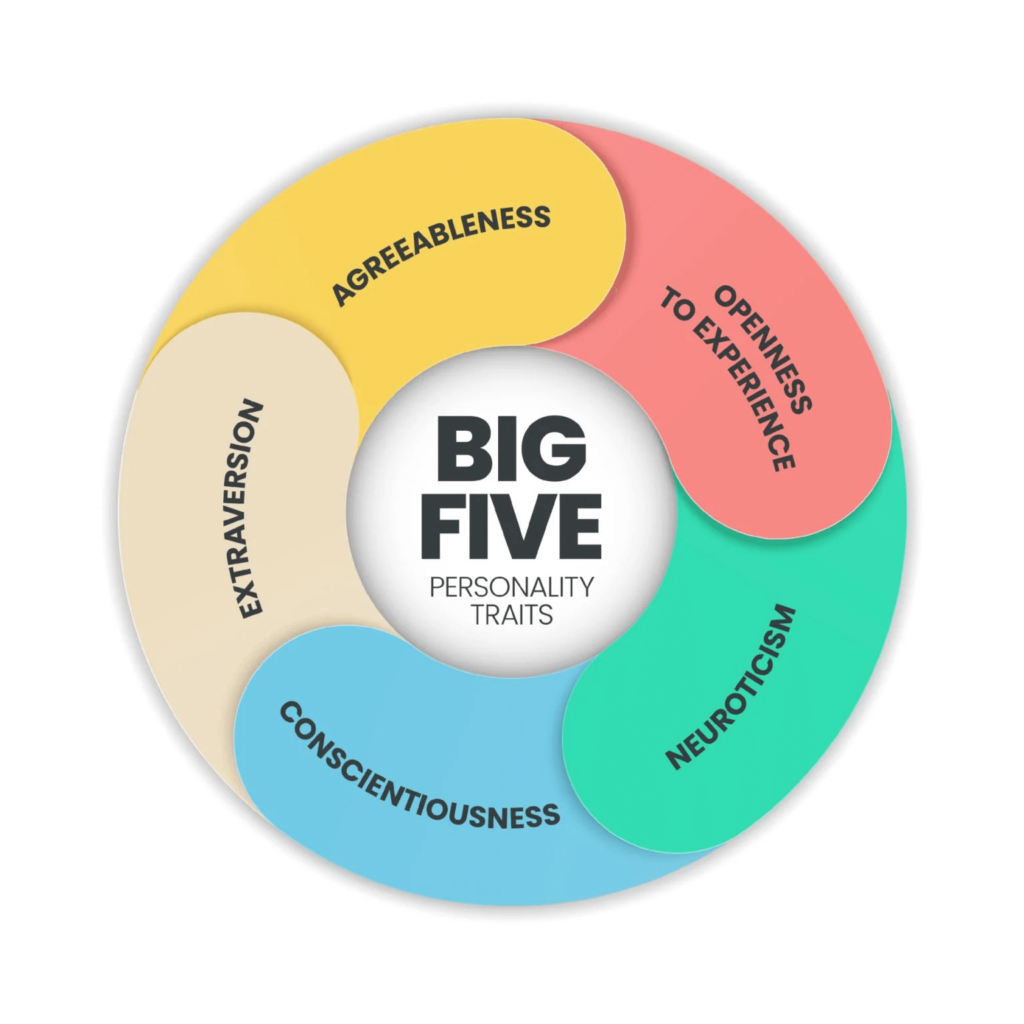
Present Authoring is structured around the Big Five personality model and consists of two separate but complementary programs:
This program helps you identify aspects of your personality that are causing problems in your life. Rather than just listing flaws, you explore how these traits show up in your behavior, what triggers them, and how they affect your relationships and goals.
Here, you examine your positive qualities and strengths: how they’ve helped you overcome challenges and achieve things you’re proud of. This builds self-awareness of what you’re actually good at and how to use those strengths more intentionally.
Together, Faults and Virtues give you a more balanced picture of yourself so you can make better, more intentional choices.
Pricing: $14.95
Future Authoring Program
Future Authoring guides you through building a detailed vision and implementation plan for your life three to five years out.
The process includes:
- Reflecting on what a good life actually looks like for you (not based on someone else’s expectations)
- Identifying the specific goals and skills you want to build
- Understanding why those goals matter to you personally
- Developing concrete, actionable plans to get there
- Anticipating obstacles and planning how to handle them
The research behind Future Authoring is solid. A study with undergraduate students found that completing an abridged version of the Future Authoring program during freshman orientation improved academic performance and retention. Only 14% of students who completed the Future Authoring program dropped out by the second semester, compared to 27% in the control group. That’s roughly half the dropout rate.
University of Toronto research also found that Future Authoring improved GPA and credits earned among undergraduates, with especially strong effects for minority and male students who typically show lower engagement. More than 10,000 people have completed Future Authoring and report reduced anxiety about the future.
Pricing: $14.95
How They Work Together
Each program is available separately, but you’ll get a lot more from doing all three.
Together, they create a complete arc:
- Past Authoring helps you understand how you became who you are and work through anything that might be holding you back.
- Present Authoring (Faults and Virtues) gives you a clear picture of where you are right now, strengths, blind spots, and all.
- Future Authoring channels all that self-knowledge into a meaningful vision and a plan to actually achieve it.
When people take the time to write carefully about themselves, they tend to become more effective at pursuing what matters most to them. Peterson says this, and so does the expressive writing research the suite is built on.
Does the Self-Authoring Program Work? What the Research Says
This is the question most people actually have, so let’s go straight to the data.
The Self-Authoring Suite is built on three decades of research into expressive writing, primarily the work of James Pennebaker at the University of Texas in Austin, whose landmark research showed that structured writing about emotional experiences produces measurable health and psychological benefits.
Peterson and his colleagues at McGill University and the University of Toronto applied this framework to goal-setting and self-development, with some notable results:
- A study at Mohawk College found that students who completed an abridged Future Authoring exercise during orientation had a dropout rate of 14% vs. 27% for the control group, nearly half.
- University of Toronto research showed that the Future Authoring program improved both GPA and credits earned among undergraduate students, with especially strong effects for minority and male students who typically show lower engagement.
- The Cambridge Core / Advances in Psychiatric Treatment review of 146 expressive writing studies found consistent reductions in stress, anxiety, and physical health complaints across populations.
The caveat: most of the strongest research is on Future Authoring, and specifically on students in academic settings. The evidence for Past and Present Authoring is more mixed and harder to study in controlled settings. That’s worth knowing going in.
Time Commitment: How Long Does the Self-Authoring Program Take?
This comes up a lot, so here’s an honest breakdown based on the program’s own guidance and what real users report:
- Past Authoring: Roughly 4–6 hours total. The more thoroughly you write, the longer it takes.
- Present Authoring (Faults + Virtues): Around 2–3 hours for each component, so 4–6 hours combined.
- Future Authoring: Around 4–6 hours, though some people take significantly longer when they go deep on the planning sections.
Most people spread the work across several weeks, doing it in one-to-two hour sessions. That’s actually how the program is designed. Cramming it all into a weekend defeats the purpose of sitting with each section.
If you’re recommending this to coaching clients, that’s worth flagging upfront. This isn’t a 30-minute quiz. The time investment is part of what makes it work.
Self-Authoring Pros and Cons
Most reviews of the Self-Authoring Suite focus on the positives. Here’s a more balanced take.
What Works Well
- Evidence-based structure: The prompts aren’t random journaling questions. They’re built on research-backed frameworks, which gives the process real depth.
- Affordable: At $29.90 for the full suite, it’s genuinely cheap compared to what most personal development programs cost.
- Self-paced: No live sessions, no scheduling, no one waiting on you. You can work at your own pace and revisit your writing anytime.
- The Future Authoring module is especially strong: This is where the research evidence is clearest and where most people report the biggest shifts.
- Unique coaching tool: There’s very little else like it at this price point for generating client self-insight between sessions.
What to Watch Out For
- No human support: There’s no coach, therapist, or community built in. If difficult memories surface during Past Authoring, there’s no one to process them with. For clients with trauma history, this matters.
- Requires self-motivation: The program doesn’t hold your hand. If a client tends to abandon self-paced work, this probably won’t finish.
- Writing-heavy: People who struggle with written expression will find this harder to benefit from. The program is designed around text, full stop.
- Interface is dated: The website and user experience haven’t been updated in years. It functions fine, but it doesn’t feel modern.
- Peterson’s public profile: Depending on your client base, some people have strong feelings about Jordan Peterson as a public figure. That’s worth being aware of if you’re recommending this.
Is Jordan Peterson’s Self-Authoring Program Worth It?
When deciding whether to invest in the Self-Authoring Suite (or recommend it to clients), you need to know what you’re actually getting and who benefits most.
What’s Included in the Program
When you buy the Self-Authoring Suite, you get:
- Access to all four modules (Past, Present-Faults, Present-Virtues, and Future Authoring)
- Structured writing prompts for each module
- A secure online space to write and save your responses
- The ability to revisit and revise your writing any time
This is fully self-paced with no live components or interaction with the creators. That makes it more accessible and affordable than most personal development programs, but it does require self-motivation.
Who Gets the Most Out of Self-Authoring
Based on the research and real-world reviews, certain people tend to get a lot from this program:
- People at transition points: Major life changes (career shifts, ending relationships, finishing school) make the structured reflection especially valuable for finding clarity.
- Those seeking direction: If a client feels lost or uncertain about their path, Future Authoring can be genuinely clarifying for priorities and next steps.
- People processing difficult experiences: Not a therapy replacement. Past Authoring can help make sense of tough events in a constructive way, especially when paired with coaching support.
- Students and young adults: The research is clearest here. Young people still forming their identity and direction see the strongest measurable results.
It may be less useful for clients who struggle with written expression, prefer interactive personal development, or have significant trauma that needs professional therapeutic support.
Self-authoring can strengthen the coaching relationship by giving clients a private space to reflect deeply between sessions. When clients come to a coaching session having already processed some of their past experiences and articulated what they want, the conversation gets more focused and more productive.
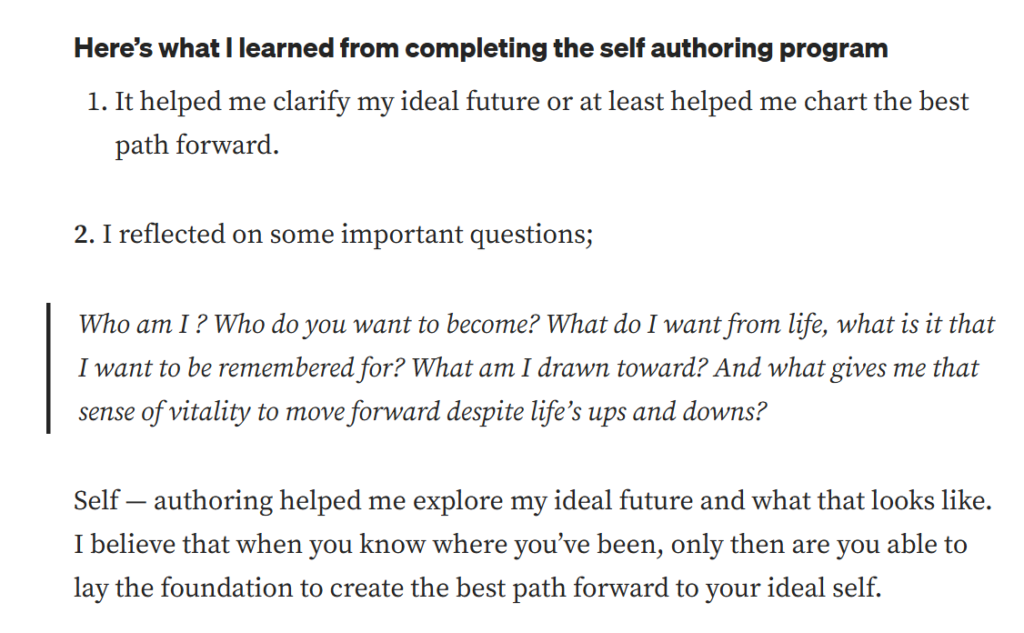
The verdict: At $29.90 for the full suite, it’s hard to argue against trying it. The Future Authoring module alone is worth that price: the dropout and GPA research is genuinely compelling. For coaches, it’s one of the few tools you can recommend that’s both affordable for clients and backed by solid research.
Source: Nelisiwe Zangana
Free Alternatives to the Self-Authoring Program
$29.90 is pretty cheap for a structured personal development program. But if cost is a barrier for your clients, or you want to test the approach before recommending it, there are some genuine free alternatives worth knowing about.
Pennebaker Expressive Writing
James Pennebaker’s original expressive writing protocol is free and proven. The basic version: write for 15–20 minutes per day for four consecutive days about your deepest thoughts and feelings related to a difficult experience. Research consistently shows measurable psychological and physical health benefits from this simple exercise. It’s less structured than Past Authoring but draws on the same foundational research.
Free Narrative Therapy Worksheets
Narrative therapy (the practice of re-authoring your life story) offers free guided worksheets online. The free narrative therapy worksheets and techniques cover externalizing problems, exploring alternative stories, and writing preferred identity documents. These themes parallel what Present and Past Authoring do in the suite.
Stoic Journaling (Morning Pages Approach)
Marcus Aurelius’s Meditations is essentially a self-authoring practice: structured daily reflection on character, goals, and values. The modern version is morning pages or a daily Stoic journaling prompt. Apps like Day One (free tier) make this easy to build into a routine. It’s less rigorous than Future Authoring but addresses similar territory around what you want and why.
The Best Possible Self Exercise
This is the closest free equivalent to Future Authoring. Research from positive psychology shows that writing for 20 minutes about your “best possible self” (imagining everything has gone as well as it could in your life five to ten years out) increases optimism, positive affect, and motivation. A 2019 meta-analysis of 29 BPS studies — building on Laura King’s 2001 research — found consistent measurable effects on wellbeing, optimism, and positive affect. No purchase required.
If you’re a coach looking to introduce self-authoring concepts to clients without the cost barrier, these are solid starting points. Many coaches use one or two of these as a free onboarding exercise, then recommend the full suite for clients who want to go deeper.
How Coaches Can Use Self-Authoring
This is where it gets interesting for life coaches. Most of the online conversation about Self-Authoring is personal, with people doing it for themselves. But as a coaching tool, it has some real advantages.
The Self-Authoring Suite can be a coaching exercise that offers several benefits for you and your clients:
- Research-backed coaching technique: You can offer a structured process grounded in real science, which adds credibility to your practice.
- Deeper insights: Self-authoring can surface patterns and priorities that might not come up in conversation alone, giving you more to work with in coaching sessions.
- Between-session progress: Clients can work on self-authoring exercises between coaching calls to keep momentum going.
- Scalability: For group coaching programs, self-authoring gives all participants a shared framework they can work through independently.
Paperbell, the all-in-one coaching platform that handles scheduling, payments, and client management which makes integrating self-authoring into your practice straightforward.

Here are some ways to do this:
- Create self-authoring exercises as writing assignments between coaching calls.
- Send automated emails to clients about their self-authoring assignments to increase completion rates.
- Use the file-sharing feature to provide custom self-authoring prompts and coaching questions to clients.
- Have clients upload their completed self-authoring exercises before sessions so you can review them ahead of time.
This keeps the client actively engaged between sessions, and means your coaching time goes toward insight and action rather than catching up.
FAQs About Self-Authoring for Coaches
What does self-authoring mean?
Self-authoring means actively writing your own life story through structured exercises. The term comes from the idea that each person can be the author of their own life, consciously shaping its direction and meaning rather than being swept along by circumstances.
Is Jordan Peterson’s self-authoring program worth it for clients?
For most clients, yes. Especially at $29.90 for the full suite. People who complete the program (particularly Future Authoring) report meaningful shifts in clarity, motivation, and direction. The academic research is genuinely strong on dropout rates and GPA improvements. Results vary depending on how seriously a client engages with the writing process.
How much is the self-authoring program?
The Self-Authoring Suite, which includes all four programs, is $29.90. Individual programs cost $14.95 each. You can buy just Future Authoring, for example, if that’s the one that applies to your client’s situation.
How long does it take to do the self-authoring program?
Each module takes roughly four to six hours, depending on writing speed and depth of reflection. Most people spread the work across several weeks in one-to-two hour sessions. Plan for ten to fifteen hours total if you’re doing the full suite, and don’t rush it. The reflection between sessions is part of the process.
Do I need special training to guide clients through self-authoring?
No special certification is required to offer self-authoring as part of your life coaching practice. That said, you should complete the program yourself first so you understand what clients are experiencing. If a client has significant trauma history, consider whether they’d benefit from therapeutic support alongside the process.
Can I create my own self-authoring exercises for clients?
Yes. Many coaches create guided writing exercises inspired by self-authoring, tailored to their specific coaching niche. You can build these into a life coach workbook that reflects your approach and language. That’s actually one of the more creative ways to use this framework without asking every client to sign up for the suite directly.
Start Your Self-Authoring Journey
Jordan Peterson’s Self-Authoring Suite is a low-cost, research-backed tool that can make a real difference for clients who are stuck, drifting, or ready to do some serious personal work.
It won’t replace coaching. But it can make your coaching sessions sharper. Clients who’ve done the written reflection come in knowing more about themselves, and that’s where real progress starts.
Ready to build self-authoring into your coaching practice? Try Paperbell for free and see how easy it is to deliver client homework, share resources, and manage everything in one place.