

You’re building something from nothing, and some days it feels like everyone’s watching you figure it out in real time. Fundraising, hiring, product, payroll, all at once, usually without a manual.
That’s where business coaching for startups comes in. A good startup coach won’t hand you a playbook. They’ll help you make sharper decisions faster, spot the blind spots you can’t see from inside your own company, and keep you steady when everything feels on fire at once.
But how is a coach different from a mentor or an advisor? What should one actually cost? And how do you tell a genuinely useful startup coach from someone with a nice website and a good headshot?
That’s what this guide covers: the types of startup coaches and what they charge, when it’s worth hiring one, and exactly how to vet the right fit for the stage you’re at.
What Is a Startup Coach?
A startup coach is a specialized business coach who works with founders and early-stage companies to sharpen their vision, make better strategic calls, and build the skills a growing company demands.
For an early-stage company, the right coach can be the difference between spinning your wheels and actually gaining traction. A good one helps you move faster, make smarter decisions, and feel confident in areas where you don’t yet have experience.
Startups fail at a high rate, so having an experienced guide in your corner improves your odds of surviving long enough to grow.
A general business coach usually works with established companies to fine-tune performance. A startup coach focuses on the messier, earlier problems that come with a brand new venture, like:
- Validating ideas: helping you test market demand and tighten your value proposition before you sink months into the wrong thing.
- Building a roadmap: setting realistic milestones and deciding what to work on first (and what to ignore for now).
- Building leadership skills: growing your resilience, decision-making, and communication as the team grows around you.
- Fundraising: pitching, meeting the right investors, and structuring deals without giving away too much.
- Scaling teams and culture: hiring well, keeping the team aligned, and protecting the culture as headcount climbs.
Here’s the key distinction. A consultant often hands you the answer. A startup coach helps you build the judgment to find your own answers, so you’re not dependent on anyone the next time a big decision lands on your desk.
Startup Coach vs. Mentor vs. Advisor
These three roles get lumped together constantly, and founders waste real money hiring the wrong one for what they actually need. They overlap, but they’re not the same thing.
Think about it this way: a mentor shares, an advisor recommends, and a coach draws it out of you.
| Startup coach | Mentor | Advisor | |
|---|---|---|---|
| What they do | Ask structured questions, hold you accountable, and help you reach your own decisions | Share personal experience and general wisdom, usually informally | Give specific, expert recommendations on a defined area |
| Relationship | Paid, structured, time-bound engagement | Often free and open-ended, based on rapport | Formal, often paid or compensated with equity |
| Focus | You as a founder, plus the decisions in front of you | Whatever comes up in conversation | A specific domain (legal, finance, go-to-market) |
| Best when | You keep hitting the same wall and need to grow how you operate | You want a sounding board who’s been there | You need expert direction on one concrete problem |
A mentor is usually a more experienced founder or operator who’s happy to grab coffee and tell you what they’d do. That’s genuinely useful, but it’s built around their story, not your situation.
An advisor gets brought in for one specific area of expertise: a former CFO on your finance model, a growth person on your paid acquisition. They tell you what to do in their lane, full stop.
A startup coach works differently. The job isn’t the topic, it’s you: how you think, how you decide, where you keep getting stuck. A coach won’t hand you the answer. They’ll ask the question that gets you there yourself, and that habit sticks around long after the engagement ends.
Most founders end up using all three at different moments. The trick is knowing which one you need right now.
5 Types of Startup Coaches
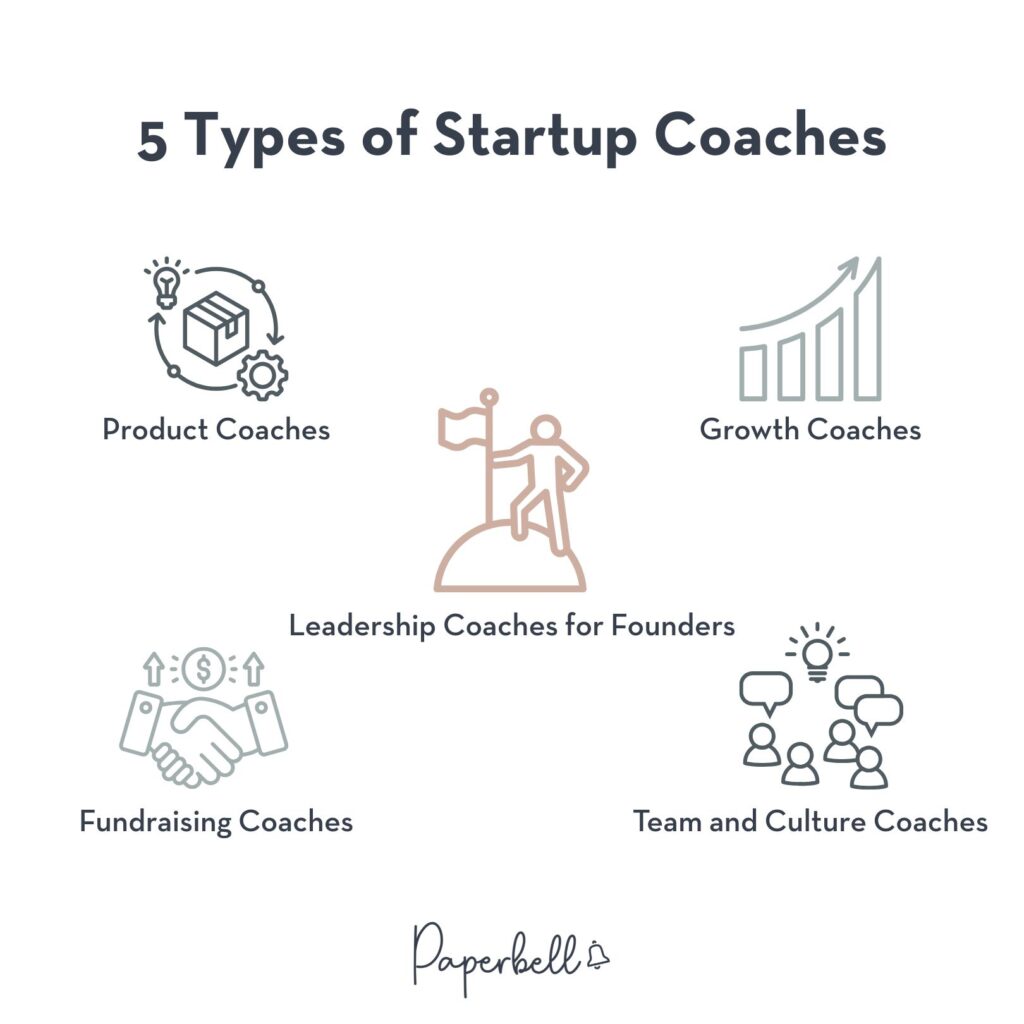
Not every startup coach does the same work. Which one you need depends a lot on where your company is right now, so it helps to match the type of coach to the stage you’re at.
Product Coaches
A product coach helps you sharpen your product vision, improve the user experience, and actually hit product-market fit. They walk teams through development, user testing, and iteration so you build something people genuinely want.
Best for: pre-seed and seed-stage founders still chasing product-market fit.
Growth Coaches
Growth coaches focus on scaling customer acquisition, retention, and revenue. They help with marketing strategy, conversion optimization, and using your data to make decisions instead of guessing.
Best for: post-product-market-fit founders ready to pour fuel on what’s working.
Leadership Coaches for Founders
Founding a company isn’t only about strategy, it’s about who you become as a leader. Leadership coaches help you build resilience, make sharper decisions, and lead well as the company scales around you.
Best for: any stage, but especially the moment you go from doing the work yourself to leading the people who do it for you.
Fundraising Coaches
Raising capital is one of the hardest parts of the job. Fundraising coaches help you build a compelling pitch deck, tighten your investor messaging, and run the raise without giving away your negotiating power.
Best for: founders heading into a seed or Series A round.
Team and Culture Coaches
As you grow, so does your team, and so do the people problems. Team and culture coaches help you build a healthy work environment, strengthen team dynamics, and shape a culture that keeps good people around.
Best for: Series A and later, when headcount is growing fast.
Plenty of experienced coaches blend a few of these. The point is to hire for the problem in front of you right now, not the one you’ll have in two years.
When It’s Time to Hire a Startup Coach
Every startup hits critical stretches where good guidance changes the outcome. A startup coach helps you get through those high-stakes moments, sidestep expensive mistakes, and make calls you won’t regret later.
Moments When Coaching Pays Off Most
A few stretches in a startup’s life are when bringing in a coach tends to matter most:
- Pre-seed to seed: early on, it’s all idea validation, customer discovery, and laying a foundation. A coach’s job here is mostly pressure-testing your assumptions before you spend six months building the wrong thing.
- Product-market fit: plenty of startups fail not from bad ideas but from never getting traction. A coach pushes you to read customer feedback honestly, instead of the version you’d rather hear, until real demand actually shows up.
- Series A and beyond: once you’re scaling, the problem shifts from surviving to managing growth. This is usually where leadership and team dynamics start to matter as much as any single strategic call.
Signs It Might Be Time for Coaching
You don’t have to be actively looking for help to need it. If any of these sound familiar, that’s worth paying attention to:
- Team conflicts: when co-founders or team members aren’t aligned, everything slows down and the mood sours. A coach can step in as a neutral third party and get everyone pointed in the same direction again.
- Founder burnout: startups demand a lot, but when exhaustion tips into chronic stress and you stop caring, it puts both the business and your health at risk. This is where a coach usually earns their fee, mostly by making you set boundaries you’d otherwise skip.
- Growth plateaus: if revenue has stalled or customer acquisition is stuck, a coach digs into what’s actually holding you back, whether that’s the business model, your pricing, or a missing hire.
- Investor pressure: once investors are in, the stakes climb. Sometimes a coach’s whole value is just being someone to talk expectations through with, so you’re not reacting to every fire in your inbox.
What Does It Cost to Work With a Startup Coach?
Startup coaching pricing swings widely based on the coach’s experience, reputation, and how much support you’re getting. Most coaches use one of three models:
- Hourly sessions: commonly in the range of $150 to $500 per hour, good for one-off decisions or a short, focused engagement.
- Monthly retainers: often $2,000 to $10,000 per month for ongoing, deeper support with regular sessions and between-session access.
- Equity-based coaching: some coaches take a small slice of equity instead of (or alongside) a fee, tying their upside to yours.
Where you land usually tracks with your funding stage:
- Pre-seed and seed: cash is tight, so founders often start with hourly sessions or shorter engagements. Some coaches offer a sliding scale based on your financials at this stage, so it’s always worth asking.
- Series A: as the challenges get deeper and more ongoing, a monthly retainer usually makes more sense than paying by the hour.
- Growth stage: here you might negotiate a blended arrangement, or bring on a coach who works partly for equity because they believe in the trajectory.
It can feel like a big expense. But the right coach helps you dodge costly mistakes and move faster, which tends to pay for itself well before the invoice does.
How to Choose (and Vet) a Startup Coach
Anyone can add “startup coach” on a website. The good ones have a track record you can actually check. Here’s how to separate the real deal from the polished pitch.
Verify Real, Specific Experience
The best startup coaches have been in the trenches themselves, as founders, operators, or investors. Look for concrete, verifiable proof, not vague claims.
- Can they name actual companies they’ve built, run, or backed?
- Have they worked with founders at your stage, not just later or earlier ones?
- Does their LinkedIn back up the story on their website?
- Will they connect you with a past client at a similar stage to yours?
A coach who has raised a round, scaled a team, or sold a company brings pattern recognition you can’t get from a certification alone.
Questions to Ask in a Discovery Call
A discovery call is your chance to test the fit before any money changes hands. Come with real questions:
- Which stage of company have you actually worked with, and can you give me an example?
- Have you been a founder or operator yourself, or is this coaching only?
- How do you structure an engagement, and what happens if it isn’t working?
- What does a typical month with you look like?
- Can I speak with a current or past client at my stage?
Pay attention to how they answer, too. A strong coach asks you as many sharp questions as you ask them.
Red Flags to Walk Away From
- Guaranteed outcomes: nobody can promise you funding or a specific revenue number. Run from anyone who does.
- Vague credentials: if they can’t name a single relevant client or result, there’s a reason.
- A one-size-fits-all program: the same rigid package for a pre-seed founder and a Series B CEO is a bad sign.
- Pushing equity before proving value: a coach angling for a big equity slice on day one, before you’ve seen results, hasn’t earned it yet.
Whatever you agree on, get the terms in writing. A simple coaching contract that spells out scope, schedule, and payment protects both of you and sets a professional tone from the start.
How to Become a Startup Coach
Gain Practical Experience
A great startup coach doesn’t necessarily need a formal coaching certification, but real-world experience in the startup world is essential.
Former founders, investors, and operators make great startup coaches because they’ve actually done it. They’ve been in the trenches, so they know how business decisions really play out.
That said, a solid grasp of coaching skills like active listening, powerful questioning, and goal-setting frameworks makes a real difference in the impact you have.
Start Testing Your Methodology
Start by offering guidance to early-stage founders in your network, whether that’s informal mentorship, an advisory role, or structured coaching sessions. Notice the challenges that keep coming up and where your advice lands hardest.
Pro bono work is also a great way to gather feedback, testimonials, and referrals to your first paying clients.
Design Your Coaching Program
Once you’ve refined your approach, package your services into a structured package.
Define the time frame and pace of your program, your session structure, and any extra support you’ll offer. Build a format that reliably gets clients to the outcome they want.
For example, your Product-Market Fit Accelerator package might include:
- 6 to 8 weeks of intensive coaching
- Market validation frameworks and exercises
- Personalized feedback on their minimum viable product (MVP)
- Metrics tracking for traction
- Ongoing accountability
Paperbell lets you set up and sell your coaching packages directly: flat payments, installments, or subscriptions, each with its own landing page, all tied together by your own coaching website.
Set Up Your Practice
To manage clients without drowning in admin, you need the right systems from day one. Otherwise you’ll spend more time on paperwork than coaching.
That’s why it pays to simplify your workflow early. Paperbell handles bookings, payments, contracts, client surveys, package materials, and automated emails in one place.
Client data lives in one place, in your Clients list, and each client gets their own portal, so you’re not stitching together five different tools just to run your practice.
Promote Your Services
Even with deep startup experience, you still have to market yourself. The best way is to show the results you create and position yourself as a trusted name in the startup space.
Start with testimonials from early clients. A few well-placed success stories on your website or LinkedIn profile are powerful proof.
Then go further with case studies that show how you helped founders through challenges like fundraising, hiring, or product-market fit. The more specific and measurable the results, the more convincing they are.
Positioning yourself as a thought leader works too. Speak at events, get on podcasts, or write for industry blogs to build credibility and give founders a taste of how you think.
Sharing insights on common startup challenges, through social posts, newsletters, or articles, keeps you top of mind for when founders are finally ready to hire a coach.
Curious how Paperbell founder Laura Roeder grew MeetEdgar into a 7-figure business while working part-time? Check out her blog on Medium. She also shares how she’s run Paperbell with no meetings or managers since 2020.
Real-World Startup Coaching Case Studies
Founders turn to startup coaches for more than business advice. They want accountability, clarity, and a bit of personal growth too. Here’s a real example of coaching making a difference.
Alex Turnbull, founder of Groove, hired a coach when a stretch of fast growth meant it was finally time to build real processes.
He wrote on his company blog, “As much as we’re proud of how far we’ve come, we’ve grown through being scrappy, moving fast and breaking things along the way.”
His coach guided the team toward the systems and processes that would let them scale in a predictable, repeatable way, and kept them accountable to it.
The takeaway: the right startup coach makes a real impact, whether that’s helping a founder past their blind spots or steering a team through the growing pains of scale.
FAQ
How much does a startup coach cost?
Startup coaching rates vary widely, commonly from $150 to $500 per session or $2,000 to $10,000 per month, depending on the coach’s experience, the scope of the engagement, and your company stage. Some coaches also work partly for equity.
How long should a startup coaching engagement last?
Anywhere from a few months to a year or more. Some founders hire a coach for one specific challenge and wrap up quickly, while others keep ongoing support through several growth stages.
What’s the difference between a startup coach, a mentor, and an advisor?
A mentor shares personal experience informally, usually for free. An advisor gives expert recommendations in one specific area, often for pay or equity. A startup coach runs a structured, paid engagement focused on you as a founder, helping you reach your own decisions rather than handing you theirs. See the full comparison above for more.
Can a coach help with fundraising?
Yes. Many startup coaches specialize in fundraising, helping with pitch decks, investor outreach, negotiation strategy, and positioning to attract the right investors.
Should startup coaches have equity in their client companies?
Some accept equity as part of their compensation, but many prefer cash to keep their objectivity. If you do go the equity route, structure it carefully so incentives actually line up, and be wary of any coach pushing for equity before they’ve proven their value.
What does it take to become a startup coach?
Strong business knowledge, real startup experience, coaching skills, and a track record of guiding founders. Many start by coaching people in their network, refining their approach, then packaging it into structured coaching programs.
How do I vet or choose a startup coach?
Look for verifiable experience at your stage, ask for a client reference, and use a discovery call to test the fit before you commit. Watch for red flags like guaranteed outcomes, vague credentials, or a rigid one-size-fits-all program. Our section on how to choose a startup coach has the full checklist and questions to ask.
Do I need a different coach at each funding stage?
Not necessarily, but your needs shift as you grow. A product coach makes sense while you’re chasing product-market fit, a fundraising coach around a raise, and a leadership or culture coach as your team scales. Some experienced coaches can support you across multiple stages, so it’s worth asking how far their experience goes.
Is business coaching for startups worth the cost?
For most founders, yes, if you pick the right coach at the right time. A good coach helps you avoid expensive mistakes, make faster decisions, and stay focused, which usually returns far more than the fee. The key is hiring for a real, current need rather than a vague sense that you “should” have a coach.
Get Your Practice Organized
Running a coaching practice without a system behind it catches up with you eventually. The fix is making the day-to-day admin take as little of your time as possible.
Paperbell covers your coaching website, bookings, payments, and contracts in one place. You can set up installment plans and subscriptions, run client surveys, and give clients their own self-service portal.
Try Paperbell for free and see how much easier running your practice can be.