

The easiest way for a coach to get a contract signed online is to make the e-signature part of how clients buy from you. With an all-in-one coaching platform like Paperbell, your client picks a package, signs your contract and pays, all in the same checkout. The purchase doesn’t go through until the contract is signed, so there’s nobody to chase.
Need signatures on one-off documents, or on an agreement with more than one signer? Then a standalone e-signature tool like Dropbox Sign or DocuSign is the better fit. Same goes for any paperwork that isn’t tied to a package purchase.
Read on for a step-by-step guide to getting your contract signed, plus the five tools worth a look and where each one falls short.
Heads up: some links in this article are affiliate links, which means Paperbell may earn a commission if you buy through them, at no extra cost to you.
How do I get a coaching contract signed online?
Whichever tool you pick, the process looks pretty similar. Here’s the short version.
- Get your contract written. It should spell out what you’re delivering, how and when you get paid, and what happens if either of you needs to cancel. Our coaching contract guide has a template you can start from. Save the final version as a PDF.
- Decide when it gets signed. Ideally, that’s before the client pays and before your first session, so no work starts without an agreement in place. In Paperbell, that part’s automatic: the client signs during checkout.
- Send it. With a standalone tool, you upload the PDF and send your client a link to sign. In Paperbell, you upload the PDF to a package once (contracts are optional, so you choose which packages need one), and every client who buys that package is asked to sign it at checkout.
- Check what your client sees. In Paperbell, the contract shows up as a step in checkout. Dropbox Sign, which powers the signing, adds a signature page with timestamps and an audit trail. Used on their own, Dropbox Sign and DocuSign both let clients sign without creating an account.
- Know where the signed copy ends up. In Paperbell, you’ll find it on the client’s profile, and your client can find it in their client portal. Standalone tools keep it in your account with them.
One thing to watch for in Paperbell: if you gift a package, your client skips the checkout process, so they won’t be asked to sign. If you still need their signature, create a private free package with the contract attached instead.
How Does E-Signature Software Work?
E-signature tools let you sign documents online quickly and securely without meeting your client in person or scanning documents.
In the US and the UK, a contract isn’t invalid just because it was signed electronically (there’s more on the legal side in the FAQ below). You can type an e-signature, draw it, or generate it with the help of an app.
You must have an agreement signed with all your clients before you start doing any work for them. Having it on file will ensure you’re on the same page about the scope of the partnership and that you can refer to it in case of any misunderstandings or legal disputes.
A signature image pasted into a PDF or Word document is easy to copy. Dedicated e-signature tools go further by keeping a record of the signing itself.
Dropbox Sign, for example, attaches an audit trail to each signature request so every action is tracked and time-stamped. That record helps prove later that the contract was indeed signed by the people listed on it.
When you use an e-signature tool, all you need to do is upload your agreement as a PDF file, set up a digital signature for yourself, and send the document to each client to sign.
Though it allows you to collect electronic signatures and close deals, you must still prepare an agreement with all essential details about the coaching engagement.
Compliance standards may differ depending on your country and industry, so it’s best to check with a legal professional about what to include in your contract. To help you get started, we created free templates for both coaching and consulting agreements that you can access here:
[ Read: How to Put Together A Consulting Agreement + Free PDF Template ]
[ Read: Coaching Contract Template (Free): Complete Guide for Coaches ]
How to Choose an Electronic Signature Tool
Here’s what to look for in a reliable e-signature tool.
It’s Easy to Use
E-signature apps are meant to simplify your workflow, not add to it. A great signature solution shouldn’t require you to watch tutorial videos, trying to make sense of features. It should be straightforward, and help you get the job done in a few clicks.
The same is true for your client. If it’s unclear how to sign your document, they may delay it, which in turn prolongs the onboarding process.
A great digital signature tool shows your client how to finalize your contract with a few clicks and automatically sends a copy to both of you.
It’s Suitable for Your Business Size
Some advanced e-signature tools are built for large organizations or specific industries.
If you’re a small business owner or service provider, you probably won’t need to sign hundreds of documents in a year or make your agreements HIPAA compliant.
What you need is a quick way to add digital signatures to your documents and store them safely in one neat place for future reference.
When testing out digital signature apps, take a look at what’s included in their plan on each vendor’s own site.
It Integrates With Your Current Workflow
Getting signatures down is just one step in onboarding a new client. You must also collect payments, schedule sessions, and share package materials.
Make sure your document signing app integrates with your other apps so you don’t need to jump back and forth between them. Better yet, you can automate your entire onboarding flow on a single platform, e-signatures included, with our all-in-one client management system, Paperbell.
The 5 Best Electronic Signature Apps for Coaches

1. Paperbell

Paperbell is a client management tool for coaches and other appointment-based service providers. It handles your entire client onboarding and management workflow, including digital contract signing, secure payments, packages, surveys, scheduling, and more.
Paperbell integrates Dropbox Sign (formerly HelloSign), a simple and reliable e-signature tool, to make your contract signing as effortless as possible.
Simply upload a contract as a PDF document (you can use one of our templates as a start) to your packages. New clients can sign documents digitally when they buy your program on your Paperbell website.

They’ll be asked to e-sign your contract and pay before their booking is confirmed. No need to chase them with follow-up emails!
All your agreements will be stored securely in your account. No need to download them to your computer.
Managing clients with Paperbell is easy, and you can trust that all your agreements, schedule, payments, and client information stay safely stored in your account. Try Paperbell for free.
Best for: Coaches who sell packages and want the contract signed and the payment taken in the same checkout, without sending anything separately.
The catch: Paperbell gets your client’s signature as part of buying a package. It isn’t a general tool for signing any document you like. Everyone who buys a package gets the same PDF contract (no per-client edits), and only one person can sign it.
2. Dropbox Sign (Formerly HelloSign)
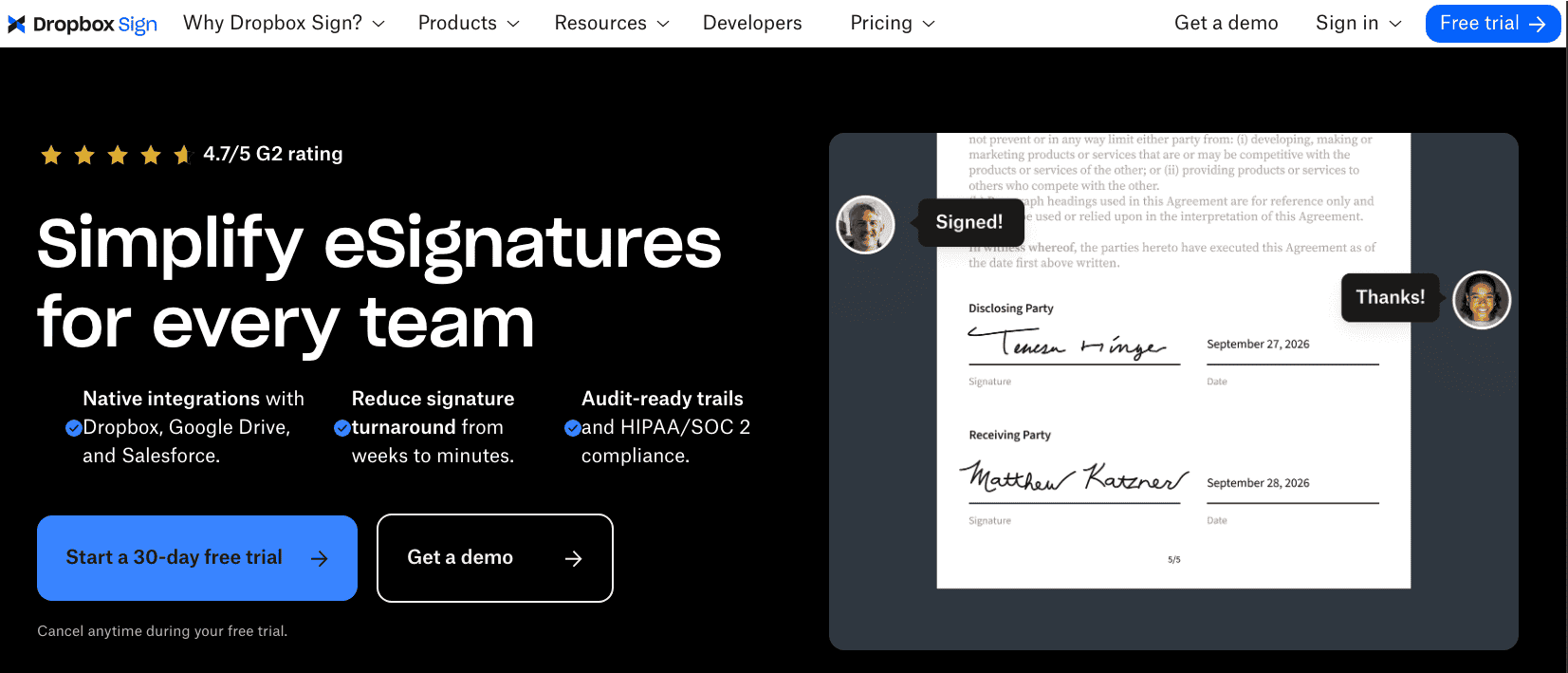
You can also use Dropbox Sign on its own. It’s the same e-signature tool that powers Paperbell’s contracts, just as a standalone app.
It works on mobile, and you can send clients reminders about agreements that are still waiting for their signature.
There are templates too, plus integrations with HubSpot, Dropbox, Google Drive, Salesforce, and other business apps.
Best for: Getting your own documents signed, with templates and reminders built in, if your booking and payments are already sorted elsewhere.
The catch: On its own, it only handles the signature. Booking sessions and taking payment happen in separate tools, so you’ll be sending each contract yourself and checking it’s back before you start.
3. PandaDoc

With PandaDoc, you can draw your signature, type it, or upload an image of it.
It also has a drag-and-drop editor for building contracts from reusable templates, though you can just upload a PDF if you already have one.
You can set a renewal date on a contract and have PandaDoc email you a reminder a set number of days before it, so you don’t forget to send the next one out for signing.
There’s also an approval workflow that adds a review step before your contract lands in your client’s inbox. That’s handy if a virtual assistant puts your contracts together but you still want to check them yourself.
Best for: Proposal-first coaching, where you send a proposal before the contract and you enjoy building documents from templates rather than uploading a PDF.
The catch: It’s designed around proposals and sales documents. If you’d rather just upload the contract you already have, its editor is more than you need.
4. DocuSign

DocuSign lets your clients sign on any device without creating an account, and it integrates with popular apps like Google Workspace and Microsoft 365.
DocuSign makes it easy to add signatures, initials, names, dates and other text to your agreements to customize them. This lets you reuse the same agreement template for different clients and projects, simply adding a few custom details.
You can also bulk send a contract to multiple recipients. Custom branding and automated reminders are in there too.
Best for: Coaches working with businesses or teams, where features like bulk sending and custom branding actually get used.
The catch: There’s a lot of it. With 1,100+ integrations and options like role-based permissions, DocuSign is built with larger organizations in mind, so a solo coach will probably only use a small slice of it.
5. airSlate SignNow

airSlate SignNow (you’ll still see it called SignNow) lets you add signatures, dates, text, and checkmarks to your documents, plus fillable fields for anything else you need your client to complete.
There are iOS and Android apps, reminders, and unlimited templates.
You can send contracts in bulk, or generate a signing link to share with a client without needing their email address. Your logo can go on every signature invite, and you can ask for attachments, too.
It can also route documents to recipients in a set order, which helps when more than one person needs to sign (a parent and a teen, say, or two business partners).
Best for: Sending a contract by link, or to several people in a set order, with your logo on the invite.
The catch: Signed contracts live in airSlate SignNow, separate from wherever your clients book sessions with you, so you’ll be checking two places to see who’s ready to start.
Frequently Asked Questions
What should I use to get client contracts signed?
If you sell coaching packages, the simplest setup is to make signing part of buying: in Paperbell, the contract is a step in checkout, right before payment. You attach the contract to a package once, and every client who buys it signs before their purchase completes.
If you need signatures on standalone documents, or on agreements with several signers, a dedicated tool like Dropbox Sign, DocuSign or airSlate SignNow is the better choice. Curious how contracts sit alongside booking and payments? Here’s our guide to scheduling, payments and contracts in one tool.
Are electronic signatures legally binding for coaching contracts?
In the US, the Electronic Signatures in Global and National Commerce Act (ESIGN Act) says a signature or contract “may not be denied legal effect, validity, or enforceability solely because it is in electronic form”. In the UK, the Law Commission concluded that an electronic signature is capable in law of being used to execute a document, as long as the person signing intends to authenticate it and any formalities are met.
This is general information, not legal advice. Rules vary by country and by type of document, so check with a lawyer for your specific situation.
How do I get a client to sign a contract before they pay?
Put the signature step in front of the payment step. Paperbell does this for you: the contract comes up during checkout, and the client can’t complete their purchase until they’ve signed it.
With a standalone e-signature tool, send the signing link first and only send your payment link once the contract comes back. Our guide on how to take payments as a coach covers the payment side.
Can I use my own contract in Paperbell, and what if I need to change it?
Yes. You upload your own contract as a PDF on the package, Paperbell adds a signature page to the end, and every client who buys that package signs the same version.
To change it, upload a new PDF. Paperbell won’t ask existing clients to sign again automatically, so if you need an updated signature from them, give them a new private package (a free one is fine) that includes the new contract.
Can more than one person sign the same contract in Paperbell?
No, each contract has one signer: the client who buys the package. If a second person needs to sign, like a partner in couples coaching, create a separate free package with the contract attached and have them sign via the additional package.
If you regularly need several people to sign one agreement, a standalone tool that routes documents in a set order, like airSlate SignNow, will suit you better.
Is Dropbox Sign the same as HelloSign?
Yes. HelloSign is now called Dropbox Sign, and the old hellosign.com address takes you to the Dropbox Sign site. It’s also the tool behind contract signing in Paperbell, so if you use Paperbell, you’re already using it under the hood.
Simplify Your Workflow With Paperbell
Managing client agreements doesn’t have to be a hassle.
With Paperbell, online contract signing sits right inside checkout, alongside your scheduling and payments, so the contract is signed before the purchase goes through.
Ready to simplify your coaching practice? Try Paperbell for free.