

If you’re a coach, you already know how much of your week disappears into your inbox. Client follow-ups, onboarding emails, the dreaded “I need to address this situation” message at 11pm on a Wednesday.
Most of those emails aren’t complicated. They’re just repetitive. You’re writing the same kinds of things again and again, starting from a blank screen every time.
That’s exactly what ChatGPT is good for. Used well, it can turn a 30-minute email task into a 5-minute one. This guide will show you how, with 8 ready-to-use prompts built for coaches, a simple framework to get better outputs every time, and honest advice on when NOT to use AI for your emails.
Why Use ChatGPT for Email Writing?
Save Time on Routine Tasks
The best thing about AI writing your emails is getting through your inbox faster without burning mental energy on every message.
Instead of starting each email from scratch, jot down the key points, let ChatGPT build a draft, then tweak it to sound like you. The whole thing takes minutes.
It’s especially useful for formal email templates, repetitive client responses, and brainstorming subject lines.
Take the Emotion Out of It
Ever spent an hour agonizing over how to word a boundary-setting email or a “this isn’t working” conversation?
ChatGPT can get you unstuck. It gives you a professional, neutral starting point so you stop spinning and start editing.
Get Better at Writing Emails
Writing clear, direct emails is a skill. ChatGPT can help you structure your thoughts, find a sharper opening, or tighten up a message that’s gone on too long.
You’re still in control. You just have a solid draft to react to instead of a blank page.
How to Use ChatGPT for Emails: The PREP Method
One of the most common problems with AI email writing? Vague prompts produce vague drafts. If you ask ChatGPT to “write a follow-up email,” you’ll get something generic that doesn’t sound like you.
Here’s a simple four-part framework that fixes that. It works for any type of coaching email and takes about 60 seconds to apply.
P – Purpose
Start with what you actually want the email to do. Not just “follow up” – be specific. Are you asking for payment? Confirming a booking? Checking in after a tough session? Announcing a price change?
The clearer your purpose, the more useful ChatGPT’s draft will be.
R – Recipient
Tell ChatGPT who you’re writing to. A warm existing client needs a different tone than a cold prospect. A long-term client you’ve built real rapport with gets a different email than someone who just signed up yesterday.
Include any relevant context: their goal, the challenge they mentioned, the niche you work in. The more specific, the better.
E – Examples
This is the step most people skip, and it makes the biggest difference. Paste in a couple of emails you’ve actually sent before and tell ChatGPT to match that style.
You’re essentially giving it a writing sample. It will pick up your tone, your typical length, your word choices – and your drafts will stop sounding generic.
P – Polish
The first draft is never the final draft. Once ChatGPT gives you something, ask for specific revisions. “Make this warmer.” “Cut it by half.” “Sound less formal.” “Add a clear call to action at the end.”
Treat it like editing, not accepting. One or two revision rounds and you’ll have something worth sending.
An example prompt using the PREP Method:
“I’m a career coach who helps corporate professionals move into leadership roles. I need to follow up with a client named Sarah who signed up for my 3-month package but hasn’t booked her first session yet. The tone should be warm but gently nudging – she’s been enthusiastic but tends to get busy. Here are two emails I’ve sent to similar clients in the past: [paste examples]. Write a 100-word follow-up.”
That’s the kind of prompt that gets you a genuinely usable email on the first try.
Asking for Revisions
A few ways to guide ChatGPT when the first draft misses the mark:
- Tone: “Make this warmer/more direct/less formal.”
- Voice: “Rewrite this in the style of [your own past emails].”
- Focus: “Emphasize the benefit to the client more clearly.”
- Length: “Cut this to 80 words” or “Add a short example to make it more concrete.”
Personalizing Your Email
Once you have a solid draft, jump in and make it yours. Add their name where it’s missing, swap in a specific detail from your last conversation, and change any phrases that don’t sound like you.
This step takes two minutes and is what turns a “fine” email into one that actually feels personal.
Generating Subject Lines
Your subject line is just as important as the email body – especially for marketing and onboarding emails. ChatGPT can give you ten options in seconds.
Try: “Write 10 subject lines for this email. Mix curiosity-driven, direct, and benefit-focused options.” Then pick the one that fits your relationship with this client.
8 ChatGPT Email Prompts for Coaches (With Example Outputs)
Here are eight email types coaches send all the time, with the exact prompts to use and a sample of what ChatGPT produces. These are starting points – tweak the context to fit your niche and clients.
1. Cold Outreach Email
A cold email can be a surprisingly big mental block. How do you convey what you offer without sounding salesy?
Prompt:
“I’m a health and wellness coach with 5 years of experience helping clients improve their daily health routines. Write a 150-word cold outreach email to a potential client introducing my coaching services.”
Example output:
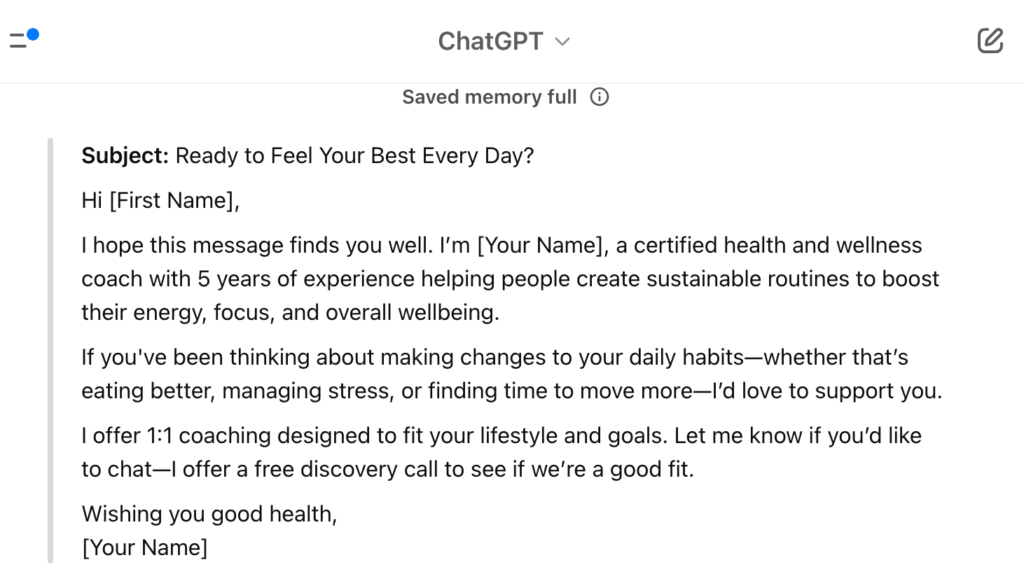
Conversational and clear. From here, personalize based on what you know about this particular prospect – their challenges, how you found them, why you’re reaching out to them specifically.
2. Follow-Up Email
Let’s try a follow-up for a late payment. A common situation coaches hate dealing with.
Prompt:
“A coaching client still hasn’t paid their invoice due a week ago. Write a 100-word follow-up email that’s polite but direct.”
Example output:
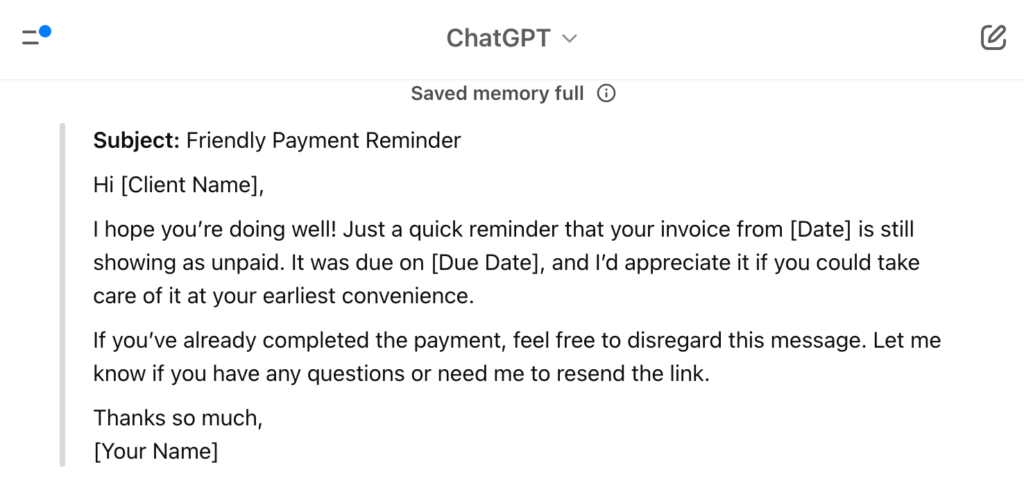
Polite and clear, though a bit wordy. Tighten it up and add the payment link directly in the email so there’s no back-and-forth.
Or skip late payment chasing entirely. If you’re using Paperbell, clients pay upfront as part of the booking process, so this email type mostly disappears from your workflow.
3. Client Onboarding Email
One of the more fun emails to write, but it still takes time when you’re doing it from scratch each time.
Prompt:
“I’ve had a discovery call with a client and they said yes to my 6-week coaching program called 6 Weeks to a New You. Help me write an email to onboard the client. Include a link for booking and payment.”
Example output:
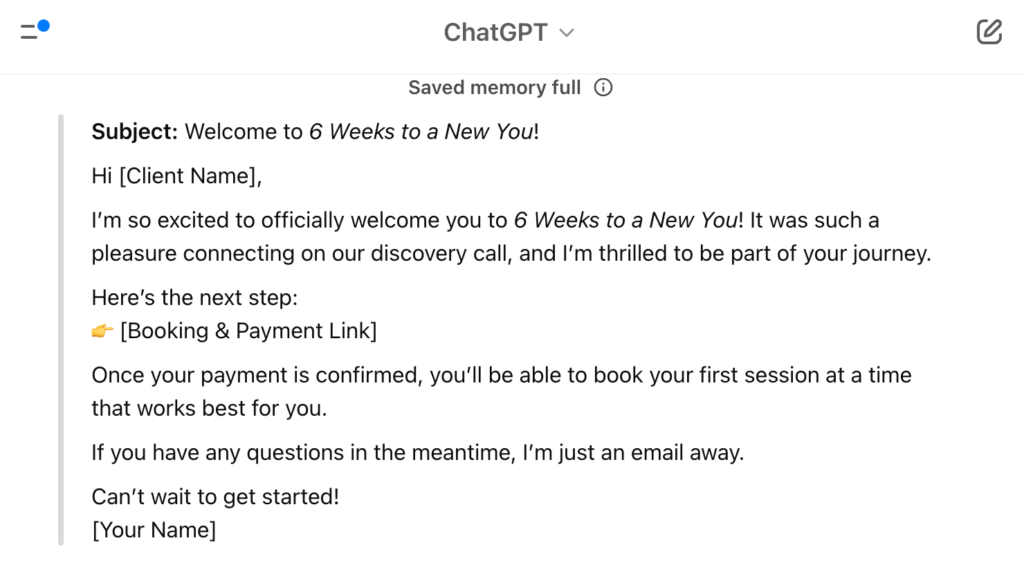
Short and gets the job done. Notice it stays simple because there’s not much to explain – Paperbell handles the contract, payment, and session booking in one link, so the onboarding email itself can stay short.
4. Firing a Client
No one enjoys writing this one.
Prompt:
“A client has missed multiple sessions without notice. Write a short, professional email to end the coaching relationship.”
Example output:
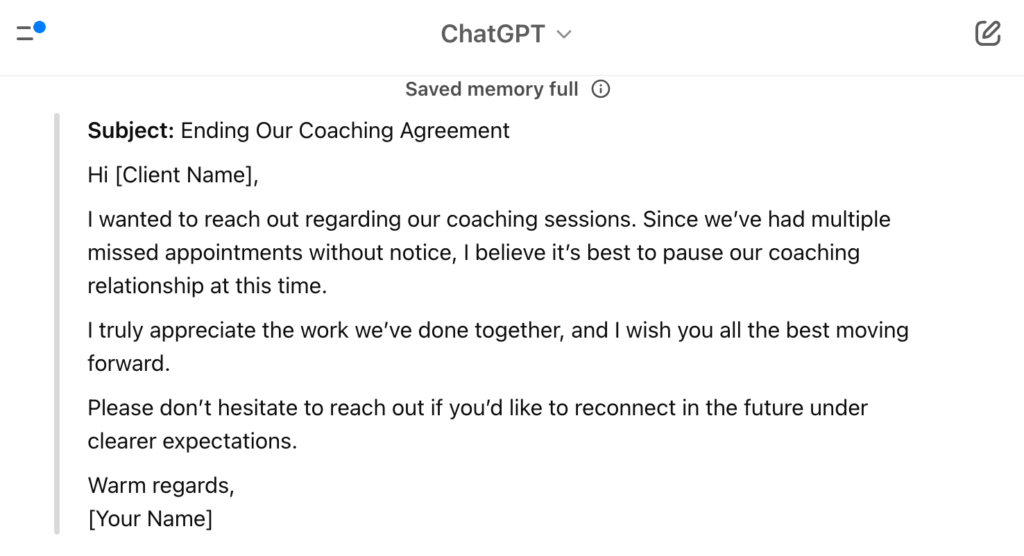
This is a reasonable starting point but adjust the tone depending on the situation. Are you actually open to working together again? Do you want to reference your termination policy? If they have sessions remaining, decide whether to set an expiration date or issue a refund per your contract.
5. Session Recap Email
Sending a recap after each session reinforces your value and keeps clients accountable between calls. The problem is it can turn into a 20-minute writing task if you let it.
Prompt:
“I’m a business coach. I just finished a session with a client where we worked on pricing strategy – they decided to raise their rates by 30% and we mapped out a 3-step rollout plan. Write a short recap email summarizing what we covered and the action steps she’s committed to.”
Example output (shortened for illustration):
“Hi [Client Name], great session today! Here’s a quick recap of what we covered… Your action steps for the next two weeks: 1) Update your pricing page by [date], 2) Send the new rate email to existing clients, 3) Review the script we drafted for any pushback. Excited to hear how it goes. See you on [date]!”
Clean, structured, and takes 30 seconds to personalize. Clients appreciate the follow-through, and it saves you from reconstructing the session from memory a week later.
6. Re-Engagement Email
You’ve got a client who bought a package but has gone quiet. They’re not responding to messages, missing check-ins, and you’re not sure what happened.
Prompt:
“A coaching client signed up for my 3-month package two months ago but has been unresponsive for the past three weeks. They seemed engaged at first. Write a warm, no-pressure re-engagement email checking in and reminding them they still have sessions available.”
Example output (shortened):
“Hi [Name], I’ve been thinking about you! I know life gets busy, and I just wanted to check in. You’ve still got [X] sessions available in your package, and I’d love to use them to help you make progress on [their goal]. No pressure – just wanted you to know I’m here when you’re ready.”
Warm without being pushy. A well-timed re-engagement email like this often gets a reply when a more formal message wouldn’t.
7. Discovery Call Confirmation
You want this email to do more than just confirm a time. It’s your chance to set expectations, get the client excited, and reduce no-shows.
Prompt:
“I’m a life coach and I’ve just scheduled a discovery call with a potential new client. Write a confirmation email that confirms the time and Zoom link, briefly explains what to expect on the call, and gets them a little excited about it.”
Example output (shortened):
“Hi [Name], so excited to chat with you on [day] at [time]! Here’s the Zoom link: [link]. On our call, we’ll talk about where you are right now, where you want to be, and whether coaching is the right fit for you. Come ready to talk about your biggest goal – there are no wrong answers. See you soon!”
Takes 2 minutes to personalize and does a lot of the pre-call selling for you.
8. Price Increase Announcement
This one makes coaches nervous, which is exactly why having a draft to start from helps.
Prompt:
“I’m raising my 1:1 coaching rates by 25% starting next quarter. Write an email to my existing clients announcing the increase. The tone should be confident and warm – I want to acknowledge their loyalty and give them the option to lock in current rates before the change.”
Example output (shortened):
“Hi [Name], I have some news to share about my coaching rates. Starting [date], my 1:1 packages will be moving to [new rate]. As a valued client, I wanted to give you advance notice and the option to lock in your current rate if you’d like to book ahead before [date]. Thank you so much for being part of this community – it means more than you know.”
Confident without being apologetic. You can adjust the specific language around the lock-in offer depending on how you want to handle it.
When NOT to Use ChatGPT for Emails
ChatGPT is a genuinely useful tool. It’s also not the right tool for every situation. Here’s when to be careful:
- Don’t paste client personal data into ChatGPT. Mental health disclosures, financial details, family situations – none of that should go into a third-party AI tool. Keep any sensitive client information out of your prompts and use placeholder names instead.
- Be careful with emotionally loaded situations. Grief, trauma, a session that went badly, a client going through a crisis – these emails deserve your full attention and personal voice, not a generated draft. The stakes are too high for “good enough.”
- Always personalize before hitting send. AI-generated emails have recognizable patterns. Clients who receive a generic-sounding message from you will notice. It doesn’t take much – a specific detail, a reference to something they said, a sentence that only makes sense in context – but that’s what makes it feel like you actually wrote it.
- Fact-check anything specific. ChatGPT can confidently state inaccurate things, especially if you ask it to reference specific dates, industry stats, or platform features. Always verify before sending anything that might need to be accurate.
FAQ
Is ChatGPT Error-Free?
No. ChatGPT is helpful but not perfect. It might occasionally generate responses that are outdated or inaccurate, so always review and fact-check before using it in professional settings. Running the final email through Grammarly is also worth doing.

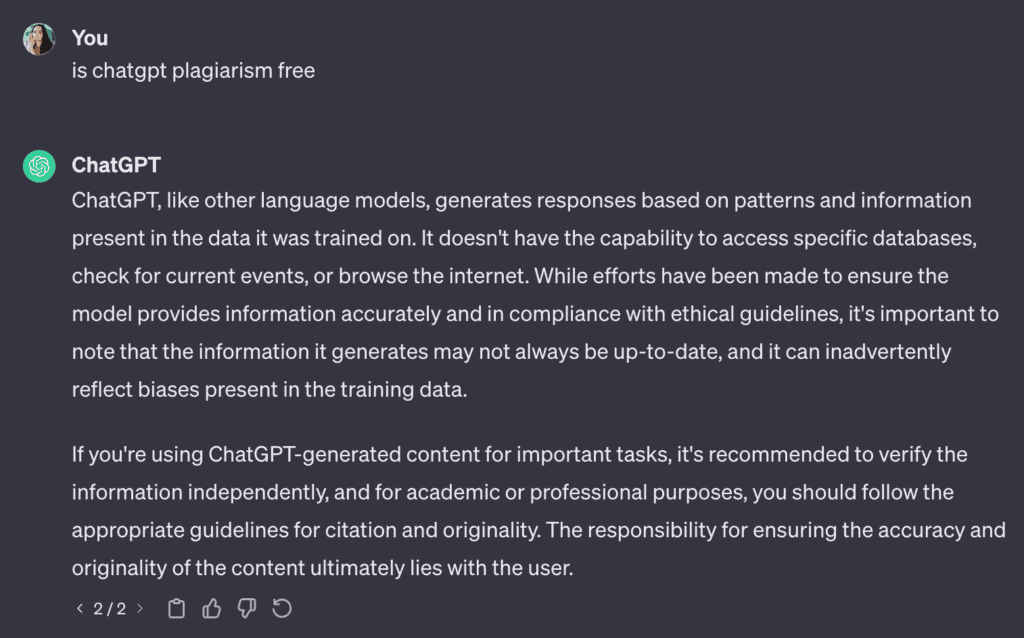
Is ChatGPT Plagiarism-Free?
ChatGPT generates original responses based on patterns in its training data. For basic emails, plagiarism isn’t a practical concern. For longer published content, running it through a plagiarism checker is a sensible precaution.
Can I Use ChatGPT for Free?
Yes. There’s a free version of ChatGPT available. For faster performance and access to more advanced features, you can upgrade to a paid plan. For most coaching emails, the free version is perfectly capable.
How Do I Make ChatGPT Sound More Like Me?
Paste in 2-3 emails you’ve actually sent and ask ChatGPT to match your tone and style. Then ask for specific adjustments: “more casual,” “shorter sentences,” “add a bit of humor.” The more examples you give it, the closer it gets to your actual voice.
Save Even More Time on Emails With Paperbell
ChatGPT is great for writing emails faster. But the fastest win is not having to send certain emails at all.
Paperbell is a payment-first client management platform, which means clients pay upfront as part of the booking process. No invoices, no late payment follow-ups, no awkward reminders.
It also automates your routine client emails – session reminders, post-session testimonial requests, scheduling nudges. Set them up once and they run automatically for every client in your program.
Paperbell also gives you a ready-made coaching website with dedicated landing pages for each package, built-in contracts, client surveys, and more.
Want to automate your coaching admin as well as your emails? Try Paperbell for free.

Editor’s Note: This post was originally published in December 2023 and has since been updated for accuracy.