
You’re a few months into your coaching practice and things are going well. Clients are showing up, sessions are productive, and you genuinely love the work.
Then a client texts you at 10 PM. Another one wants to talk through a crisis that sounds a lot more like a therapy situation than a coaching one. A third misses their third session in a row and acts surprised when you bring it up.
Here’s the thing. None of those problems are the client’s fault. They’re yours, because you didn’t have clear coaching guidelines.
Having a solid set of coaching guidelines isn’t just a professional nicety. It’s what separates a practice you love running from one that slowly drains you. In this guide, you’ll find the 7 pillars of professional coaching guidelines, how to handle the coaching-vs-therapy line, and a practical checklist for building your own guidelines document from scratch.
What Is a Coaching Guideline?
A coaching guideline is a set of principles, boundaries, and standards that define how you run your coaching practice. Think of it as the operating system for your client relationships: it tells clients what to expect from you, what you expect from them, and how you’ll work together to achieve their goals.
Coaching guidelines cover everything from session structure and communication protocols to goal-setting processes and cancellation policies.
They’re also part of a broader set of professional documents that coaches use. Before we get into the 7 pillars, it’s worth knowing how the terms relate to each other:
| Coaching Guidelines | Coaching Agreement | Coaching Contract | |
|---|---|---|---|
| What it is | The principles and norms that shape how you work | A written document both parties sign about the coaching relationship | A legally binding services agreement |
| What it covers | Your professional philosophy and operating norms | Goals, process, roles, expectations | Payment terms, IP, liability |
| When you use it | Ongoing; shapes every session | At the start of every coaching relationship | For formal business relationships |
Most coaches need all three. Your guidelines are the philosophy behind the paperwork. Your coaching agreement and coaching contract are the formal expressions of it.
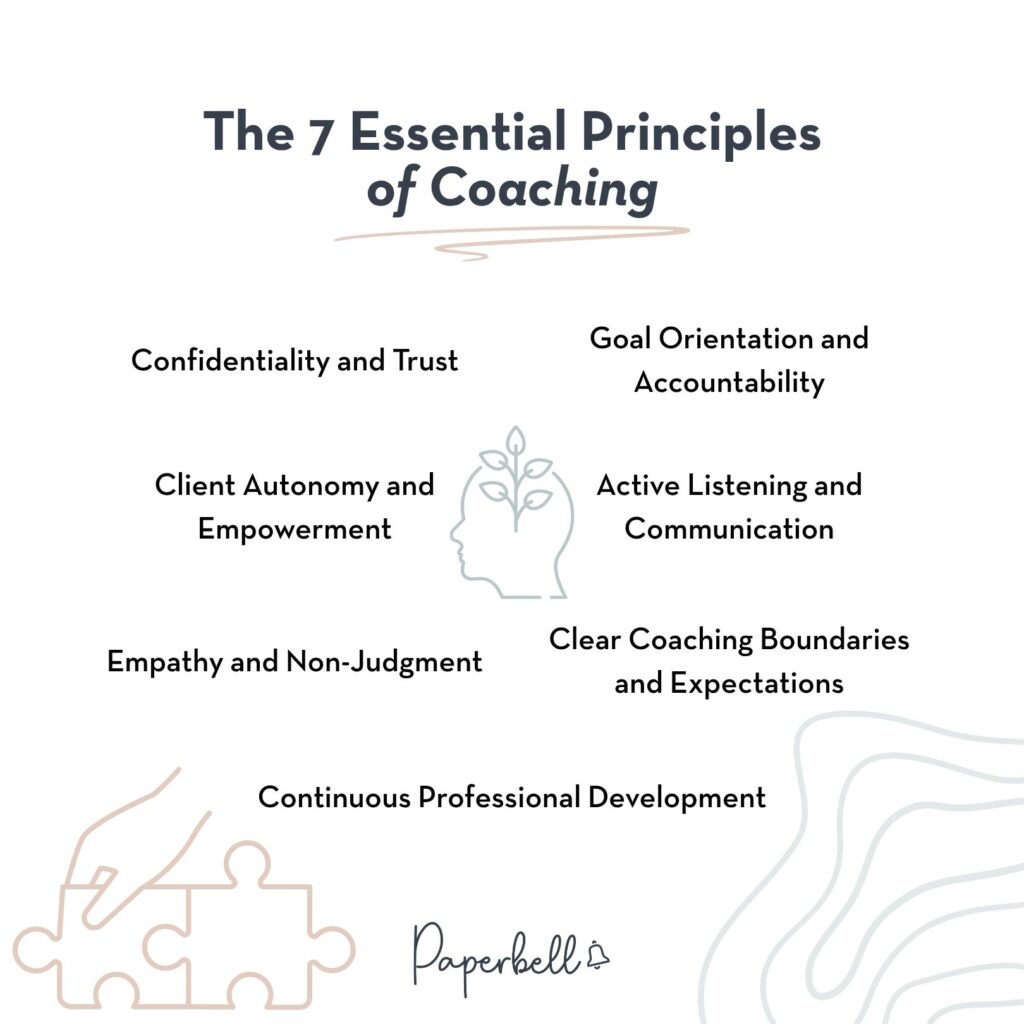
The 7 Pillars of Professional Coaching Guidelines
These principles are the foundation of ethical practice. Coaching governing bodies (including the International Coaching Federation, or ICF) expect coaches to uphold these. They ensure every coaching relationship grows in mutual understanding and respect.
Pillar 1: Confidentiality and Trust
Confidentiality is the first thing you establish and the last thing you compromise.
Your clients need to know what they share with you, stays with you. That psychological safety is what makes honest self-exploration possible in the first place.
- State your confidentiality policy clearly in your coaching agreement
- Explain any legal exceptions upfront (harm to self or others, court orders)
- Remind clients regularly that sessions are a safe space for open conversation
A note on AI tools: In 2025, the ICF updated its Code of Ethics to require coaches to disclose when AI tools are used in their practice, and to apply client confidentiality standards to any data processed by AI. If you use AI for session notes, transcription, or email drafting, your clients should know. This disclosure belongs in your guidelines.
Example: Executive coach Sarah’s client shared concerns about their CEO and company culture while considering resignation. Sarah maintained strict confidentiality, which created the safety for honest exploration and ethical decision-making.
Pillar 2: Client Autonomy and Empowerment
Coaching is about helping clients find their own answers, not giving them yours.
This principle keeps the client in the driver’s seat. They develop self-awareness, problem-solving skills, and a sense of ownership over their own growth.
- Practice open-ended questions that invite self-reflection
- Hold back from giving direct advice (even when you’re sure you know the answer)
- Help clients spot their own patterns and triggers
Example: Life coach Michael’s client came in wanting work-life balance advice. Instead of listing solutions, he asked: “What would a perfect balance actually look like for you?” The client discovered her own answers, and recognized a people-pleasing pattern she hadn’t named before.
Pillar 3: Empathy and Non-Judgment
Genuine empathy means understanding your client’s perspective without filtering it through your own values or biases.
Clients can tell when you’re judging them, even subtly. The moment they feel that, they start self-censoring. The real work stops.
- Reflect back what you’re hearing, including the emotional layer
- Regularly examine your own biases and consciously set them aside
- Validate their emotions before moving toward action
- Focus on understanding their choices, not evaluating them
Example: Career coach Jennifer’s client wanted to leave a corporate salary to pursue art. Jennifer didn’t steer. She said: “This creative pull feels important, and I hear the financial uncertainty. Help me understand what this means to you.” That one question opened three months of real exploration.
Pillar 4: Goal Orientation and Accountability
Effective coaching moves toward something specific.
Without a clear goal and a system for accountability, sessions become pleasant conversations that don’t produce change. Accountability is what turns intention into action.
- Help clients set SMART goals that are specific and time-bound
- Build regular progress check-ins into your session structure
- Share resources that make it easier for clients to follow through
- Celebrate milestones (acknowledgment matters)
Example: Business coach David helped an entrepreneur turn “grow my business” into three concrete milestones: a 20% revenue increase, two new team members, and one product launch, all with deadlines attached.
Pillar 5: Active Listening and Communication
Most coaches know how to listen. Fewer know how to listen at the level that changes people.
Active listening isn’t just hearing the words. It’s tracking what’s underneath them. The word a client avoids. The long pause before a simple answer. The shift in energy when a particular topic comes up.
- Listen for both the content and the emotional signal
- Ask introspective questions that push past surface responses
- Give feedback that’s specific and tied directly to their goals
Example: Relationship coach Lisa noticed her client was constantly saying “should”: “I should want that,” “I should be okay with it.” She named the pattern, asked about it, and tracked the energy shift when the client switched to “I want” language. That single observation opened three sessions of genuine self-discovery.
Pillar 6: Clear Coaching Boundaries and Expectations
Professional boundaries aren’t about being cold or rigid. They protect the coaching relationship and keep the focus where it belongs: on your client’s growth.
This includes clarifying your role, your availability, how you communicate between sessions, and what the coaching relationship does and doesn’t cover. These are your coaching rules, and they’re worth spelling out from day one.
- Be explicit about your availability and response windows
- Define which communication channels you use and which you don’t
- State the scope of the coaching engagement clearly
- Outline cancellation and payment policies in writing
Example: Wellness coach Amanda made it clear from the start: brief emails are fine between sessions, but lengthy emotional processing is saved for sessions. When a client started sending daily emails, Amanda redirected the relationship warmly but firmly, and offered crisis resources while doing it.
Pillar 7: Continuous Professional Development
The best coaches are always students.
Staying current with coaching research, ethical standards, and new tools isn’t optional if you want to serve clients at a high level. The coaching world evolves, and your practice should too.
- Regularly identify your skills and knowledge gaps
- Invest in relevant training and certifications
- Seek supervision or mentorship from more experienced coaches
- Join coaching communities and professional networks
Example: Leadership coach Robert worked primarily with tech industry clients. He invested in ongoing development: joining tech industry groups, getting specialized training, and seeking mentorship from coaches who understood that world. The result: he could speak his clients’ language at every level.
Coaching Guidelines vs. Therapy: Where to Draw the Line
This is the question every coach runs into eventually, usually mid-session, when a client goes somewhere unexpected.
Knowing the difference between what you can hold space for and what requires a different kind of professional isn’t about being rigid. It’s about knowing your role and protecting your client.
What Falls Inside Coaching Scope
Coaching is the right container for:
- Working toward specific personal or professional goals
- Navigating life transitions (career changes, relationship shifts, starting a business)
- Building accountability systems and action plans
- Developing self-awareness and communication skills
- Processing growth, not pathology
What Falls Outside Coaching Scope
Coaching is not the right container for:
- Diagnosing or treating mental health conditions
- Processing unresolved trauma (especially recent or acute trauma)
- Providing therapeutic intervention for clinical depression, anxiety disorders, or other mental health diagnoses
- Crisis intervention beyond providing emergency resources
Signs a Client May Need a Referral
Watch for:
- Persistent grief or loss that isn’t lifting after several sessions
- Symptoms consistent with clinical depression or anxiety (not just a rough week)
- Trauma responses that surface and escalate rather than settle
- Any mention of suicidal ideation or self-harm
- Sessions that consistently circle back to the same emotional wound without forward movement
How to Refer Without Abandoning the Client
Referring a client to a therapist doesn’t mean ending the relationship. It means being honest about what kind of support they need right now.
A script that works:
“I want to make sure you’re getting the right kind of support. What you’re describing sounds like something a therapist could help with more directly than I can. I’d love to help you find someone, and I’m open to continuing the goal-setting work together when you’re ready.”
That’s not a rejection. That’s professional care. Include your referral protocol in your coaching guidelines so you’re not improvising this conversation when it matters most.
The Coach’s Role
As a coach, here’s what your role looks like when it comes to putting your guidelines into practice:
How to Introduce Guidelines at the Beginning of a Coaching Relationship
The first session sets the tone for everything that follows.
Don’t just hand clients a document to sign. Walk through your guidelines together. Explain the reasoning behind each one. Invite questions. Make it a conversation, not a presentation.
When clients understand why a guideline exists (not just what it says), they’re far more likely to respect it. And when they feel included in the conversation, they feel safe from day one.
Including Guidelines in Your Coaching Agreement
Your coaching agreement should reflect your guidelines in practical terms: session structure, confidentiality policy, communication expectations, and what both parties are committing to.
This isn’t just legal protection. It’s a reference document both of you can point to when something gets murky.
A tool like Paperbell makes this simple: you can upload standardized agreements that are automatically sent to new clients during onboarding, no chasing required.
When and How to Review Guidelines During the Coaching Relationship
Guidelines aren’t “set it and forget it” documents.
Plan to revisit them: monthly, quarterly, or whenever a challenge surfaces. If a client is frequently canceling sessions or struggling to complete between-session work, go back to the original agreement and problem-solve together. The guideline is the anchor, not the verdict.
Handling Guideline Violations
When a guideline gets crossed, address it promptly and with curiosity rather than judgment.
Most violations signal an unmet need or a misunderstanding, not deliberate disrespect. Treat them as coaching material.
That said, some situations require a more direct response:
Client in crisis mid-session. Stay present. Ask directly: “Are you having thoughts of hurting yourself?” Provide crisis resources. The 988 Suicide and Crisis Lifeline is the number to have ready. Don’t leave the client alone mid-session. Document the conversation afterward and follow up the next day.
Coaching relationship not working. You can refer out professionally without abandoning the client. Use the script from the therapy section above. Staying in a relationship that isn’t serving the client isn’t loyalty. It’s avoidance.
Client pushing scope. A warm, clear response: “I appreciate you trusting me with this. What I’m hearing is that you might benefit from working with a therapist alongside our coaching. I can help you think through that.” Hold the line kindly but clearly.
What to Include in Your Coaching Guidelines Document
Ready to put your guidelines on paper? Here’s a practical checklist. This is the section to screenshot, save, and come back to.
Free Coaching Guidelines Template (2026)
A one-page document you can customize with your own practice philosophy, cancellation policy, and session structure.
Get the free template → Download as PDF
This button allows you to copy our Google Docs template
- Session structure: Standard session length (45 min? 60 min?), start and end protocols, what happens if a client is late
- Between-session contact: When clients can reach you, expected response time, which channels (email only? voice message? definitely no texts?)
- Cancellation and no-show policy: How much notice is required, what happens with late cancellations (50%? 100%? grace period?), how no-shows are handled
- Payment terms: When payment is due (before sessions? monthly?), what happens if a payment fails, whether you offer refunds
- Scope of practice statement: A brief written description of what coaching is and what it isn’t. This protects you and sets honest expectations
- Emergency protocol: What you’ll do if a client is in crisis: provide crisis line numbers (988), refer to emergency services, document the conversation. Your role has limits, and spelling them out is a kindness.
- Confidentiality exceptions: Harm to self or others, legal court orders. Clients should know these exist before they share something sensitive
- AI tool disclosure: If you use AI for notes, transcription, or communication, state it clearly and confirm how client data is protected
- Review schedule: When and how often you’ll revisit guidelines together, at minimum at the start of each new coaching package
Coaching Guidelines for Specific Settings
The core principles stay the same across every coaching context. But different settings introduce their own wrinkles, and your guidelines should address them.
Executive and Corporate Coaching Guidelines
Executive coaching adds a layer of complexity that individual coaching doesn’t have: a sponsor organization. You may be hired by a company to coach one of their leaders, which means you serve the client, but the paying party has expectations too.
Be explicit from the start about what you will and won’t share. A workable standard: you’ll share the coaching agenda and broad themes (with client consent) but never session content. Your client’s insights, struggles, and disclosures stay in the room. Get this in writing before the engagement begins.
Group Coaching Guidelines
Group coaching requires a second layer of agreements: not just between you and each client, but among the clients themselves.
Your group guidelines should include:
- Confidentiality among participants (“what happens in the group stays in the group”)
- A no-unsolicited-advice rule: coaches lead the conversation, participants don’t coach each other
- Expectations around contact between members outside the group (this needs to be opt-in, not assumed)
- How you’ll handle a participant who disrupts the group dynamic
Online and Virtual Coaching Guidelines
Virtual coaching has its own practical realities. Your guidelines should cover them so they don’t become awkward mid-session.
- Tech backup plan: What happens if the call drops? (Phone call? Reschedule? 10-minute buffer?) State it in advance.
- Recording consent: Never record a session without explicit prior consent (in writing). Include this in your onboarding documents.
- Time zone agreements: Put it in writing. “Monday at 10 AM” is ambiguous if your client is in a different country.
The 5 C’s of Coaching in Your Guidelines
Here are the 5 C’s to anchor your coaching guidelines:
- Clarity: Setting Clear Expectations from the Start
Clarity eliminates confusion before it starts. Be specific about session frequency, duration, and format. Explain your coaching approach and what clients can actually expect from working with you.
Tip: Create a welcome packet that outlines your coaching process, answers common questions, and gives clients a clear sense of what the first 30 days will look like.
- Connection: Building Rapport Within Appropriate Boundaries
Strong coaching relationships need genuine connection. But connection isn’t the same as friendship. You’re not your client’s friend, therapist, or consultant. You’re their coach. That distinction is worth holding.
Tip: Share enough about yourself to build rapport without shifting the spotlight away from your client.
- Curiosity: Space to Explore Within Structure
Curiosity drives self-discovery, but it needs a container. Open exploration is most productive when it’s anchored to your client’s actual goals.
Tip: Keep a list of powerful questions organized by theme (career transitions, leadership, relationships) and have it handy during sessions.
- Commitment: Both Parties Must Be All In
Coaching only works when both the coach and the client show up fully. That means showing up prepared, following through on between-session commitments, and staying engaged even when the work gets uncomfortable.
Tip: Check in on commitment levels regularly, on both sides. If a client’s engagement is dropping, name it and explore it together rather than letting it slide.
- Confidentiality: Building Trust Through Privacy
Confidentiality is bigger than “keeping secrets.” It’s what makes the entire relationship possible. Without it, clients can’t be honest. Without honesty, coaching doesn’t work.
Tip: Remind clients before sensitive conversations that what they share stays in the room. Saying it out loud reinforces the safety, even with clients you’ve worked with for months.
Create Your Own Coaching Guidelines: A Step-by-Step Guide
Want to build coaching guidelines that actually reflect how you work? Here’s a straightforward process.
Your Coaching Style and Core Values
Before you write anything, get clear on your coaching philosophy. These questions are worth sitting with:
- What do you believe about human potential and how people change?
- What role do you play in that process?
- What kind of coach do you want your clients to experience you as?
Your guidelines should reflect your unique coaching style while meeting universal ethical standards. They’re also foundational to your coaching business plan. Your guidelines and your brand voice should feel like they come from the same place.
Your Non-Negotiables vs. Flexible Areas
Not every guideline carries the same weight. Some things are firm (confidentiality, scope of practice), and others can flex based on client needs or circumstances (session frequency, communication preferences).
Know which is which before you start writing. A guideline you’ll bend isn’t really a guideline. It’s a preference. That’s fine, but label it honestly.
Write Guidelines That Reflect You
Use plain language that sounds like you. Clients don’t need legal boilerplate. They need to understand clearly what they’re agreeing to.
Include the reasoning behind your important coaching protocols. When clients understand why a boundary exists, they’re much more likely to respect it.
Test and Refine Your Guidelines Based on Client Feedback
Your first version of your guidelines is a starting point. Pay attention to what questions clients keep asking, what misunderstandings keep coming up, and what issues surface repeatedly in your practice. That’s your feedback loop. Use it.
Use Paperbell to Easily Share and Manage Your Guidelines with Clients

Paperbell is an all-in-one coaching tool that handles the administrative side of running a professional practice, so you can focus on the actual coaching.
You can upload your agreements, intake forms, and coaching contracts, and they’re automatically available to new clients during onboarding.
You can also:
- Automate email reminders and session notifications
- Create a professional website without touching any code
- Set up different types of coaching packages
- Accept payments for your packages
- Track client activities and payment history in one place
Ready to run a cleaner practice? Try Paperbell for free and see how much easier it makes the business side of coaching.
FAQ: Coaching Guidelines
What are ICF coaching guidelines?
The ICF (International Coaching Federation) publishes two key frameworks that shape professional coaching guidelines: the ICF Core Competency Framework (8 competencies, from setting the foundation to facilitating learning) and the ICF Code of Ethics. The 2025 Code of Ethics update added specific language around AI disclosure: coaches must tell clients when AI tools are used in their practice. Together, these frameworks are the foundation for any professional coaching guidelines.
What is the difference between coaching guidelines and a coaching agreement?
Your coaching guidelines are your professional philosophy: the principles that shape how you work with every client. Your coaching agreement is the written document both you and a specific client sign at the start of the relationship. Think of guidelines as the values behind the paperwork. See the comparison table near the top of this guide for the full breakdown.
Do I need different guidelines for online coaching?
Yes. At minimum, you need to add three things for virtual coaching: a tech backup plan (what happens if the call drops), explicit recording consent (in writing, before any session), and time zone agreements. Online clients often span multiple time zones, and “Tuesday at 2 PM” without a location reference has caused more than a few missed sessions.
What is coaching guidance?
Coaching guidance refers to the framework and support a coach provides to help clients achieve their goals. It includes coaching standards, instructional strategies, and the principles that govern the coaching relationship, all aimed at getting real results.
What are the 5 C’s of coaching?
The 5 C’s of coaching are clarity, connection, curiosity, commitment, and confidentiality.
What are the 7 pillars of coaching?
In the framework used in this guide: confidentiality and trust, client autonomy, empathy and non-judgment, goal orientation and accountability, active listening, clear boundaries and expectations, and continuous professional development.
How often should I review my coaching guidelines?
At minimum, once a year, or whenever you notice recurring issues in your practice. Also revisit them when you add new services, shift your coaching niche, or receive feedback that suggests something isn’t working. Build a review into the end of every coaching package so it becomes a natural part of your rhythm.
Using Coaching Guidelines Effectively
Good coaching guidelines don’t restrict your practice. They protect it.
They’re what let you show up fully present in every session, because you’re not improvising the structure. You’ve already thought it through. Your clients feel the difference, even if they can’t name it.
Start with the 7 pillars. Add the sections that match your specific setting. Review them regularly. And when something doesn’t work, treat it like a coaching client: get curious, not defensive.
The best part? Once your guidelines are solid, tools like Paperbell make it easy to share, sign, and track them without the admin headache. Try Paperbell for free and see how much smoother onboarding gets when everything is in one place.