

You’ve narrowed your search down to iPEC coaching, and now you’re staring at a five-figure tuition page trying to work out whether it’s worth it.
Heads up: some links in this article are affiliate links, which means Paperbell may earn a commission if you buy through them, at no extra cost to you.
Most of what you’ll find online is glowing. Graduates use the word “life-changing” a lot. But not every past student was happy with the training and support they got for the price they paid, and those stories are much harder to find.
So we went looking for both sides.
Below you’ll find reviews from real coaches who went through the program, tuition numbers we verified against iPEC’s own pricing page in September 2026, and the red flags worth knowing before you pay a deposit. Still comparing? Our roundup of paid and free life coaching certifications widens the search.
First, what iPEC actually offers.
What is iPEC coaching?
iPEC Coaching (formerly the Institute for Professional Excellence in Coaching) is one of the best-known life coaching certification providers, running programs in the US, Canada, the UK, and the EU. Its About Us page puts the number of coaches it has trained at more than 25,000.
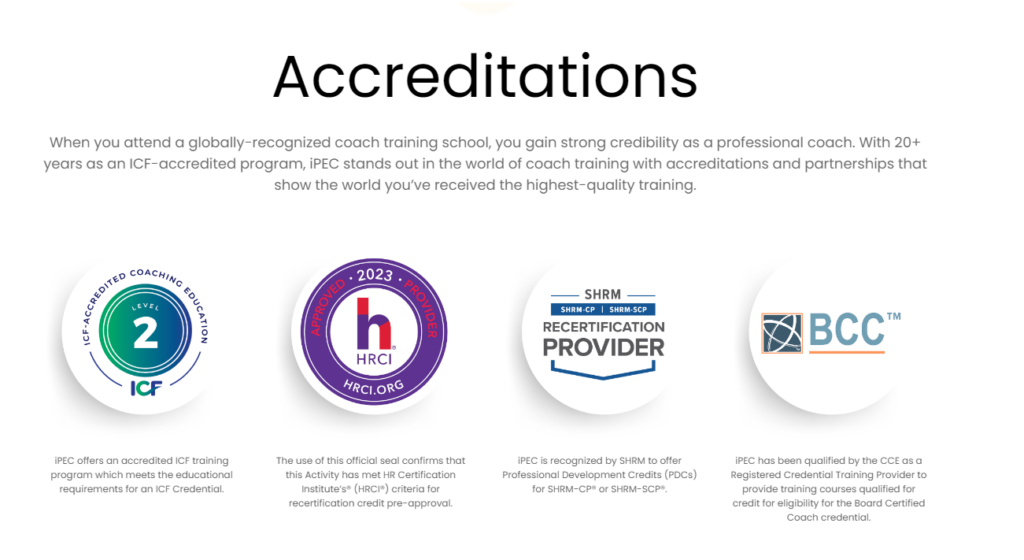
iPEC has been an International Coaching Federation (ICF) accredited program for over 20 years. It’s also recognized by the:
- Human Resources Certification Institute (HRCI), for recertification credit
- Society for Human Resource Management (SHRM), for Professional Development Credits
- Center for Credentialing Education (CCE), as a registered training provider
iPEC’s coaching philosophy asserts that individuals are self-experts. The coach’s role is to guide clients in uncovering their:
- Underlying thoughts
- Emotions
- Energy
Once those are on the table, the client can work on the root causes of their challenges. That’s the Core Energy Coaching™ process, which iPEC describes as coaching rooted in consciousness.
Whether you train with iPEC or not, growing a coaching business shouldn’t be complicated. Paperbell lets you manage your whole practice on a single platform. Try Paperbell for free and get a coaching website up in minutes.
Is the iPEC coaching certification legit?
iPEC makes big claims about personal transformation, so this is a fair thing to ask before spending five figures.
The short answer: yes, the credential is real and recognized.
iPEC is an ICF-accredited coach training program, meaning its curriculum has been reviewed against the standards the ICF sets. Practically, the training hours you earn there count toward an ICF credential. If you’re weighing whether that credential is worth chasing at all, coaches give their honest take in our post on whether ICF certification is worth it.
iPEC also runs its own certifications on top of the ICF pathway, and it holds recognition from four separate bodies (ICF, HRCI, SHRM, and CCE). That’s a wider spread than most providers publish.
So “legit” isn’t the open question. The open question is whether the experience, the support, and the price add up for you, which is what the reviews below get into.
Who founded iPEC coaching?

iPEC was founded by Bruce D. Schneider, and the school has been running for more than two decades.
The story starts earlier. In 1978, after surviving a devastating car accident, Schneider began a long search to understand the purpose of his survival and the nature of reality. Through a process he calls “uncovery,” he found his answers and his purpose. (You’ll see 1978 quoted as iPEC’s founding date on plenty of review sites, including an earlier version of this article. It’s the year of the accident, not the year the school opened.)
That journey laid the foundation for iPEC, one of the first coach training programs accredited by the ICF.
Today, Bruce is known as a speaker.
iPEC is now led by Joan M. Ryan, a Certified Professional Coach (CPC) and Energy Leadership™ Index Master Practitioner (ELI-MP), as Chief Executive Officer.
How is the iPEC coaching certification structured?
The flagship offering is the iPEC Coach Training Program (CTP), described on iPEC’s tuition page as a 7 to 10 month part-time journey built around three live, three-day modules, in person or virtual, spaced roughly three months apart. Finish it and you earn 160 hours of ICF-accredited training plus two iPEC certifications: Certified Professional Coach (CPC) and Energy Leadership™ Index Master Practitioner (ELI-MP).
There’s a smaller entry point too. Coaching Fundamentals is a three-day intensive worth 30 hours of ICF-accredited training, and it doubles as the full program’s first module. Start there and continue later, and iPEC applies what you already paid toward the CTP.
The four specialization tracks
After the core program, COR.E® Dynamics is where you pick a lane. It’s self-paced, runs 2 to 4 months, and ends in a COR.E® Dynamics Specialist certification in one of four tracks:
- Life coaching
- Health and wellness coaching
- Executive and leadership development coaching
- Sports and performance coaching
You have to finish the Coach Training Program before enrolling in COR.E® Dynamics, so it’s a second step, not an alternative one.
Pick carefully: the money and the daily work differ a lot by the track you choose. If sports and performance appeals to you, our guide to performance coaching covers what that work involves. Still undecided? Start with how to find your coaching niche rather than letting the enrollment form decide.
What else you get with tuition
The live modules are the visible part, but a fair bit happens in the gaps. Per iPEC’s tuition page, between modules you’ll be:
- Practicing coaching, and being coached, with both peers and mentors
- Attending weekly skill-building webinars
- Working through self-study assignments that reinforce the core concepts
Mentor coaching matters more than it sounds, because the ICF requires mentor coaching hours for credentialing. Getting them inside your program instead of buying them separately afterward can mean real savings.
iPEC also lists work with a Success Coach, who helps you shape a vision of success and a plan for it. Its current tuition page marks this as optional, so ask admissions how many sessions your quoted package includes rather than trusting a number from a review.
Classes themselves involve role-play, writing prompts, and simulations, with feedback throughout.
How much does iPEC coaching cost in 2026?
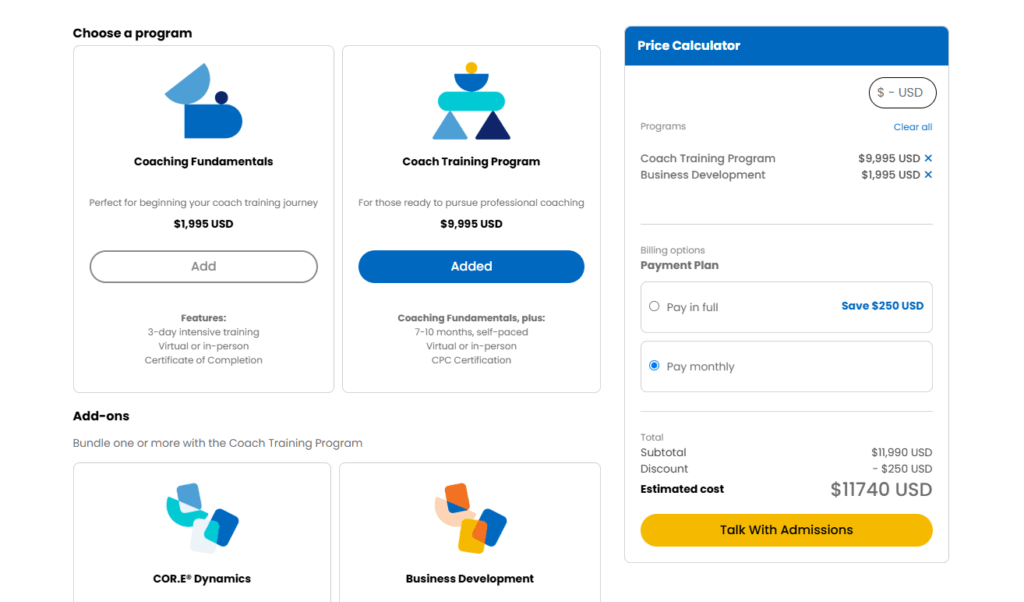
Let’s be straight: iPEC is not cheap. It sits at the higher end of accredited coach certification pricing. Here’s what its tuition page lists, in USD:
- Coaching Fundamentals (3-day intensive, 30 ICF-accredited hours): $1,995
- The iPEC Coach Training Program, including Coaching Fundamentals (160 ICF-accredited hours): $9,995
- COR.E® Dynamics specialization (2 to 4 months, self-paced): $1,995
Tuition figures verified September 2026 against iPEC’s tuition page. Prices and program bundles change, so check iPEC’s tuition page for current pricing before you budget.
A note on bundles: older iPEC reviews (including an earlier version of this one) quote a standalone Business Development course and one bundled total. Neither appears on the current tuition page, so check iPEC’s tuition page for current pricing on any add-on rather than trusting a figure from a review, ours included.
On payment terms, iPEC currently shows:
- Pay in full: saves you $250
- Pay monthly: monthly installments at 0% interest, for those who qualify
Tuition also covers all training hours and practicum, the webinars, mentor coaching, and course materials.
If that repayment schedule is too compressed, iPEC’s financing partner, Coach Financing, stretches it to as little as $350 per month. Rates and terms are subject to approval, so treat that as a starting point, not a quote. For specifics, chat with iPEC’s admissions team.
Want to get a head start on your coaching business even before you’re certified? Get everything you need to land and coach your clients on one platform. Try Paperbell for free.
What do real iPEC coaching reviews say?
Against other ICF-accredited certifications, iPEC’s pitch rests on three things: a high number of accredited training hours, a hybrid model of live modules plus self-paced work, and specialized training in your niche. All of it carries a hefty price tag.
There are plenty of positive reviews about iPEC online, but some students weren’t satisfied with the value they got. Here’s what real coaches who took certification programs at iPEC have said.
Please note that we haven’t taken this particular certification ourselves. If you want to speak to program graduates, we suggest you connect with them through LinkedIn.
Interactive Classes
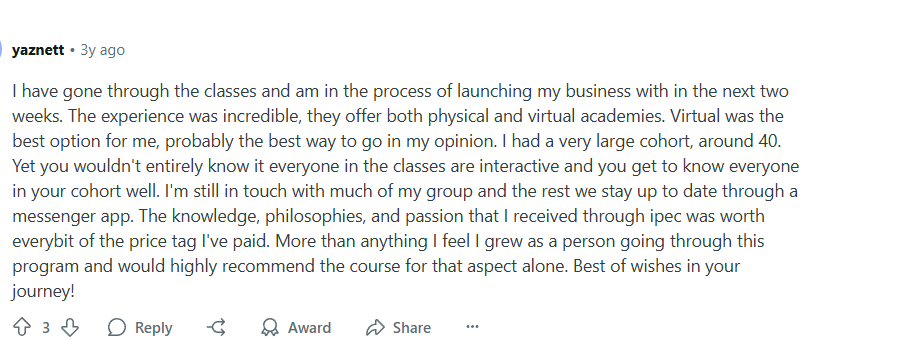
Several students appreciated the practical and hands-on nature of the classes with iPEC coaching. A reviewer on Reddit has also highlighted that although her virtual cohort was pretty large for a certification program (40 people), she had the chance to interact with everyone.
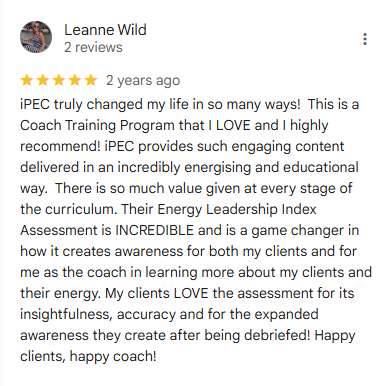
Many reviewers use the term “life-changing” when describing the experience. For instance, a reviewer named Leanne mentions how both her and her clients love the Energy Leadership Index Assessment:
One caveat before you weigh star ratings: iPEC’s presence on the big review platforms is thin. Its Trustpilot listing and its Google reviews both carry few enough reviews that one new entry swings the average. Read the reviews, not the score.
Red Flags in Facilitation
One negative review doesn’t mean a certification isn’t up to par. But when the same red flags show up across multiple platforms, from different students, that’s harder to wave off.
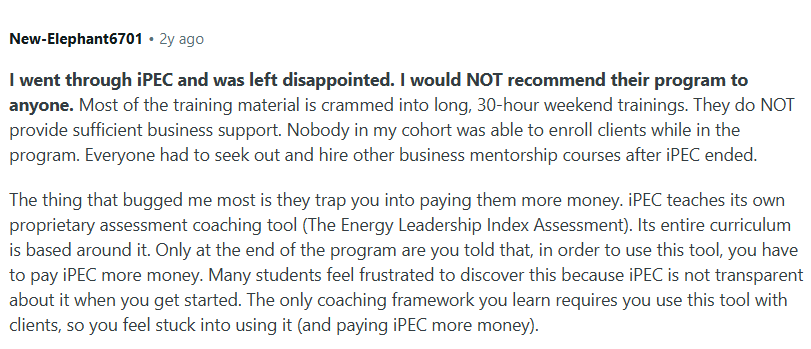
A Reddit contributor mentions that there isn’t sufficient business support and that you need to pay extra money to use the Energy Leadership Index Assessment. They also mention how the training material is crammed into very intensive sessions.
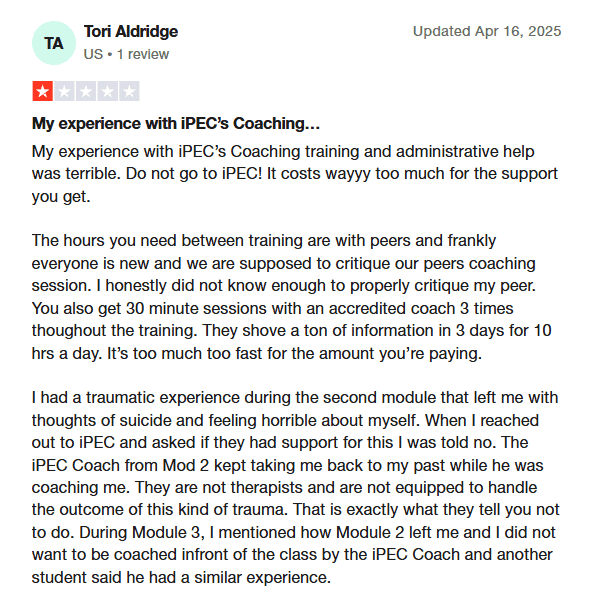
The same feedback is shared in a Trustpilot review, mentioning that for the price paid, iPEC instructors shove too much information into too little time. What’s even more concerning is how this reviewer mentions the lack of trauma-informed coaching, which became problematic for this student.
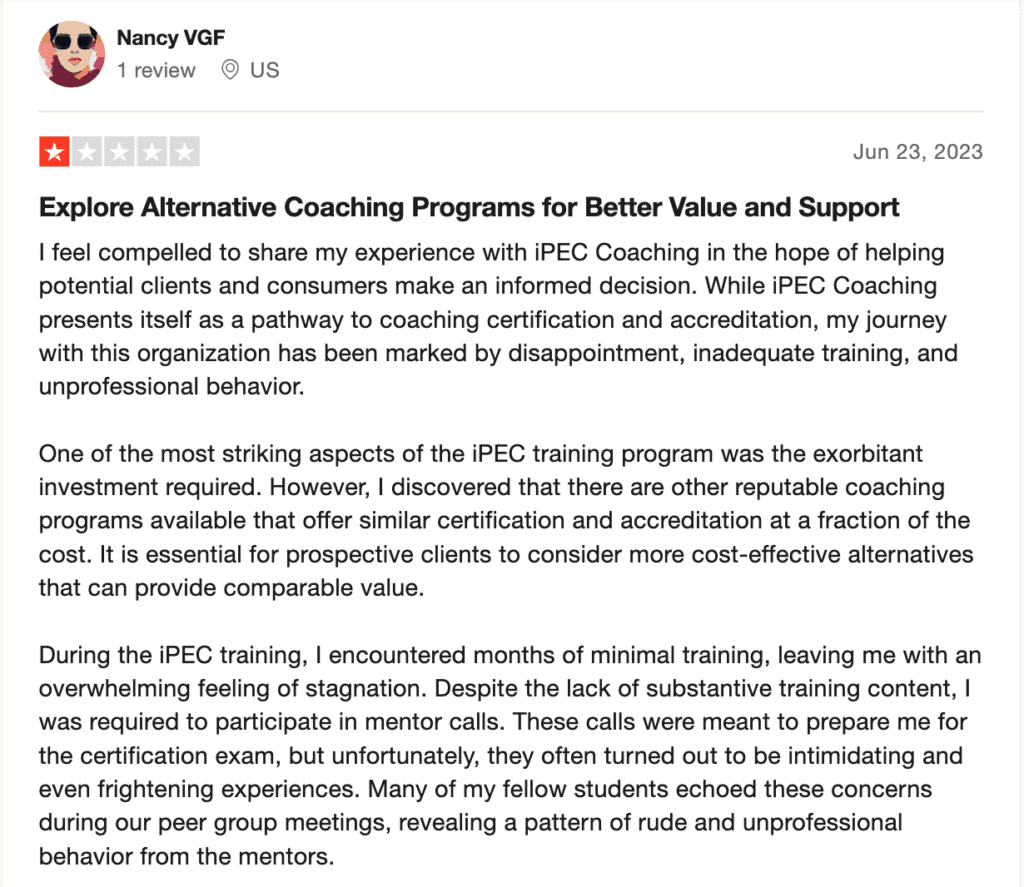
Some participants have called their experience with mentor coaches at iPEC “frightening,” “rude,” and even “abusive.”
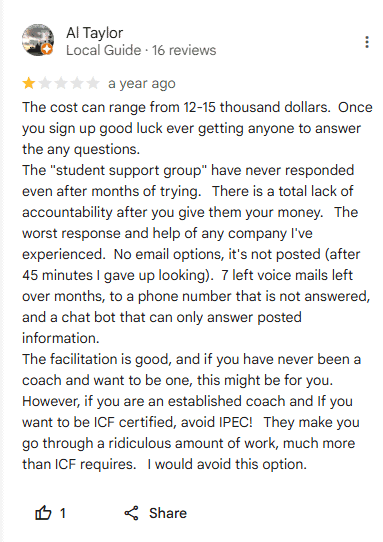
This reviewer mentioned a lack of accountability and little to no support once you join the certification program.
iPEC isn’t new. It has been around for decades and trained tens of thousands of students, which is ample time to hear feedback and fix things.
All of the reviews above were shared within the last few years, though, and the participants say the staff never addressed their complaints.
The iPEC team couldn’t justify the program’s high tuition fees either. When they reached out to coach and blogger Rob Kish for a feature, he inquired:
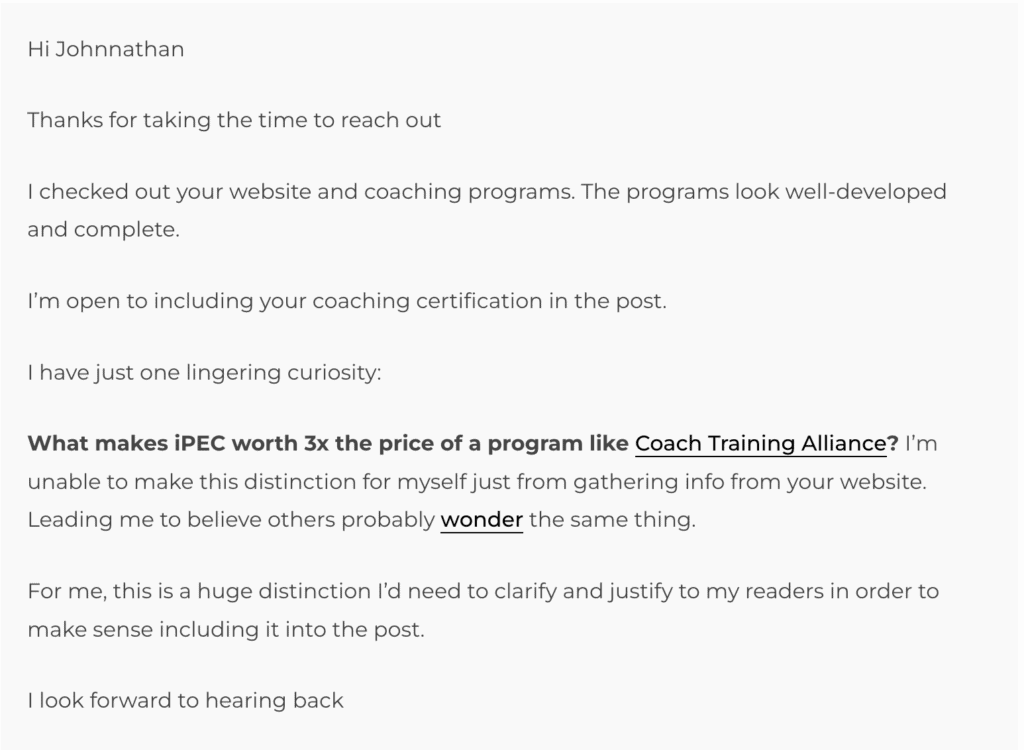
He never heard back from them.
One person’s bad experience doesn’t mean a program can’t benefit others. But at this price, work out which parts of a certification matter most to you, then go ask graduates about those parts specifically.
Watch Out for Fake Reviews
iPEC’s own tuition page currently advertises 235 reviews with a 94% recommend rate, drawn from its Facebook reviews page. That’s the only platform with more than a handful of reviews about iPEC.
On the surface, that makes iPEC look highly rated among students. But Facebook Reviews need a grain of salt.
Facebook Reviews used to work like Google or Trustpilot, with a five-star rating system. That changed a few years back.
Nowadays, a reviewer can either mark a review as “Recommended” or “Not Recommended.” So what happens to old reviews that used the star rating system?
Well, it can get a bit wonky.
For example, this comment mentions not having gone through the certification process yet, and doesn’t say anything negative:

Or this one, which simply asks a question rather than offering a review:
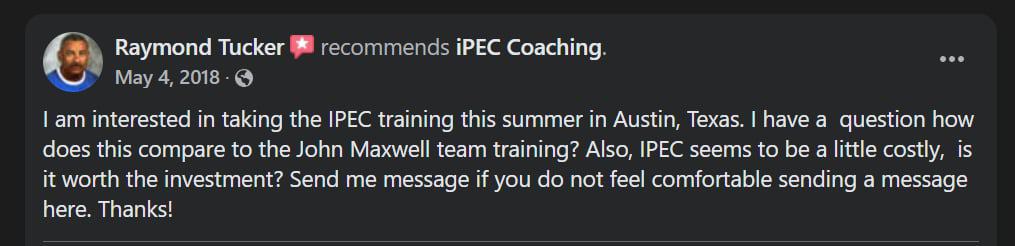
Neither of these should really count as reviews at all.
All of this is to say: the 94% recommendation rate may be skewed. Feel free to read through the reviews yourself and use your discernment.
Personal Growth as an Added Benefit
Several past graduates of iPEC appreciated the energy-centered approach of the program.
For them, the methodology did double duty: it built their coaching skills and pushed their own personal growth along the way.
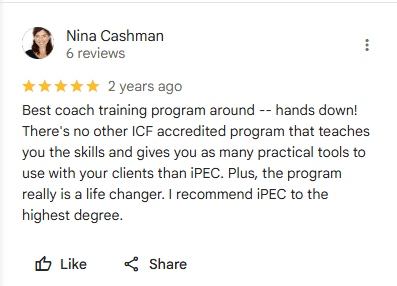
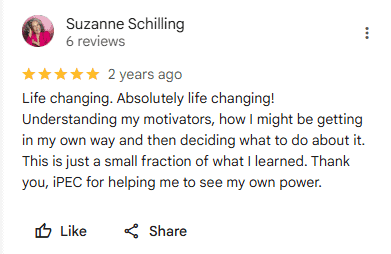
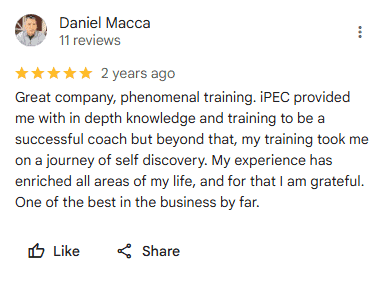
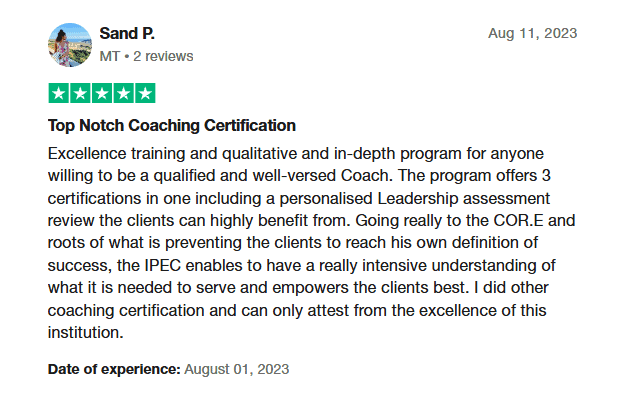
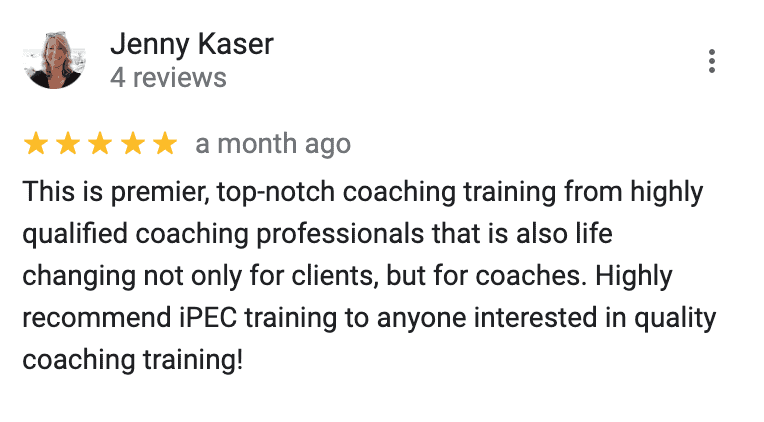
But does personal growth justify a five-figure price tag?
This feedback is promising, but it mostly comes from coaches with no prior training to compare against. Fair enough, since most students enroll for exactly that foundational training. Still, we haven’t found positive reviews from experienced professionals with a wider view of coaching methodologies, unlike when we researched other certification programs.
Should you enroll in iPEC coaching?
The majority of online reviews about iPEC are positive, but there are several red flags that seem concerning for a well-established institute, including:
- Lack of proper support
- Inadequate business training
- Lack of trauma-informed methodology
If you want hands-on training that prepares you to start a practice while helping you grow as a person, iPEC could be a good fit. Just do your own research and compare alternatives first.
Three things to ask admissions before signing: how many mentor coaching and success coaching sessions your quoted package includes, what business training is included versus sold as an add-on, and what happens if you need to pause between modules. That’s where the negative reviews cluster, and all three are answerable in one call.
Certification is only half the job either way. The other half is starting the business itself, and no certificate does that for you. Our guide on how to become a certified life coach lays out the full sequence.
The one thing you don’t want when starting out is manual client management.
Paperbell handles contracts, scheduling, and payments in one system. Its honest limits: it’s not a full marketing website builder for a content-heavy site, there’s no built-in video calling (you connect your own meeting link), and it isn’t a way to run a business at $0 forever. It’s $97 per month or $970 per year, and you can start with a free account, no credit card required.
Try Paperbell for free and get your coaching website live today.
Frequently Asked Questions About iPEC Coaching
What does iPEC stand for?
iPEC stands for the Institute for Professional Excellence in Coaching. The organization now brands itself simply as iPEC Coaching, but you’ll still see the full name on accreditation listings and older directory pages.
Is iPEC coaching certification worth the cost?
It depends on what you’re buying it for. At $9,995 for the Coach Training Program, you’re paying a premium for live training, 160 ICF-accredited hours, and two iPEC certifications rolled into one program, which is genuinely more than most accredited providers bundle together.
Where reviewers push back is on business support and how much material gets packed into each intensive. If your main goal is learning to sign clients rather than learning to coach, that’s the part to press on before enrolling.
Is iPEC ICF accredited?
Yes. iPEC’s About Us page states it has been an ICF-accredited program for more than 20 years, and it was one of the first programs the ICF accredited.
It’s also recognized by HRCI, SHRM, and the CCE, which approves the Coach Training Program for 120 hours toward the Board Certified Coach credential.
What are iPEC’s Google and Trustpilot reviews like?
Both listings exist and both are small, so one strongly worded entry can move the average by a full star. The score itself doesn’t tell you much.
The useful read is the pattern: praise clusters around the live training and personal growth, criticism around business support, session intensity, and mentor coach behavior.
How long does iPEC coaching certification take?
iPEC’s tuition page describes the Coach Training Program as 7 to 10 months part-time, built around three live three-day modules spaced about three months apart. Coaching Fundamentals on its own is a single three-day intensive.
If you add a COR.E® Dynamics specialization afterward, budget another 2 to 4 months of self-paced study on top.
How does iPEC compare to other ICF-accredited coaching schools?
iPEC’s differentiators are the live modules, the accredited hours packed into one program, and mentor coaching built in rather than bought separately. The trade-off is price: it sits at the higher end of accredited coach training.
The fair comparison is cost per accredited training hour, plus how much live contact time you get. Our list of 32 free and paid life coaching certifications lines up the options side by side.
Sources:
Editor’s Note: This post was originally published in January 2024 and has since been updated for accuracy, most recently in September 2026.