
You’ve just finished a discovery call. Your new client is excited, ready to go, and is now staring at you across Zoom waiting for session one to begin. So what do you actually talk about?
Coaching conversations can go a hundred different directions. The coaches who get real results are the ones who pick the right focus. A clear coaching topic is the difference between a pleasant chat and a session your client can feel.
Good news: you don’t have to invent that focus from scratch every time. Below are 50+ coaching topics organized by client type and niche (career, business, health and wellness, relationships, leadership, group coaching, and more), plus 2-3 example questions for every topic so you’re never fumbling for an opener.
What are coaching topics?
Coaching topics are the defined areas of focus that give structure to your sessions. They’re the shared map for the work ahead.
Therapy can be open-ended. Coaching works better with clarity. Both of you benefit from knowing exactly what you’re exploring together, so even when the conversation wanders, you have a home base to come back to.
Think of topics as containers. They hold the goals, the questions, the assignments, and the progress markers. Without them, sessions can feel like free-flowing chats that never quite land.
Coaching frameworks that organize your topics
Before we get to the topics themselves, a quick word on frameworks. A good framework gives each topic a spine so you’re not winging it session to session. Here are the three most-used coaching frameworks and when to reach for each.
GROW (Goal, Reality, Options, Will)
The classic coaching model. Start with the Goal for the session. Explore the current Reality. Brainstorm Options. Commit to the Will (what they’ll actually do).
Best for: goal-setting, career topics, decision-making sessions.
SMART Goals (Specific, Measurable, Achievable, Relevant, Time-bound)
Not really a coaching framework. More a goal-setting discipline you weave into most topics. Reach for it whenever your client’s goal sounds vague (“I want to feel happier,” “I want to grow my business”).
Best for: any session where the goal needs sharpening before the real work can start.
CLEAR (Contracting, Listening, Exploring, Action, Review)
A leadership and workplace coaching favorite. It front-loads contracting (agreeing on what the session is for) and closes with an explicit review of what was agreed.
Best for: executive and team coaching, where stakeholders want to see structure.
You don’t have to pick just one. Most experienced coaches mix and match: GROW for career clarity, CLEAR for a leadership session, SMART whenever a goal needs teeth.
Universal coaching topics for any client
These are the bread-and-butter topics that work for almost any coaching style or client type. Start here if you’re building your first menu of offers.
1. Goal Setting and Achievement
We all have dreams, but turning vague aspirations into real achievements takes structure. This topic helps clients separate what they think they should want from what actually lights them up.
Example questions:
- “If nothing changed in the next year, what would you most regret?”
- “What’s the ‘why’ underneath this goal — what does achieving it make possible?”
- “What’s one step you could take this week that would prove to yourself this is real?”
2. Self-Improvement and Personal Growth
“I feel like I’m always behind and never fully present anywhere.” Sound familiar? This topic helps clients identify what depletes them, what replenishes them, and how to honor what actually matters.
Example questions:
- “When in the past month did you feel most like yourself? What were you doing?”
- “What are three things you’ve outgrown but haven’t let go of yet?”
- “What’s a small daily ritual that would feel like a gift to a future-you?”
3. Confidence Building
Underneath a surprising number of presenting issues is a plain old confidence gap. The client who hesitates to apply, speaks too softly, or needs constant reassurance usually needs support here first.
As a confidence coach, you help clients find the origin of their self-doubt, challenge their limiting beliefs, and build new evidence from a lived experience.
Example questions:
- “Whose voice do you hear when you tell yourself you’re not good enough?”
- “When have you done something that scared you — and it worked out?”
- “What would you do this week if you were 10% more confident?”
4. Effective Communication
Communication isn’t just what’s said. It’s what’s heard, felt, and remembered. This topic closes the gap between what your client means and what the people around them actually receive.
Example questions:
- “Where in your life is the gap between your intention and impact biggest?”
- “What do you wish you could say, but haven’t?”
- “What’s one conversation you’ve been avoiding — and what’s the cost of avoiding it?”
5. Decision Making
Some clients aren’t stuck on a goal. They’re stuck between two options. This topic gives them a process for making cleaner decisions (and actually sticking with them).
Example questions:
- “If you had to decide today, what would you choose — and why does that make you flinch?”
- “What’s the cost of not deciding?”
- “Which option is the ‘safe’ one, and which one are you excited by?”
6. Stress and Overwhelm
Nearly every client brings overwhelm to at least one session. This topic separates the real sources from the imagined ones and builds a plan they can actually follow on a bad week.
Example questions:
- “If you could take one thing off your plate this week, what would it be?”
- “What are you tolerating that you don’t have to?”
- “When does overwhelm show up most — and what usually triggers it?”
Career coaching topics
Career is one of the most-requested coaching categories, and one of the easiest to package, because the client’s pain point is usually specific and measurable.
7. Career Clarity and Direction
For clients who say “I just don’t know what I want to do next.” This topic helps them stop looking for the perfect answer and start testing directions.
Example questions:
- “Imagine it’s two years from now and you love your work. What does a normal Tuesday look like?”
- “What would you do if you knew you could come back to your current career anytime?”
- “What part of your current role would you keep if you could redesign it from scratch?”
8. Career Transitions and Pivots
Changing industries, switching from employee to founder, going back after a break. Career transitions are a coaching sweet spot: the stakes are high and the process is confusing.
Example questions:
- “What skills from your current role transfer directly to where you want to go?”
- “What’s the smallest version of this new career you could try in the next 30 days?”
- “Who already has the job you want? What’s one step you could take this week to talk to them?”
9. Salary Negotiation and Asking for a Raise
Most clients underprice themselves, then get angry about it. Coaching around negotiation gives them language, evidence, and a script.
Example questions:
- “What would you ask for if you knew the answer was yes?”
- “What evidence do you have that you’ve outgrown your current comp?”
- “What number would feel great — and what number would feel like settling?”
10. Interview Confidence and Prep
This topic is pure ROI. Clients land the job, you get the testimonial. Focus on the story, not the script.
Example questions:
- “What’s the story you most want this interviewer to remember about you?”
- “What question are you dreading — and what would a great answer to it sound like?”
- “How do you want to feel walking into the room?”
11. Career Plateaus and Feeling Stuck
For the client who’s doing fine on paper but quietly dying inside. This topic separates “I need a new job” from “I need a new relationship with my current job.”
Example questions:
- “What’s one thing that used to excite you about your work that doesn’t anymore?”
- “Is this a role problem, a boss problem, an industry problem — or a you problem?”
- “What would it take to feel challenged again?”
Business coaching topics
Business coaching clients are usually founders, solopreneurs, or small-team owners. They want more clients, more revenue, or more sanity. Often all three.
12. Defining Your Niche and Ideal Client
This is the single most common sticking point for new coaches and consultants. This topic forces clarity before clients waste months marketing to everyone.
Example questions:
- “Who was your best client ever? What made them great to work with?”
- “If you could only work with one type of person for the next year, who would it be?”
- “What problem do people keep coming to you with, even when you’re not trying to sell it?”
13. Pricing and Packaging
Pricing isn’t just a number. It’s a signal. This topic helps clients price for value instead of pricing from fear.
Example questions:
- “What would you charge if you had a waiting list?”
- “Whose rates are you benchmarking against — and why those people?”
- “What transformation are you actually selling, and what is that worth to your client?”
14. Marketing and Lead Generation
Most business owners want “more clients” but don’t have a clear way to get them. This topic picks one channel and builds a plan.
Example questions:
- “Where did your last five clients actually come from?”
- “What’s one marketing activity you could commit to for the next 90 days, no matter what?”
- “What do you wish your ideal clients knew about you that they don’t?”
15. Sales and Closing Conversations
The discovery call is where most coaching businesses win or lose. This topic turns “pitches” into conversations.
Example questions:
- “Where in your sales conversation do things usually go sideways?”
- “What are you afraid they’ll say?”
- “What would it look like to sell from a place of service, not pressure?”
16. Hiring Your First Team
Solo business owners hit a ceiling the moment they stop being able to do it all. This topic handles the emotional side of delegation, not just the logistics.
Example questions:
- “What’s one task you did this week that a $25/hour contractor could have done?”
- “What are you holding onto because it feels safe, not because it’s the best use of your time?”
- “Who would you hire first if money wasn’t the issue?”
17. Scaling Beyond 1:1 Work
For coaches and service providers who are booked out and still not making what they want. This topic covers group programs, courses, and other leveraged offers.
Example questions:
- “If you could only coach 10 hours a week, how would you earn the rest of your income?”
- “What do you teach every new 1:1 client that could be a group program?”
- “What would doubling your revenue without doubling your hours require?”
Health and wellness coaching topics
Wellness coaching has exploded. So has client skepticism of generic advice. These topics focus on behavior, not willpower.
18. Sustainable Weight and Body Goals
Diets don’t work. Behavior change does. This topic helps clients uncouple body goals from body shame.
Example questions:
- “What does ‘healthy’ actually feel like in your body — outside of a number?”
- “What’s one habit that used to work for you that you’ve dropped?”
- “If you stopped trying to lose weight for 6 months, what would you focus on instead?”
19. Energy and Sleep
Clients rarely realize how much of their “motivation problem” is really a sleep problem. This topic audits the actual inputs.
Example questions:
- “When did you last feel rested — and what was different then?”
- “What’s the first thing you change when life gets busy? What does that cost you?”
- “What would a non-negotiable evening routine look like?”
20. Stress, Burnout, and Recovery
Burnout isn’t a badge. It’s a signal. This topic helps clients recognize the early signs and build recovery into the schedule, not around it.
Example questions:
- “What are the first three signs you’re heading toward burnout?”
- “What do you do to recover, versus what do you tell yourself you’ll do to recover?”
- “What does a real day off look like for you?”
21. Nutrition Habits (Without the Drama)
Most clients know what to eat. They need help with when, how, and why they don’t. This topic is behavioral, not prescriptive.
Example questions:
- “When do you eat in ways you don’t feel good about — and what’s usually happening in your life that day?”
- “What’s one small change you could make that you’d actually keep?”
- “How do you want to feel after you eat — and how often does that actually happen?”
22. Movement and Exercise Consistency
“I know I should work out” is never the real problem. This topic finds the actual obstacle.
Example questions:
- “What kind of movement have you actually enjoyed in the past?”
- “What gets in the way on the days you skip?”
- “What would ‘enough’ movement look like for this season of your life?”
23. Mental Health and Emotional Wellness
Coaching isn’t therapy, and good coaches know where the line is. This topic focuses on day-to-day emotional skills: regulation, resilience, processing, perspective.
Example questions:
- “What helps you come back to yourself when you’re dysregulated?”
- “What support do you have outside of our sessions?”
- “What’s one emotion you’ve been avoiding this month?”
Relationship coaching topics
Relationship coaching covers romantic partnerships, family dynamics, and friendships. Any two (or more) humans trying to figure each other out.
24. Dating and Finding a Partner
For clients who want a relationship and keep hitting the same walls. This topic looks at patterns, not just apps.
Example questions:
- “What’s the pattern you keep repeating — and what’s the part you play in it?”
- “What would a great first date look like, outside of ‘vibes’?”
- “What are you not willing to compromise on? What have you been compromising on?”
25. Communication in Romantic Relationships
Most couples don’t have a love problem. They have a communication problem. This topic gives them a vocabulary.
Example questions:
- “What’s the one conversation you keep having — that never actually lands?”
- “What does your partner do that makes you feel truly heard?”
- “What are you afraid would happen if you said the thing you actually feel?”
26. Boundaries in Family Relationships
Family dynamics pull grown adults back into old roles fast. This topic helps clients show up as the adult they actually are, even at family events.
Example questions:
- “When do you stop feeling like yourself around your family?”
- “What’s one boundary you’ve been meaning to set but haven’t?”
- “What role do you fall into with your family — and is it the one you want?”
27. Friendship and Adult Social Life
Loneliness is an epidemic, and coaching can meet it. This topic helps clients build (and keep) the friendships they want.
Example questions:
- “Who are the three people you’d call if something great happened today?”
- “What’s one friendship you’ve let slip that you’d like to rebuild?”
- “What kind of friend do you most want to be?”
28. Co-Parenting and Parenting Challenges
Parents often come to coaching feeling like they’re failing. This topic brings them back to their own values as a parent, not what the internet is shouting about this week.
Example questions:
- “What do you want your kid to say about you when they’re 30?”
- “What parenting pattern from your own childhood are you trying not to repeat?”
- “What’s one small thing you could change about this week that would feel like a win?”
Coaching topics for women
Women bring a specific set of challenges to coaching. Not because they’re harder to coach, but because the systems around them create pressure points men often don’t feel in the same way. Here are the topics that come up most in life coaching for women.
29. Career Advancement and Leadership for Women
Women often face unique dynamics at work: bias, expectations, being the only woman in the room. This topic addresses external barriers and the internal patterns that can keep capable women from stepping up.
Coaching conversations often explore how to:
- Use her distinctive strengths as advantages, not liabilities
- Build a real network of sponsors and allies (not just mentors)
- Develop an authentic leadership presence without borrowing a style that isn’t hers
Example questions:
- “Where are you waiting to be chosen instead of choosing yourself?”
- “Whose career do you envy — and what specifically do you envy about it?”
- “What would you do this quarter if you stopped trying to be liked at work?”
30. Work-Life Balance (Beyond “Having It All”)
The “having it all” narrative created impossible standards for a whole generation. Here, women stop chasing perfection and start creating rhythms that actually hold up.
Example questions:
- “What does a great week look like for you — not a perfect one?”
- “What have you been trying to do that simply isn’t possible in this season?”
- “Who told you it was supposed to look this way?”
31. Self-Esteem and Self-Advocacy
Many women are told assertiveness reads as “pushy,” so they prioritize likability over asking for what they’re worth. Here, clients learn the difference between self-promotion and honest self-advocacy.
The coaching often addresses patterns of downplaying wins, over-apologizing, and putting others’ needs first as a default.
Example questions:
- “When did you last take credit for something in the room where it happened?”
- “What’s one thing you know you’re great at that you rarely say out loud?”
- “What would change if you stopped apologizing for taking up space?”
32. Navigating Life Transitions
Career shift, motherhood, divorce, empty nesting. Women’s lives are marked by big identity-level transitions. This topic supports clients through the messy middle.
The process often involves:
- Honoring what’s being left behind
- Sitting in the discomfort of the “in-between”
- Writing a new story about who you’re becoming
Example questions:
- “Who were you before this transition? Who do you want to be after?”
- “What part of this change are you grieving? What part are you excited about?”
- “What would it mean to stop rushing through this stage?”
33. Motherhood and Identity
Becoming a mother (or choosing not to) brings identity questions most other transitions don’t. This topic holds space for ambivalence without trying to fix it.
Example questions:
- “What part of yourself have you been told to put on hold?”
- “When do you feel most like you — outside of being a mom?”
- “What kind of mother do you want to be — not the kind you were told to be?”
34. Perimenopause, Menopause, and Midlife
A hugely underserved coaching topic. Women in midlife are often navigating hormonal shifts, career peaks, aging parents, and their own identity reinvention all at once.
Example questions:
- “What did you think midlife would look like — and what does it actually look like?”
- “What would you do next if you stopped pretending to be 32?”
- “What’s one thing you’d give yourself permission for, right now, if nobody was watching?”
35. Money and Financial Confidence
Women are still socialized to not talk about money, which means most carry money stories they’ve never examined. This topic brings them to the surface.
Example questions:
- “What did you learn about women and money growing up?”
- “What would financial confidence look like for you? What would it let you do?”
- “What’s one number you’ve been avoiding looking at?”
Coaching topics for leaders
Leadership coaching is one of the most lucrative coaching niches and one of the most structured. Here are the topics that show up most in leadership coaching.
36. Strategic Vision and Direction
The difference between management and leadership often comes down to vision: the ability to see possibilities beyond the current reality.
Example questions:
- “What’s the future your team would run toward if you painted it clearly?”
- “What are you doing now that won’t matter in 18 months?”
- “What’s the one thing only you can do in your role?”
37. Building High-Performance Teams
A leader’s results ultimately depend on their team. Performance coaching addresses how leaders select, develop, and engage the people around them.
Topics include how to identify talent, delegate real work (not just tasks), give growth-promoting feedback, and create the psychological safety that lets teams take smart risks.
Example questions:
- “Who on your team are you underinvesting in?”
- “What feedback have you been holding back — and from whom?”
- “What does your team need from you right now that they don’t have?”
38. Executive Presence and Influence
Executive presence is about bringing your full, authentic self to leadership moments with confidence and clarity. Executive coaching digs into how leaders show up physically, emotionally, and verbally when the stakes are high.
Example questions:
- “When you imagine yourself at your most powerful, what are you doing?”
- “Who in your org has the presence you want? What do they actually do?”
- “Where do you shrink — and what would it take to stay full-sized?”
39. Managing Change and Complexity
In environments full of rapid change, leaders need adaptive capacity more than technical expertise. This topic is about staying grounded when the ground is moving.
Example questions:
- “What’s the change you’re leading that you haven’t fully accepted yourself?”
- “What are you pretending to be certain about?”
- “What does your team need to hear from you this week — even if you don’t have all the answers?”
40. Leading Through Conflict
Most leaders avoid conflict until it’s expensive. This topic teaches them to lean in early, and listen with intention.
Example questions:
- “What conflict are you avoiding right now — and what’s it costing?”
- “When you imagine the hard conversation going well, what’s different about how you show up?”
- “What’s the story you’re telling yourself about the other person — and is it the whole story?”
Coaching topics in the workplace
These are the topics that come up most in workplace coaching, whether you’re coaching individual contributors, teams, or mid-level managers.
41. Career Development Inside Your Company
Many professionals reach plateaus where they feel stuck or uncertain about what’s next. This topic helps them take ownership of their trajectory instead of waiting to be noticed.
Example questions:
- “What would you do this year if you weren’t waiting for a promotion?”
- “What would make you irreplaceable in your current role?”
- “Who has the career you want three moves from now — and what do they know that you don’t?”
42. Performance Improvement
A good coach works with potential, not just problems. This topic identifies the real factors behind underperformance — clarity, motivation, or skill gaps — and builds a focused plan.
Example questions:
- “What does great performance look like in your role — and where are you falling short of it?”
- “Is this a skill gap, a motivation gap, or a clarity gap?”
- “What’s one metric you’d be proud to move in the next 30 days?”
43. Conflict Resolution at Work
Workplace tension burns energy faster than almost anything else. This topic helps clients address the friction instead of routing around it.
Example questions:
- “What’s the conversation you’ve been carrying in your head for weeks?”
- “What would you say if you knew the other person was going to listen?”
- “What’s your part in this pattern?”
44. Time and Energy Management
Not every productivity problem is a time problem. This topic looks at energy, priorities, and boundaries, then builds systems that actually match how the client’s brain works.
Example questions:
- “When in the week are you most ‘on’? What’s scheduled then?”
- “What are you spending energy on that isn’t moving the needle?”
- “What’s one meeting you could cancel this week and nobody would notice?”
Personal development coaching topics
Personal development is broad on purpose. It covers any topic a life coach might explore that isn’t tied to career, health, or relationships specifically.
45. Values Clarification and Alignment
Many people operate on autopilot, making decisions based on external expectations rather than internal clarity. This topic gets the values on paper, then checks whether the client’s calendar matches them.
Example questions:
- “What are three values you’d never compromise, no matter what?”
- “Looking at last week’s calendar — which values got the most time? Which got the least?”
- “What value have you been pretending matters that actually doesn’t?”
46. Habit Formation and Behavior Change
We’re largely the product of our routines, and changing ingrained patterns takes more than willpower. Clients learn about cue-routine-reward loops, environment design, and honoring progress over perfection.
Example questions:
- “What’s one habit that used to work for you — that fell off?”
- “What’s the smallest version of this new habit that you could do every day?”
- “What needs to change in your environment to make this easier?”
47. Mindfulness and Emotional Intelligence
In a reactive culture, it’s easy to respond impulsively instead of consciously. This topic builds attentional control and emotion recognition, the core skills behind almost every personal goal.
Example questions:
- “When did you last react in a way you later regretted?”
- “What emotion do you have the hardest time sitting with?”
- “What does being present feel like for you, when you actually get there?”
48. Life Purpose and Meaning
The big questions usually show up at transitions, or after reaching a long-chased goal and realizing it didn’t change how you feel. Clients come to this topic asking some version of: “Is this all there is?”
Example questions:
- “What did you love doing as a kid that you’d forgotten about?”
- “When do you feel most alive?”
- “What would you regret not having tried, if you look back at age 80?”
Coaching topics for managers
New managers are often coached last but need it most. These topics hit the biggest transitions managers face.
49. Effective Delegation
The shift from doing to enabling others’ success trips up almost every new manager. This topic addresses the coaching management style and the fear of letting go.
Example questions:
- “What are you still doing by yourself that you shouldn’t be?”
- “What’s the worst that could happen if you handed this off this week?”
- “What does ‘done well enough’ look like — and can someone else hit that bar?”
50. Managing Up and Across
Organizational influence takes more than vertical authority. Managers learn to build productive relationships in every direction: upward, sideways, and downward.
Example questions:
- “What does your boss care most about that you haven’t fully addressed?”
- “Who are the peer stakeholders you need to invest in more?”
- “What’s one ask you’ve been sitting on?”
51. Transitioning from Individual Contributor to Manager
This identity shift challenges even the most accomplished professionals. It’s not a promotion. It’s a new job. Topics include:
- Moving from personal productivity to team results
- Developing oversight systems without micromanaging
- Building leadership presence in a role you haven’t fully claimed yet
Example questions:
- “What part of being an IC are you secretly still doing — and why?”
- “What would a great manager in your role focus on this week?”
- “Who’s a manager you’d want to be? What do they do differently?”
52. Giving Feedback That Actually Lands
Most managers either avoid feedback or deliver it so softly nothing changes. This topic builds a simple, honest feedback practice.
Example questions:
- “What feedback have you been rehearsing but not delivering?”
- “What do you wish your boss would tell you directly?”
- “What makes feedback land for you — and can you do that for your team?”
Group coaching topics
Group coaching lets you serve more clients at lower per-person prices while still delivering real results. The trick is picking a topic that works in a group, where shared experience adds value rather than diluting it.
53. Accountability and Goal Achievement Groups
Peer accountability is one of the highest-leverage things a group can offer. Members set goals, check in weekly, and coach each other between sessions.
Example topics for group sessions:
- “What’s one commitment you made last week — and did you keep it?”
- “Where are you stuck, and what would make you unstuck?”
- “Who’s been a great accountability partner this week, and what made that work?”
54. Confidence and Visibility for Entrepreneurs
Working on confidence in a group is almost unfair. Everyone’s inner critic gets smaller when they see everyone else has one too.
Example group prompts:
- “Share one thing you did this week that scared you.”
- “What’s a belief about yourself you want to leave behind?”
- “Who in the group has courage you want to borrow?”
55. Career Pivoters and Reinventors
People in transition are often isolated. Group coaching with others who are also reinventing themselves is an instant support system.
Example group prompts:
- “What’s the next smallest experiment in your pivot?”
- “What are you afraid of that someone else here has already survived?”
- “What did last week teach you about where you’re actually headed?”
56. Mastermind Groups for Business Owners
A mastermind gives business owners a board of advisors they’d never hire individually. Topics rotate by member need: sales one week, hiring the next, pricing after that.
Example group prompts:
- “What’s the biggest decision you’re sitting on right now?”
- “What number are you chasing — and is it the right one?”
- “What would you do this quarter if you had this group in your corner all year?”
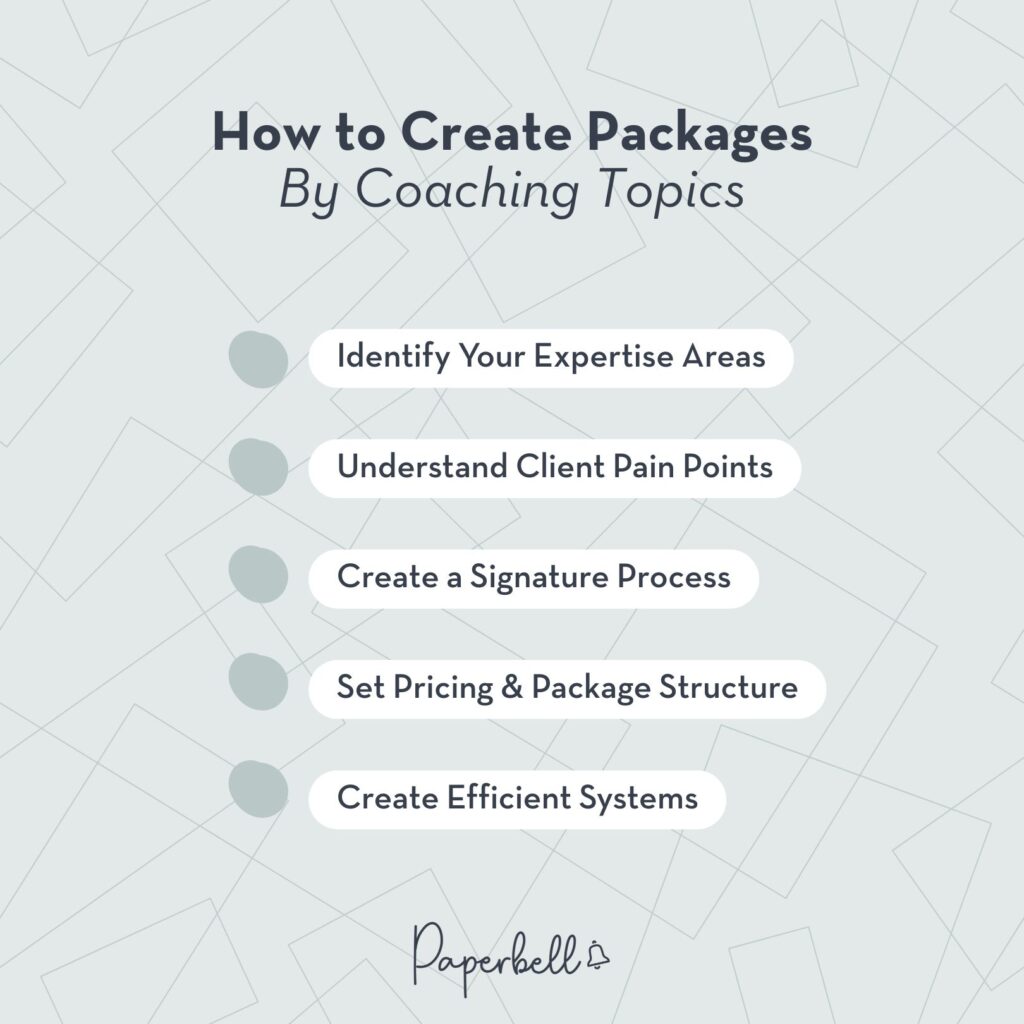
How to create packages by coaching topics
Picking topics is step one. Turning them into packages clients actually want to buy is step two. Here’s the process.
Identify your expertise areas
Focus on the coaching topics where you have real strength, experience, or training. This sets you apart from generalists who try to cover everything, and it creates a clear entry point for clients facing specific challenges.
Understand client pain points
For each topic, get clear on what your ideal clients actually struggle with and what outcomes they most want. That understanding shapes how you position your packages and how you get coaching clients.
Create a signature process
Build a repeatable method for each topic. A clear process builds client confidence and makes your services much easier to describe. Supporting worksheets or resources round out the experience.
Set pricing and package structure
Design your coaching package length and session frequency based on what drives real results for that topic. You can experiment with tiers. Price based on the transformation you deliver, not just the hours you spend.
Create efficient systems
Systems are what turn a great coaching topic into a sustainable business. That’s where Paperbell comes in: an all-in-one coaching platform and no-code website builder built for coaches.
With Paperbell, you can:
- Create distinct packages for different coaching topics
- Set up automated scheduling for every session
- Customize intake form questions per topic
- Manage payments and contracts in one place
- Track your whole client base from one dashboard
So if you offer both a “Leadership Presence” and a “Career Transition” package, Paperbell lets you run them as separate listings with their own session counts, pricing, and supporting materials, all from one website. Less admin, more coaching.
Coaching topics FAQs
What are the most popular coaching topics clients request help with?
The most-requested topics are confidence, career direction, work-life balance, and leadership. That said, what clients ask for at the start often isn’t the real work. Someone booking for “time management” regularly finds out the root issue is boundary-setting or perfectionism.
Which coaching topics are most profitable?
Executive and leadership coaching command the highest rates, followed by business and career coaching. But profitability depends on your expertise, your positioning, and how you package and deliver, not just the topic.
How do I create packages around specific coaching topics?
Pick a topic you have real expertise in, define a clear starting point and outcome, build a repeatable process, and set milestones. Then price it as a transformation, not as a stack of hours.
How many coaching topics should I offer?
Start with one or two. A focused menu beats a scattered one every time. Once you have traction and testimonials, you can expand into related topics your existing clients ask for.
What’s the difference between coaching topics and coaching niches?
A niche is who you work with (e.g. women in tech, new parents, early-career lawyers). A coaching topic is what you work on with them (confidence, career transition, boundaries). Most successful coaches combine one niche with two or three topics.
How do I stay current on evolving coaching topics in my field?
The coaching industry shifts as work, culture, and client needs shift. Stay close to what your clients are actually bringing to sessions, follow thought leaders like Tony Robbins and Brené Brown, and join communities like The Co-Active Network and ICF communities of practice.
Choosing the right coaching topics for your practice
The best coaching happens in the sweet spot between your expertise, your client’s real needs, and the topics that genuinely energize you both.
You don’t need to offer all 50+. Pick two or three that fit your niche, build signature processes around them, and turn them into packages your clients can understand in ten seconds.
The best part? With a coaching platform like Paperbell, you can turn any coaching topic into a clean, bookable package, with scheduling, payments, contracts, intake forms, and client portal all in one place. Try Paperbell for free.