
Turning your coaching process into an online course lets you scale your impact beyond one-on-one sessions. However, if you’ve built your business on deep transformation, it’s natural to worry a course might feel impersonal or surface-level.
This guide walks you through how to translate your coaching expertise into a course format step by step. Start scaling without losing the human element in your work that makes it so effective!
Read on to learn:
- Why packaging coaching into an online course scales your impact
- Key differences between coaching and courses (and how to blend both)
- The 6-step process to turn your coaching into a course
- Common mistakes coaches make when creating courses
- How to price and host your coaching course
Why Package Your Coaching Into an Online Course?
Turning your coaching process into a course helps you scale your business without additional client hours. Here’s how:
- It scales your impact: Share your proven framework with many clients at once.
- It can generate passive income: Set it up once and keep earning from your expertise even when you’re not working.
- It diversifies your target audience: Draw clients into your funnel with a lower-cost product who can’t afford your one-on-one coaching package yet.
- It builds your authority: Position yourself as an expert and build your brand in your coaching niche.
The Key Differences Between Coaching vs. Online Courses
Coaching and online courses both create transformation, but they do it differently. Knowing where each format shines helps you design the right offer.
What Makes Coaching Unique
Coaching is dynamic and personal. It adapts to the client’s mindset, pace, and emotions in real time. In one-on-one or group sessions, you can:
- Ask targeted questions that uncover blind spots.
- Reflect language or patterns back to the client.
- Challenge assumptions or guide through resistance.
- Hold accountability and emotional space that a video or worksheet can’t replicate.
That immediacy, the ability to meet clients exactly where they are, is what makes live coaching so transformational. A hands-on approach with ongoing feedback is also better when working on sensitive issues and high-stakes objectives.
What Translates Well Into a Course Format
Courses are best for frameworks, skills, and repeatable strategies. Anything you find yourself explaining again and again can be turned into lessons. Think:
- Step-by-step methods or models you teach every client
- Foundational exercises or journaling prompts
- Templates, scripts, or assessments that clients can apply independently
A course works when clients can progress at their own pace using structured material that builds on itself. It’s great for education and skill development, less so for emotional processing or personalized behavior change.
How to Blend Both: Hybrid Models
Personal coaching and course materials can go hand in hand. In fact, the most effective programs often combine them. Common hybrid options include:
- Course + group coaching: Clients study foundational concepts independently, then join live calls for discussion and feedback.
- Course + one-on-one sessions: Include a few private calls for tailored guidance and accountability.
- Self-paced course with live Q&As: Hold monthly “office hours” where students can ask questions and share wins. You can also add email or voice chat support in the mix.
These approaches let you scale without giving up on coaching entirely. You deliver structured content once, then connect with clients to help them apply what they’ve learned.
Pro tip: Paperbell makes delivering hybrid programs effortless. You can upload your course materials, schedule live sessions, and manage payments, contracts, and surveys all in one place.
Before We Jump In… Are You Ready to Create a Course?
Before building an online course, make sure your coaching framework is ready to stand on its own. Are these statements true for you?
You have a clear, repeatable process that delivers consistent results.
Clients often ask similar questions or face similar challenges.
You’re fully booked or want to scale without adding hours.
You can define one specific transformation your course will deliver.
You’ve collected testimonials that prove your approach works.
You’re confident in explaining your concepts without the need for live feedback.
If most of these fit, your coaching is structured enough to succeed as a course. If not, get in a few more sessions to refine your process first.
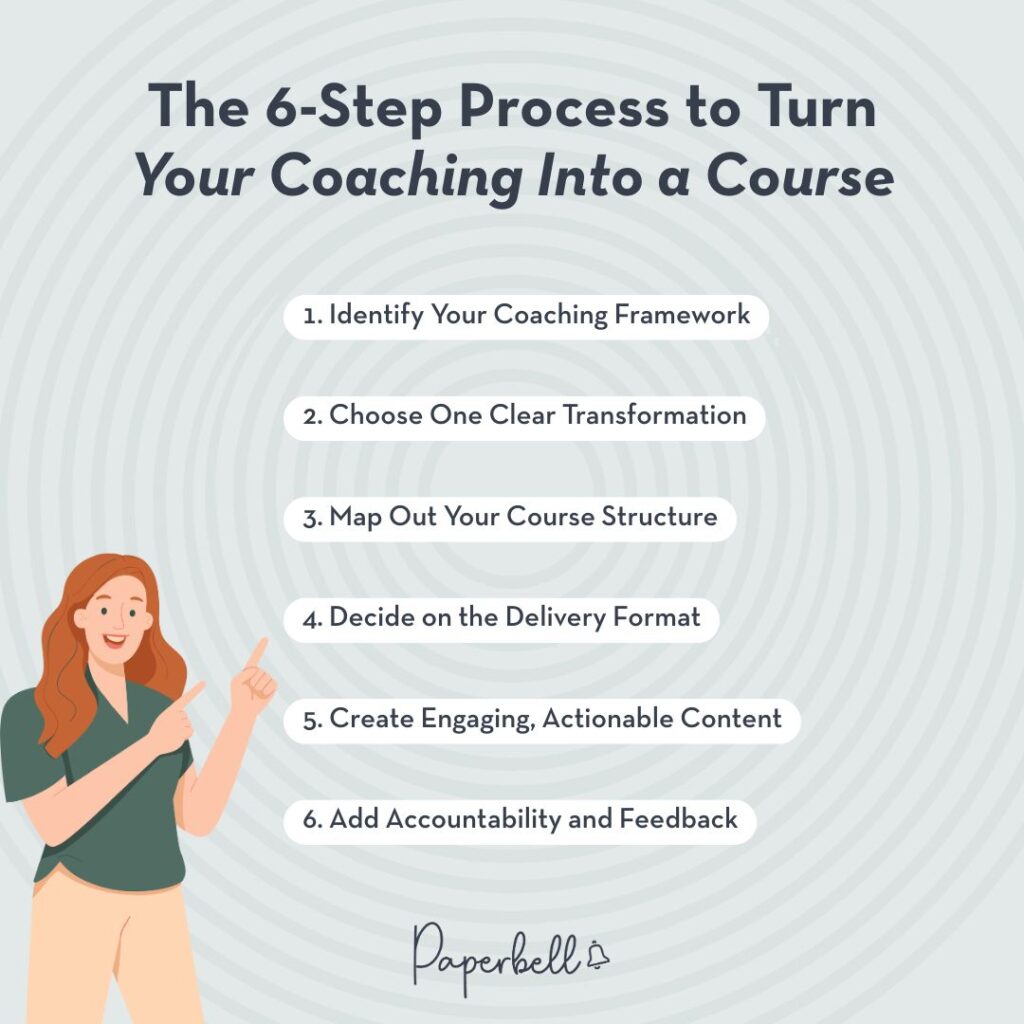
The 6-Step Process to Turn Your Coaching Into a Course
Creating an online course from your coaching practice isn’t about recording your sessions. It’s about designing a learning experience that captures your unique process in a structured, repeatable way.
Here’s how to translate your coaching into a self-paced or hybrid course that delivers real transformation.
1. Identify Your Coaching Framework
Start with what already works. List the main steps or themes you cover with every client, in other words, your signature method.
Each step should represent a key stage in the transformation you help create. These will form your course modules.
Give each stage a clear outcome. For example, “Define your goal,” “Reframe limiting beliefs,” or “Plan consistent action.”
2. Choose One Clear Transformation
Courses work best when they help students achieve a single, well-defined goal. Instead of covering your entire coaching approach, focus on one specific result, like “Build a daily self-care routine” or “Find your first coaching client.”
The narrower your promise, the stronger your course positioning and the easier it is for students to follow through. You can always create additional courses for other parts of your framework later.
3. Map Out Your Course Structure
Turn your framework into a clear, sequential outline. Each module should address one major concept and end with a takeaway or exercise.
You can start with 4-8 modules, depending on the depth of your topic. Keep lessons short, ideally under 10 minutes, to keep viewers engaged.
Include worksheets, prompts, or reflection questions to help students apply what they’ve learned right away. The aim isn’t to overwhelm them with content, but for your course to create results, just like with coaching.
4. Decide on the Delivery Format
Your delivery format determines how much support your students get. The three main options are:
- Self-paced: Students complete lessons independently. Best for evergreen courses or entry-level offers.
- Cohort-based: Everyone starts and progresses together. Great for community and accountability.
- Hybrid: Combine self-study content and call recordings with live group calls or one-on-one check-ins.
Hybrid models work especially well for coaching because they mix scalable teaching with personalized guidance.
5. Create Engaging, Actionable Content
The best coaching courses feel like you’re being coached: clear, supportive, and practical. Avoid long, theoretical videos or content that students can easily find online for free. Instead, teach one key concept per lesson that’s essential for them to reach their goal.
You can add examples from client experiences (without disclosing personal information) to make lessons relatable. A mix of short videos, guided reflections, and downloadable tools helps keep up the momentum for your course participants.
6. Add Accountability and Feedback
Coaching leads to results because clients have support and accountability, so your course needs that too. You can incorporate this through:
- Checklists and progress trackers
- Choosing an accountability buddy from the cohort
- Closed group discussions and regular progress check-ins
- Monthly Q&A sessions and live calls to celebrate wins
Incorporating calls is the most powerful way to troubleshoot challenges with students and re-energize them.
Common Mistakes Coaches Make When Creating Courses
Many coaches rush into course creation before testing out their concepts. This can lead to a low sign-up rate or a negative student experience. Watch out for these pitfalls when creating yours:
- Going too broad: Trying to cram in too many concepts into a course can make the content too generic or overwhelming. Instead, you should aim to help students reach one clear outcome.
- Hours-long footage: It’s okay to add a few live call recordings to a course if other students can learn from it. However, long calls without editing can unnecessarily dilute your course content.
- Fuzzy structure: In the outline of your course, all chapters should build on each other and focus on one key outcome. Make sure all lessons are relatable and actionable.
The solution? Validate your course idea before you launch it to make sure it’s what your students truly want. Here’s how to do it:
- Run a live workshop: Teach one part of your process and gather feedback.
- Survey clients or followers: Ask what problems they’d pay to solve.
- Launch a beta version of your course: Test your content with a few participants before producing the entire course.
If people pay, engage, and ask for more, you’ve confirmed there’s real demand.
How to Price Your Coaching Course
Your course fees should reflect the value they create and how personalized they are, not their length.
For example, if your one-on-one package costs $2,000, a self-paced version that delivers part of the same outcome might fall between $200 and $500. Hybrid programs can be higher if they still include your direct support.
When setting your price, consider:
- The result: What measurable change do students achieve?
- The support level: Do they get live sessions, community, or feedback?
- Your positioning: Are you offering an entry-level product or a premium experience?
- Other courses: How does your program compare to similar ones in your niche?
You can test your pricing by running a smaller beta round first at a discounted rate. Gather feedback, measure completion rate and student experience, and raise the price once you confirm the results.
The Best Platforms to Host Your Coaching Course
The right platform depends on how complex your course is and whether you need community management features.
Best all-in-one option for coaches:
- Paperbell: Ideal for hybrid coaching programs. You can upload course materials, manage contracts and payments, and schedule sessions in one place. Clients get a private portal where they can access lessons, forms, and bookings.
Best for larger or more interactive courses:

- Kajabi: Offers strong marketing tools, email automation, and customizable landing pages for scaling your online school.
- Thinkific: Great for structured, professional courses with quizzes, certificates, and built-in community features.
- Podia: Good entry-level option that combines courses, email, and digital product sales in one clean interface.
Looking to expand your coaching business further? Here are some guides we’ve covered previously:
- How to Get Started With Done-for-You Digital Products
- 5 Best Platforms to Sell Digital Products as a Coach
- The 5 Best Business Coaching Courses to Start
FAQs About Turning Your Coaching Package Into a Course
Should I Turn My Coaching Into an Online Course?
Create a course when your coaching process delivers consistent results and can be taught step by step without live interaction.
What Tool Can I Use to Turn My Coaching Into an Online Course?
Paperbell allows you to host materials and manage scheduling and payments for hybrid coaching courses. Kajabi, Thinkific, and Podia are great for more robust courses or coaching schools with a community around them.
How Long Should My Coaching Course Be?
Most courses include around 4-8 modules. These are usually enough to deliver transformation without overwhelming students or lowering completion rates.
Can I Still Do One-on-One Coaching If I Create a Course?
Of course! Many coaches blend online courses with private or group sessions to provide hands-on support while scaling their work.
Do I Need a Big Audience to Launch a Coaching Course?
Not necessarily. You can offer it to your existing leads who may not be able to afford your full program. Or, you can design a course with a different focus for existing clients.
What’s the Difference Between a Coaching Program and an Online Course?
A coaching program includes live guidance and accountability. An online course is structured, self-paced learning that covers specific outcomes.