

You’re thinking about getting ICF-certified. Or maybe you’re wondering if you even need to.
Here’s the honest answer: it depends. Not in a wishy-washy “it’s complicated” way. It genuinely depends on the kind of coaching you want to do, who your clients are, and how much you’re willing to spend before you’ve earned a single dollar from coaching.
ICF (the International Coaching Federation) is the biggest name in coaching credentials. Their certifications are recognized everywhere, especially in the corporate world. But they also cost thousands of dollars, take months (sometimes years) to complete, and come with renewal fees that never really stop.
So is it worth it? We asked real coaches with years of experience. Their answers are… mixed.
The Short Answer: Do You Need ICF Certification?
Let’s save you some scrolling.
Going into corporate or executive coaching? ICF certification is probably worth the investment. HR departments want to see credentials. When they’re choosing between two coaches, the one with “PCC” after their name gets the call. It’s not fair, but it’s how it works.
Life coach, wellness coach, relationship coach? You probably don’t need ICF specifically. Your clients care about results, not acronyms. A good training program matters. The ICF stamp on it? Less so.
Just getting started? Get trained first. Seriously. Don’t skip training. But you don’t need to go straight to ICF. Many coaches build successful businesses with non-ICF certifications, then decide later whether the ICF credential is worth adding.
Health or wellness coach? Look at NBHWC instead (more on that below). It’s designed for your niche and often a better fit.
Below, we’ll get into the costs, the certification process, what real coaches say about their experience, and some alternatives worth looking at.
What Is the ICF Certification?
ICF certification is a credential awarded to coaches who meet the specific accreditation requirements of the International Coaching Federation (ICF). It’s one of the most widely recognized coaching credentials in the world.
Beyond just a title, an ICF coaching certification serves as a hallmark of your proficiency and commitment as a coach. It shows that you adhere to ethical coaching practices and gives you a competitive edge, especially in corporate coaching.

HR representatives and people who seek out coaching services often prefer certified coaches. That’s because of the quality assurance and strict evaluation criteria of coaching organizations.
Certification by ICF doesn’t just validate a coach’s skills. It also signifies their dedication to continuous learning and improvement in the field.
Pro tip: Want to display your ICF certification and make it easier than ever for clients to book your services? Try Paperbell for free to get a gorgeous site fully connected with bookings, payments, forms, automations, and more.
How Much Does It Cost to Get ICF Certified?
The primary cost associated with getting ICF certification is the training fees. These depend on which ICF-accredited coaching certification you choose. That being said, it ranges from at least $5,000 to $12,000.
ICF differentiates three levels of certifications that impact the cost of your training. These levels are:
- ACC (Associate Certified Coach)
- PCC (Professional Certified Coach)
- MCC (Master Certified Coach)
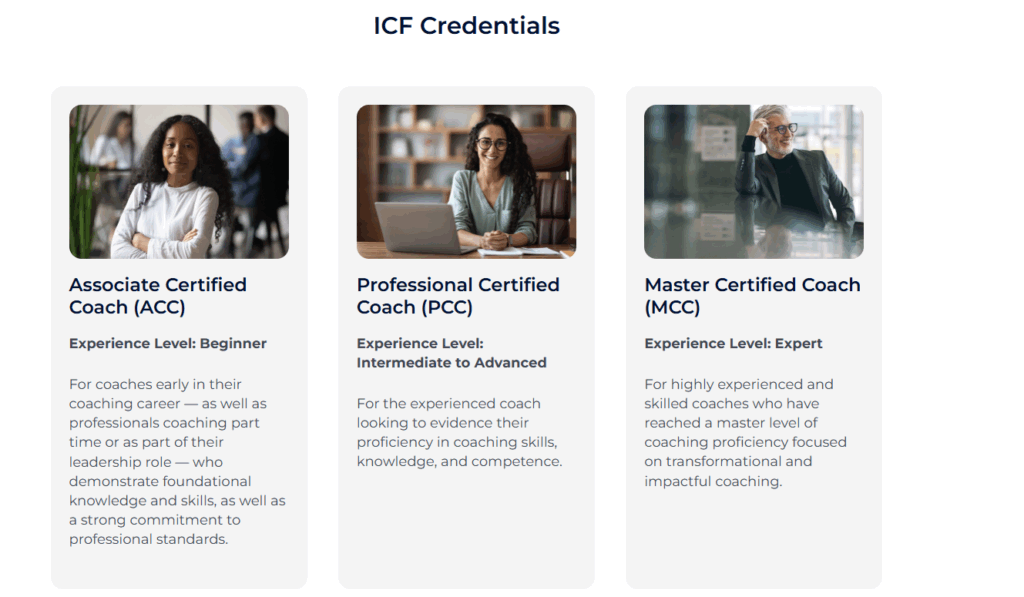
In addition to training fees, you’ll also need to pay application fees before your exams to receive your credentials. These fees range from $175 all the way to $900, depending on which level and accreditation path you choose.
For example, as a non-ICF member, the very lowest you’ll pay is $325 for the ACC certification. The same application costs $175 for ICF members.
There may be additional fees during the certification process related to the following:
- Mentor coaching: If your training doesn’t include mentor coaching, you must work with a supervising coach for a set number of hours to complete your certification requirements.
- ICF membership fees: Though optional, ICF members have lower application fees. They can access various educational materials provided by the organization at a lower rate.
- Continuing education: ICF organizes various coaching workshops and conferences for its global network to help coaches stay up-to-date with industry standards and make new connections. To renew your certification every few years, you must acquire Continuing Education Credits by attending these events.
How Do I Get an ICF-Accredited Coaching Certification?
1. Choose an Accredited Training Provider
To acquire ICF credentials, you need to get trained first. Choose a certification provider based on your coaching specialization and the curriculum that fits your priorities.
For example, some certification centers focus on helping you get new clients. Others focus on niche methodologies instead.
Some curricula revolve around a particular coaching specialty, such as:
Others focus on competencies required for life coaching in general.
2. Complete Your Training
Depending on the level of certification and schedule you choose, your training may take anywhere from a few days to 18 months. Some certification programs are held on weekends and can be organized around a full-time work schedule.
Others have a more intensive structure and require you to take time off.
The training curriculum will typically cover the following:
- Core coaching skills and competencies, such as active listening, coaching questions, and goal setting
- Ethical standards according to ICF’s Code of Ethics
- Supervised practice sessions with real-time feedback
- Mentor coaching with an experienced ICF-certified coach
- Specialized training tailored to your niche
- Evaluation and feedback that ensures adherence to ICF standards
3. Apply for Your Credentials
Once your training is complete, you need to apply for ICF credentials. For this, you need to submit:
- A certain number of logged coaching hours, depending on which credential you’re applying for (you can use Paperbell to log this automatically when your clients book through your coaching website)
- Session recordings (if ICF-accredited evaluation isn’t a part of your program)
- Documents like previous certificates or information about your external mentor coach
- Application fees
These may vary from program to program, so check the specific requirements of the one you’re enrolled in.
Please note that you must pay renewal fees and submit further documentation to the organization every few years to keep your ICF credentials.
How Do I Become an ICF Member?
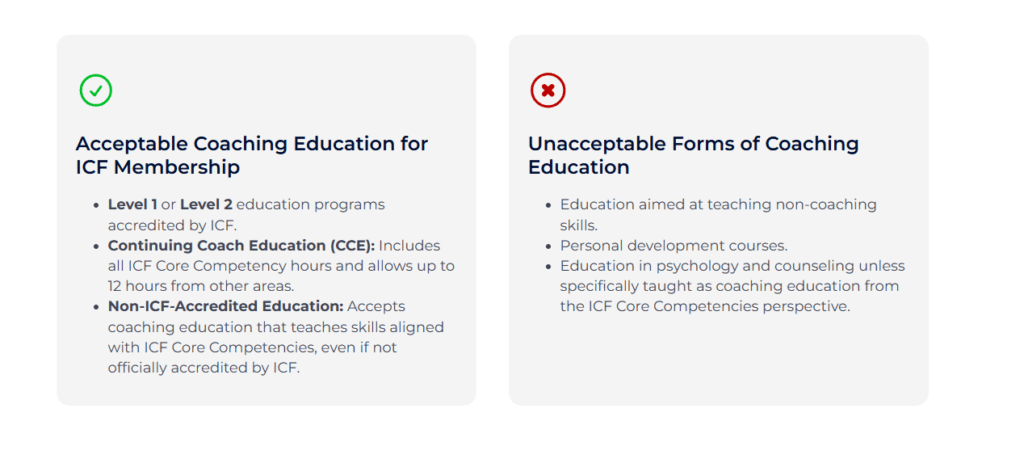
To join ICF as a member, you need to fulfill one of the following requirements:
- Holding an ICF credential of any level;
- Completing at least 60 hours of coach-specific training that meets ICF standards; or
- Being enrolled in such a program that will provide you with at least 60 hours of coach-specific training
What Coaches Think About ICF Certification
There are pros and cons to getting certified by an ICF-accredited organization. Here are some reviews and perspectives from experienced coaches to help you decide what’s best for you.
Note: We’ve not taken any of the ICF-accredited programs ourselves. If you’re looking for more detailed information about the individual certification programs, we encourage you to reach out to past trainees to inquire about their experience.
Are Credentials Really Necessary?
Coaching is an unregulated industry, meaning you don’t have to be a licensed professional to practice.
Other professional bodies, like Licensed Mental Health Counselors (LMHC) or Board Certified Doctors, operate within strict legal requirements. Therapists and doctors have to pass a bar to be permitted to work in their profession.
If they step over the line, they can lose their license or even face criminal charges.
With coaching, it’s different. The ICF has no legal power. Even in the extremely unlikely event of revoking your membership, they can’t stop you from practicing coaching.
Tim Brownson has been in the field for almost two decades. He’s a certified coach, but not by an ICF-accredited organization. Here’s his point of view on credentials in general.
“I have been coaching full-time for almost 18 years and do you know how many times I have been asked if I had ICF accreditation? Once. And that person hired me even though I said I didn’t.
That doesn’t mean formal training isn’t important. I spent north of $25k on a lot of training both in the UK and the US. Training will build your confidence and (presuming it’s good training) ensure you’re a competent coach equipped to help your clients.”
On the other hand, he also points out the difference between working in the corporate world and other coaching specialties. Human resource departments that hire coaches do their due diligence.
Those three letters on your resume can, at times, set you apart from other candidates.
As Tim explains:
“I worked with HR departments for a number of years and they will want to see the certificates and proof of competency. The Human Resource department is there to mitigate risk and any potential liability. As such, they have a tendency to play things safe.
They don’t want to roll the dice on somebody who sounds credible but has nothing to back it up with. Especially when they have somebody sporting the MCC (Master Certified Coach) moniker applying for the same position/opportunity. If that is your target market, then do your due diligence and take a look at the ICF.”
So for executive and business coaches, the credibility ICF provides matters. However, if you’re in a different niche or coach businesses outside the corporate sector, you can find lower-cost training alternatives that don’t have ICF stamped on them.
When you weigh your options, consider both training quality and how much credentials matter for your target clients.
Certification Standards You Can Trust
ICF calls itself the gold standard of coaching. Accredited organizations go through an evaluation just as strict as the trainees of their programs.
Dr. Paras is an ICF-certified life and leadership coach with over 17 years of experience, who also runs an ICF-accredited training center. Here’s how he explains the advantage of the rigorous certification requirements ICF reinforces.
“ICF governs the standards of coaching and has been doing it for over 25 years. As there is no formal license being offered in coaching, it is pertinent to make informed choices while hiring a coach for corporate or individual training.
The ICF certification is offered only after the required coach-specific training hours and call logs are submitted and the evaluation test is cleared.”
Acquiring ICF credentials doesn’t just testify to your qualifications, but also to your commitment to your coaching career. After all, if you’ve invested thousands of dollars and years of your career to get through this process, you’ll likely stick to it.
Lifetime Renewal Costs
Michele signed up for a Level 1 certification program to receive her ICF accreditation. However, after she realized how much her renewal exams would cost her over the lifetime of her career, she was reluctant to go through them.
To renew her ACC certification, she would need to go through another 10 hours of mentor coaching every three years, even if she’s been actively working with clients.
As she explains:
“So many coaches say they struggle to get clients. However, if people getting or renewing an ACC must get 20 hours of mentor coaching (10 to obtain, 10 to renew), that creates a built-in market for coaches to coach other coaches.
And, in fact, in searching, I found tons of websites with PCCs or MCCs offering “mentor coaching packages” that were all $1000+. I would love to know how many of those coaches are coaching non-coach clients, or if the bulk of their business is coaching other coaches?”
She went on to question whether the high costs of these credentials are bloated because of a pyramid scheme that the need for mentor coaching creates.
Note that she didn’t question the quality of the training she received, and she still decided to complete her initial certification process. She simply critiqued the renewal process and the costs incurred by it.
Continuous Education Throughout Your Career
Many aspiring coaches think they need to get certified at the very beginning of their career to start coaching, but this isn’t necessarily true. Many trainees join ICF-accredited programs after years of professional experience.
Jim Livingstone, ICF-certified executive coach, writes about how his certification has given him a new start in his career.
“One of the hardest parts about this journey has been accepting all the things I do wrong, or could do better. In other words, recognizing all the bad habits I have and the need to change. […] I have been coaching the problem and not the person. With this in mind, I believe that my journey is just starting, and I am determined to develop my coaching abilities even further.”
In a field where most professionals are self-employed and run their businesses on their own, a network of fellow coaches can prove invaluable too. Whether it’s the credential, the hands-on training, or the support system you most appreciate, it’s worth looking at your certification as an investment in your long-term career growth.
ICF vs Other Coaching Certifications
ICF gets the most attention, but it’s not the only option. Depending on your niche, a different certification might actually be a better fit.
| Certification | Best For | Approx. Cost | Time to Complete | Recognition |
|---|---|---|---|---|
| ICF (ACC/PCC/MCC) | Corporate, executive, leadership coaching | $5,000–$12,000+ training, $175–$900 application | 6–18 months | Most widely recognized globally |
| NBHWC | Health and wellness coaching | $3,000–$5,000 for training + $300 exam | 6–12 months | Top credential for health coaching, recognized by medical community |
| CTI (Co-Active) | Life coaching, personal development | $6,000–$12,000 | 6–12 months | Well-respected; training also counts toward ICF hours |
| iPEC | Life and leadership coaching | $10,000–$13,000 | 6–9 months | Strong reputation; also ICF-accredited |
| ICF-accredited programs (e.g., Coach U, JRNI) | Varies | $4,000–$12,000 | 6–18 months | Automatically count toward ICF credentials |
A few things that jump out:
CTI and iPEC are both ICF-accredited. So if you complete their programs, you can still apply for ICF credentials afterward. You’re not choosing one over the other. You’re choosing a training style that also keeps the ICF door open.
NBHWC is a totally different thing. The National Board for Health & Wellness Coaching isn’t connected to ICF at all. If you’re a health coach, NBHWC certification is what employers and insurance companies increasingly look for. It’s gaining ground fast.
And remember: no certification is legally required. Coaching is unregulated. You can practice without any of these. But training (from someone) matters. The real question is which credential, if any, gives you the best return for your specific situation.
So… Should You Get ICF-Certified?
It comes down to this.
If you want to coach executives at big companies, ICF certification is a smart move. HR departments look for it. It opens doors that are harder to open without it.
If you’re building a coaching practice outside the corporate world? Your clients care about whether you can help them, not which organization accredited you. Get trained. Get good. The letters after your name matter way less than the results you deliver.
And if you’re still early in your coaching journey, here’s the best advice we can give: don’t let the certification question delay you from actually coaching. Too many coaches spend years (and thousands of dollars) preparing to launch instead of just… launching.
Whatever path you choose, at some point you’ll need a way to actually run your coaching business. Scheduling. Payments. Packages. Contracts. All the stuff that has nothing to do with your training but everything to do with getting paid.
Paperbell handles all of it in one place, so you can focus on what you actually got trained to do.
FAQs About Getting ICF Certified
What is the ICF certification?
The ICF Certification is a credential awarded by the International Coaching Federation (ICF) to coaches who meet its training, experience, and ethical standards. It’s one of the most popular forms of certification in the coaching world.
How much does it cost to get ICF certified?
The cost to apply for an ICF certification for non-members is $325 at the ACC level, $525 for PCC, and $825 for MCC. This doesn’t include the cost for the training, which can range from $5,000 to $12,000.
What is the fastest way to become ICF-certified?
The quickest way to get ICF-certified is to complete an accredited Level 1 or 2 program with a condensed schedule (some take only a weekend) and apply for your credentials at the ICF.
Is it worth getting ICF-accredited?
Getting ICF-certified can be a great investment if you want to build expertise and earn credibility as a coach, especially in the corporate world or a competitive niche. It ultimately depends on your long-term career goals and target clientele.
Can you coach without ICF certification?
Yes. Coaching is an unregulated profession, which means there’s no legal requirement to hold any certification — ICF or otherwise. Thousands of successful coaches practice without ICF credentials. That said, getting trained by a reputable program (whether ICF-accredited or not) is still a good idea. Certification isn’t required, but competence matters.
What’s the cheapest way to get ICF certified?
The most affordable route is to complete an ICF-accredited Level 1 program (some start around $5,000), become an ICF member to get the lower application fee ($175 vs $325 for ACC), and apply as soon as you’ve logged the minimum coaching hours. All in, you’re looking at roughly $5,500–$6,000 minimum. Renewal every three years adds more costs — including 10 hours of mentor coaching, which typically runs $1,000+.
Editor’s Note: This post was originally published in January 2024 and was last updated in March 2026.