
You’re ready to go deeper with your coaching. You’ve seen what a great executive coach can do for a leader, and you want to deliver that same kind of transformation. But now you’re staring at a list of programs that all claim to be “the best,” and they’re not exactly cheap.
Here’s the thing. Not every executive coaching certification is built the same. Some will get you credentialed and connected. Others will leave you thousands of dollars out of pocket with a certificate nobody recognizes.
The good news? We’ve done the research so you don’t have to. Below you’ll find the 10 best executive coaching certification programs for 2026, with current pricing, accreditation status, and honest notes on who each one is best for.
What Is an Executive Coaching Certification?
An executive coaching certification is a formal credential that shows you’ve completed a structured training program and developed the skills to coach business leaders, executives, and high-performers.
It’s different from general life coach training. Executive coaching programs focus on organizational behavior, leadership dynamics, business strategy, and the unique pressures that come with leading a team or a company. You’ll learn how to help clients tackle things like:
- Leadership transitions (new executives, promotions, restructures)
- High-stakes communication and conflict
- Building executive presence
- Navigating organizational politics
- Performance under pressure
Most serious programs are accredited by the International Coaching Federation (ICF), the gold standard for coaching credentials worldwide. Some also carry accreditation from the European Mentoring and Coaching Council (EMCC).
Do You Need an Executive Coaching Certification?
Technically? No. There’s no law requiring a certification to call yourself an executive coach.
Practically? It depends on who you want to work with. Many corporate clients and HR departments specifically ask for ICF credentials when hiring coaches for their executives. If you want to work with Fortune 500 companies, land leadership coaching contracts, or charge premium rates ($300-$500+ per hour), a recognized credential matters.
That said, certification alone won’t build your practice. You still need a way to manage clients, handle scheduling, and get paid reliably. We’ll come back to that.
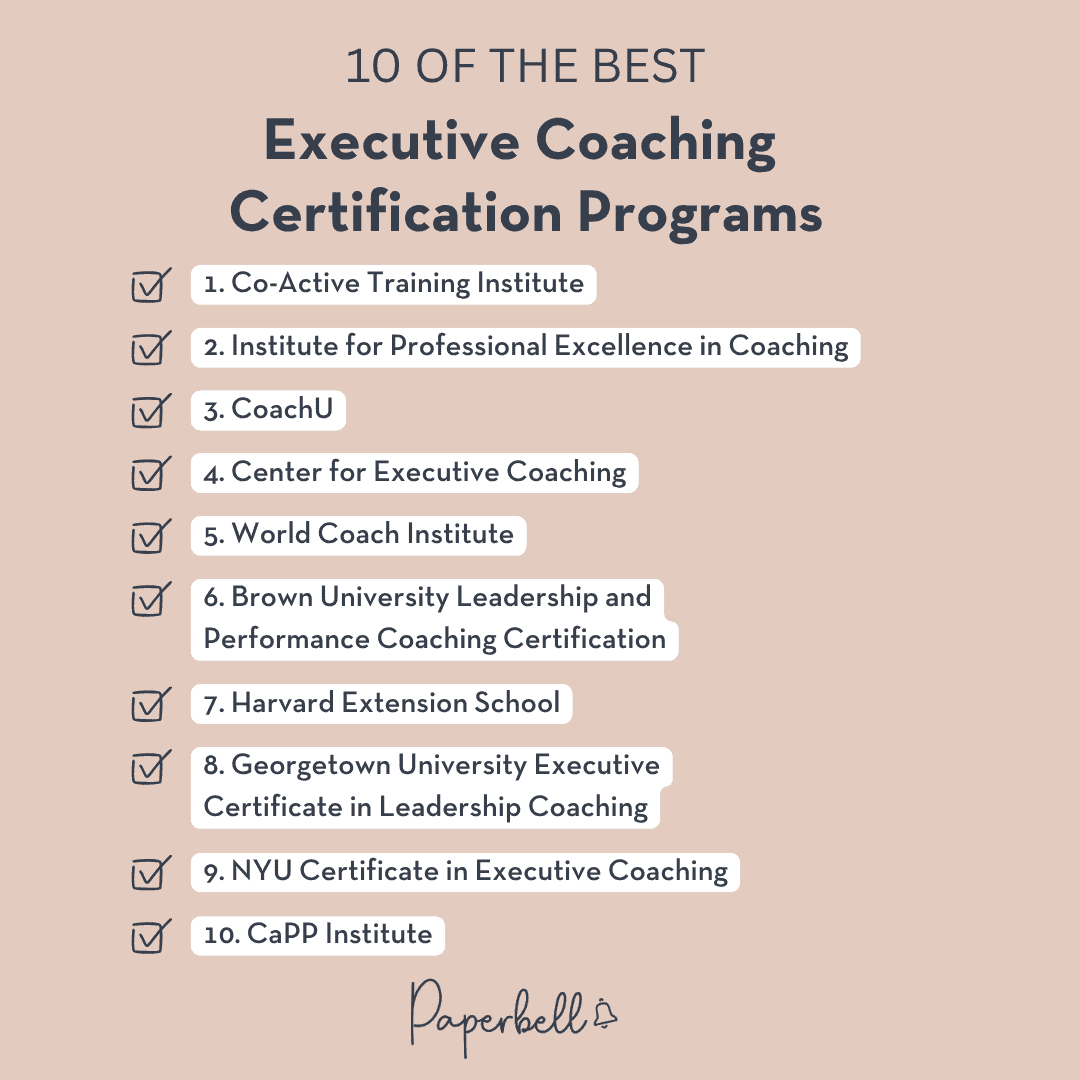
Quick Comparison: Top 10 Executive Coaching Certification Programs (2026)
Here’s a snapshot of all 10 programs before we dig in:
| Program | ICF Accreditation | Duration | Cost (approx.) | Best For |
|---|---|---|---|---|
| Co-Active Training Institute (CTI) | Level 2 | ~11 months | ~$14,000–$15,500 all-in | Coaches wanting deep experiential training |
| iPEC Coaching | Level 1 & Level 2 | ~1 year | $9,995–$15,980 | Career-changers, new coaches |
| CoachU | Level 1 & Level 2 | 6–24 months | $5,995–$11,190 | Budget-conscious coaches seeking ICF hours |
| Center for Executive Coaching | Level 1 | 6 months | ~$7,500 | Coaches targeting corporate/C-suite clients |
| World Coach Institute | Level 1 | 6–12 months | Varies | Flexibility-focused coaches |
| Brown University (Leadership & Performance Coaching) | Level 1 | 6 months | $10,495–$12,495 | University-backed credential seekers |
| Harvard Extension School | Not ICF-accredited | 1 semester | ~$3,500 | Executives adding coaching to their leadership toolkit |
| Georgetown University | Level 1 | ~9 months | ~$15,500 | Those wanting a university-backed ICF credential |
| NYU Certificate in Executive Coaching | Level 1 | 1 year | ~$12,500 | NY-area coaches, strong academic reputation |
| CaPP Institute | Level 1 | 6–12 months | Varies | Coaches integrating assessment tools |
Types of Executive Coaching Certification Programs
Before picking a program, it helps to understand how the ICF accreditation system works. ICF updated its program naming in 2022, so if you’ve been researching for a while, you may have seen the old terms.
ICF Level 1 (formerly ACSTH — Accredited Coach Specific Training Hours)
Level 1 programs are ICF’s entry-level accredited pathway. They require a minimum of 60 training hours and prepare graduates for the ICF Associate Certified Coach (ACC) credential. This is where most coaches start.
These used to be called “ACSTH” programs, but ICF rebranded them to “Level 1” in 2022. If a program still advertises ACSTH accreditation, it’s using outdated language. Confirm the current status directly with ICF.
ICF Level 2 (formerly ACTP — Accredited Coach Training Program)
Level 2 programs are the more intensive route. They require a minimum of 125 training hours plus supervised coaching, and they prepare graduates to apply directly for the Professional Certified Coach (PCC) credential, skipping several requirements of the portfolio path. These used to be called “ACTP” programs before the 2022 rebrand.
Portfolio Path (formerly CCE — Continuing Coach Education)
If you’ve already accumulated coaching hours from multiple programs, the portfolio path lets you combine them toward an ICF credential. You submit documentation of your training, mentoring hours, and coaching experience rather than completing a single accredited program from scratch.
2026 update: Effective January 1, 2026, ICF updated the Minimum Skills Requirements (MSRs) for ACC and MCC candidates. If you’re mid-program, confirm your program’s training has been updated to reflect the new requirements before you apply.
10 Best Executive Coaching Certification Programs for 2026
1. Co-Active Training Institute (CTI)
CTI is one of the most recognized names in professional coach training, and its Co-Active model has influenced executive coaching programs worldwide. The curriculum is experiential: you’re not just reading about coaching, you’re in the room doing it.
What to know:
- ICF accreditation: Level 2 (formerly ACTP)
- Duration: Approximately 11 months
- Cost: Approximately $14,000–$15,500 all-in (the core course bundle is around $10,470)
- Format: In-person intensives plus virtual sessions
- Credential path: Qualifies for PCC direct application
Best for: Coaches who want a deeply transformational personal experience alongside the technical training. CTI’s approach asks you to do your own inner work alongside the curriculum, which isn’t for everyone, but coaches who want to show up authentically with C-suite clients tend to find it worth it.
2. iPEC Coaching (Institute for Professional Excellence in Coaching)
iPEC’s Coach Training Program (CTP) is one of the most popular options for career-changers coming into coaching from corporate backgrounds. It’s known for its Energy Leadership framework, which gives coaches a practical assessment tool to use with executive clients.
What to know:
- ICF accreditation: Level 1 and Level 2
- Duration: Approximately 1 year
- Cost: Base CTP $9,995; full program with add-ons up to ~$15,980
- Format: Primarily virtual with some live components
- Bonus: Includes the Energy Leadership Index (ELI) assessment certification
Note on pricing: iPEC’s pricing structure has shifted in 2026. The base CTP is $9,995, but the program has optional add-on certifications that increase the total cost. Make sure you’re comparing apples to apples when you see quotes: ask specifically what’s included.
Best for: New coaches or career-changers who want a comprehensive program with built-in assessment tools for corporate clients.
3. CoachU
CoachU has been training coaches since 1992, making it one of the oldest programs on this list. It’s a solid choice if you want a well-established, ICF-accredited pathway at a price point that’s more accessible than some of the university programs.
What to know:
- ICF accreditation: Level 1 and Level 2
- Duration: 6 months (core) to 24 months (full program)
- Cost: Phase 1 from $5,995 (early bird); full program approximately $11,190
- Format: Virtual, self-paced with group calls
Best for: Coaches who want a well-credentialed program without the five-figure price tag of a university certificate.
4. Center for Executive Coaching (CEC)
The Center for Executive Coaching was founded by Andrew Neitlich and specifically designed for coaches working with business leaders and executives. Unlike general coaching programs that you then adapt to an executive audience, CEC builds the business context in from the start.
What to know:
- ICF accreditation: Level 1 (ICF-accredited program)
- Duration: Approximately 6 months
- Cost: Approximately $7,500
- Format: Virtual, cohort-based
- Includes: Business development training, coaching tools, and a license to use CEC materials with clients
What coaches say about CEC: The program gets consistent praise for its practical, business-first approach. Graduates frequently mention the focus on “getting clients” alongside the coaching methodology. Andrew Neitlich is unusually direct about the commercial side of building a coaching practice, which resonates with coaches transitioning from corporate careers.
The program also offers a licensing model that lets certified graduates use CEC’s tools, assessments, and frameworks with their own clients. That’s something you don’t get from most university programs.
Is CEC accredited? Yes. CEC holds ICF Level 1 accreditation, meaning its training hours count toward the ACC credential application. Check their site directly for the most current ICF program listing.
Best for: Coaches who want an executive-specific curriculum at a mid-range price point, with a strong business development component built in.
5. World Coach Institute (WCI)
WCI offers a flexible online program that caters to coaches who need to fit training around an existing career or coaching practice. It’s particularly appealing if you’re transitioning from another field and can’t commit to in-person intensives.
What to know:
- ICF accreditation: Level 1
- Duration: 6–12 months depending on pace
- Format: Fully online, self-paced with live components
Best for: Coaches who need maximum scheduling flexibility while still earning ICF-recognized training hours.
6. Brown University Leadership and Performance Coaching Certification
Brown University’s professional development program is one of the most recognized university-backed options for executive coaching credentials. The program is offered through Brown’s School of Professional Studies and runs in cohorts through the year.
What to know:
- ICF accreditation: Level 1 (ACC pathway)
- Duration: Approximately 6 months
- Cost: Virtual programs from $10,495 (early bird) to $10,995; Hybrid programs $11,495–$12,495 (2026 pricing)
- Format: Virtual or hybrid cohort
- URL: professional.brown.edu — Leadership and Performance Coaching Certification
The program pairs coaching methodology with Brown University’s academic rigor, and the cohort model means you’re learning alongside other professionals rather than watching videos alone. Spring 2026 cohorts are currently enrolling.
Best for: Coaches who want a university-backed credential and the professional network that comes with it, at a price below the Georgetown and NYU equivalents.
7. Harvard Extension School — Leadership Coaching Certificate
Harvard’s Extension School offers a graduate certificate in leadership coaching that’s well-regarded in corporate settings. It’s worth noting upfront: this program is not ICF-accredited, so if your primary goal is the ACC or PCC credential, it won’t count toward those hours. But as a credential for working inside organizations, the Harvard name carries significant weight.
What to know:
- ICF accreditation: Not accredited (no ICF hours)
- Duration: 1–2 semesters
- Cost: Approximately $3,500–$4,500 per course
- Format: In-person (Cambridge, MA) and online options
Best for: Executives who already coach internally and want a formal credential for their resume, or seasoned coaches adding a Harvard extension to an existing credential portfolio. Not the right fit if ICF accreditation is your priority.
8. Georgetown University Executive Certificate in Leadership Coaching
Georgetown’s program is widely considered one of the most rigorous university-based executive coaching certifications available. It runs through Georgetown’s Institute for Transformational Leadership and is built around a developmental, relationship-centered coaching model.
What to know:
- ICF accreditation: Level 1 (ACC pathway)
- Duration: Approximately 9 months
- Cost: Approximately $15,500
- Format: In-person intensives (Washington, DC) plus virtual sessions
Georgetown’s in-person components are a feature, not a bug. The cohort experience builds deep professional relationships, and Georgetown’s alumni network is a genuine asset when you’re building an executive coaching practice.
Best for: Coaches who can invest in the premium end of the market and want a program that opens doors to high-level organizational clients.
9. NYU Certificate in Executive Coaching
New York University’s School of Professional Studies offers a Certificate in Executive Coaching that attracts a strong cohort of professionals from New York’s finance, media, and consulting sectors. The program blends ICF-aligned coaching methodology with organizational psychology and systems thinking.
What to know:
- ICF accreditation: Level 1
- Duration: Approximately 1 year
- Cost: Approximately $12,500
- Format: In-person (New York City) and hybrid options
Best for: Coaches based in or near New York who want a strong local cohort network and a university-branded credential for corporate clients.
10. CaPP Institute (Certified Personal and Executive Coach)
The CaPP Institute stands out for its integration of personality-based assessment tools into the coaching curriculum. If you plan to offer assessments alongside your coaching (and many executive coaches do), CaPP’s model trains you in how to use them meaningfully rather than just handing clients a report.
What to know:
- ICF accreditation: Level 1
- Duration: 6–12 months
- Format: Online, self-paced with mentor coaching
Best for: Coaches who want to differentiate their executive practice with assessment-based coaching frameworks.
How Much Does an Executive Coaching Certification Cost in 2026?
Program costs range from around $3,500 (Harvard Extension individual courses) to $15,500+ (Georgetown). Most quality ICF-accredited programs fall between $7,500 and $13,000.
But the program fee is only part of the picture. Once you finish training, you’ll pay ICF directly to apply for your credential. Here are the 2026 ICF application fees:
| Credential | ICF Member | Non-Member |
|---|---|---|
| Associate Certified Coach (ACC) | $100 | $300 |
| Professional Certified Coach (PCC) | $300 | $500 |
| Master Certified Coach (MCC) | $300 | $500 |
ICF membership costs $245 per year. If you’re applying for PCC or MCC, the math usually favors joining ICF first. You save $200 on the application fee, and membership pays for itself in under two years with access to resources, events, and job boards.
One more cost to keep in mind: most programs require a set number of mentor coaching hours and paid supervision hours on top of the program itself. Budget an extra $500–$1,500 for those depending on what’s included in your program.
How to Choose the Right Executive Coaching Certification Program
With 10 programs on this list (and dozens more out there), it’s easy to get stuck in research mode forever. Here’s how to cut through it.
Start with your client. Who do you want to coach? If you’re going after C-suite corporate clients, a university-branded credential (Georgetown, Brown, NYU) carries more weight in boardrooms than a coaching-specific school they’ve never heard of. If you’re building a private practice with senior leaders, CEC or CTI’s reputation in the coaching world matters more than a university logo.
Check the ICF accreditation level. If your goal is the PCC credential, a Level 2 program (CTI, iPEC CTP) lets you apply directly without satisfying the additional portfolio requirements. Level 1 programs get you to ACC, and the PCC path requires more documented hours afterward. Neither is better: it depends on your timeline.
Consider the format honestly. A program with in-person intensives in Washington, DC is wonderful if you can get there. It’s a deal-breaker if you can’t. Online programs like CoachU and WCI exist specifically because not everyone can commit to cross-country travel every few months.
Look at the curriculum, not just the name. The best program for an executive coach includes something about working inside organizations: team dynamics, leadership transitions, organizational politics. If the curriculum is entirely individual-psychology-focused with nothing about business context, it may be a life coaching program dressed up as an executive one.
Talk to graduates. LinkedIn is your best friend here. Find 2–3 people who completed the program you’re considering, reach out, and ask one simple question: “Would you do it again?” The answers are often more useful than any sales page.
What Certifications Won’t Teach You About Running Your Practice
Here’s something most certification programs don’t cover: the business side of actually running an executive coaching practice.
You can finish a Georgetown certificate and still have no idea how to structure your coaching packages, invoice corporate clients, manage scheduling across time zones, or keep track of client notes and session history. That’s not a knock on the programs. It’s just not what they’re built for.
Once you’re certified, you’ll need a way to handle all of that. Most new coaches end up cobbling together four or five different tools: a calendar app, a payment processor, a contract tool, a client notes app, and something for onboarding. It works, but it’s a headache.
The best part? There’s a simpler way. Try Paperbell for free — it handles scheduling, payments, contracts, client portals, and session notes in one place, built specifically for coaches. You’ll spend a lot less time on admin and a lot more time actually coaching.
Frequently Asked Questions
Do I need a certification to be an executive coach?
There’s no legal requirement. But many corporate clients and HR departments specifically request ICF credentials when hiring coaches for their executives. If you want to work with large organizations, charge premium rates, or build long-term credibility in the field, a recognized certification is worth the investment.
What is the difference between ICF Level 1 and Level 2?
ICF Level 1 (formerly called ACSTH) requires a minimum of 60 training hours and qualifies graduates to apply for the ACC credential. ICF Level 2 (formerly ACTP) requires 125+ training hours plus supervised coaching, and lets graduates apply directly for the PCC credential, bypassing some of the portfolio requirements. If you’re aiming for PCC, a Level 2 program gets you there faster.
How much does an executive coaching certification cost?
Most quality ICF-accredited programs run between $7,500 and $15,500. Budget programs like CoachU start around $5,995 for Phase 1. University programs (Georgetown, NYU) run $12,500–$15,500. On top of the program fee, ICF application fees are $100–$300 for ACC and $300–$500 for PCC/MCC depending on whether you’re an ICF member.
Is iPEC worth the cost?
iPEC is worth considering if you’re a career-changer who wants a comprehensive program with built-in assessment tools. The base CTP runs $9,995, and the Energy Leadership Index (ELI) certification is a practical tool for corporate clients. The total cost can climb to $15,980 with add-ons, so make sure you know exactly what you’re getting before you commit.
Is the Center for Executive Coaching accredited?
Yes. The Center for Executive Coaching (CEC) holds ICF Level 1 accreditation, meaning training hours count toward the ACC credential. CEC also includes a business development component and a licensing model for its assessment tools, which isn’t typical of most coaching programs.
What’s the fastest way to get an executive coaching certification?
The fastest ICF-accredited pathways run about 6 months. Brown University’s virtual program and the Center for Executive Coaching both fall in that range. If speed is the priority, look for Level 1 programs with intensive formats. Keep in mind that ICF also requires documented coaching hours (10 for ACC) which you’ll need to build alongside or after your training.
What’s the difference between an executive coaching certification and a life coaching certification?
Executive coaching certifications are specifically designed for coaches working with business leaders, executives, and organizational clients. The curriculum covers leadership dynamics, organizational behavior, executive presence, and business strategy (not just personal development). Some executive coaching programs also include business development training and tools specifically for corporate engagements. If you want to work with C-suite clients or inside organizations, executive-specific training is worth the distinction.
Can I use Paperbell to run my executive coaching practice?
Yes. Paperbell is built for professional coaches at every level, including executive coaches with high-ticket clients. You can create packages, handle scheduling, send contracts, collect payments, and manage client notes, all in one place. Many executive coaches use it specifically because they want a clean, professional client experience without juggling multiple tools. Try Paperbell for free and see if it fits how you work.
Ready to Build Your Executive Coaching Practice?
Getting certified is step one. The coaches who build thriving executive practices are the ones who take the credential seriously and pair it with a real business foundation: clear packages, smooth client onboarding, and a system that doesn’t fall apart when you land a corporate contract.
Once you’ve got the training locked in, set up the rest of your practice on a platform that was actually built for coaches. Try Paperbell for free: scheduling, payments, contracts, client portals, and notes, all in one place.