

You’re finally ready to go out on your own. Or maybe you’ve been consulting for a while, but you still feel that knot in your stomach every time someone asks what you charge.
Am I pricing too high? Too low? Should I even be charging hourly?
Here’s the thing: setting your consulting rates isn’t just about picking a number. It’s about understanding what your time is actually worth, knowing what the market will bear, and charging in a way that makes your business sustainable — not just in theory, but in real life.
In this guide, we’ll walk through four pricing models, 16 industry benchmarks, and a simple formula you can use to figure out your minimum viable rate. By the end, you’ll have a clear number to work with — and the confidence to defend it.
Note: This article is for informational purposes only and should not be considered financial advice.
4 Models for Pricing Your Consulting Services
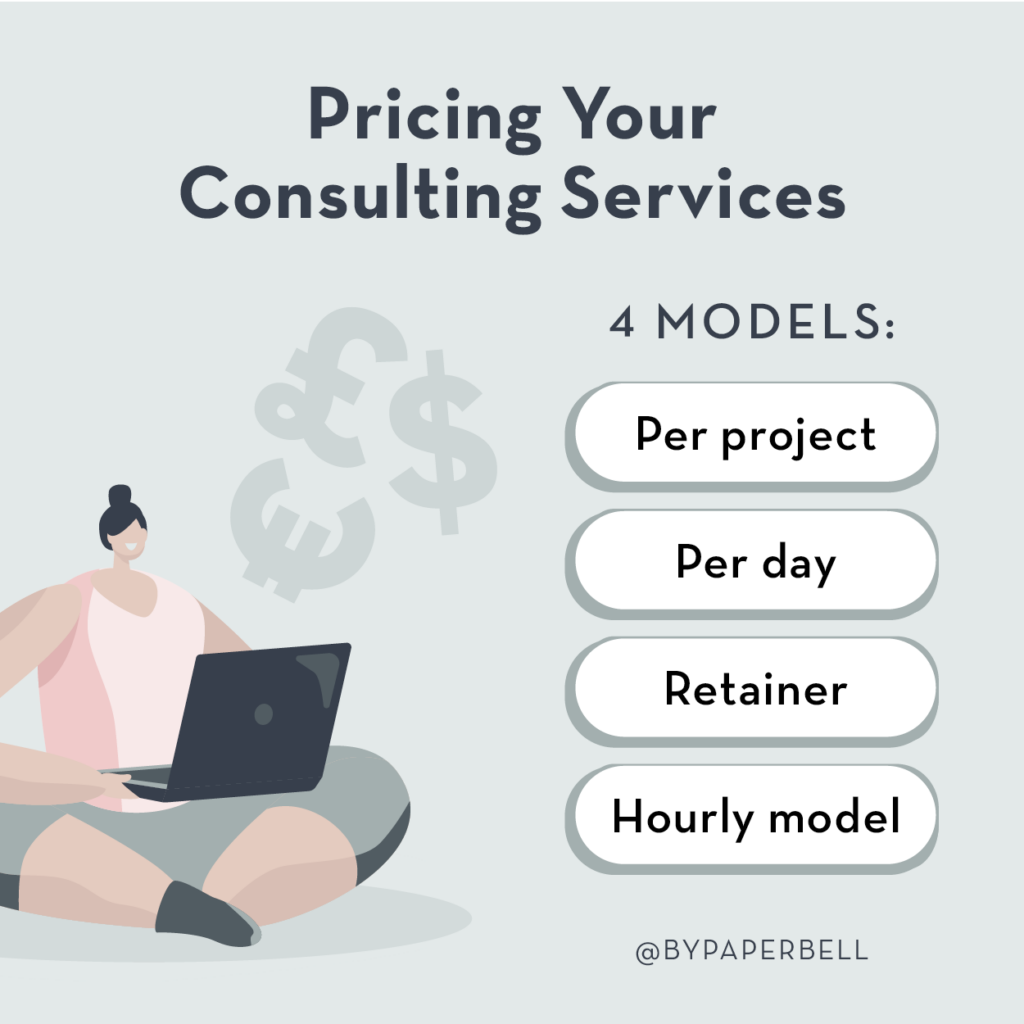
When most people think of consulting fees, they imagine hourly billing. And hourly is common — but it’s not the only option, and it’s not always the best one.
Here are the four main pricing models, along with the situations where each one makes the most sense.
1. Hourly rate
You charge for time spent. Simple, familiar, and easy for clients to understand.
The downside? Hourly billing can work against you as you get better. The more efficient you become, the less you earn — even as the value you deliver goes up. Many experienced consultants move away from hourly once they have a track record, because their value is in the outcome, not the clock.
Hourly works best when the scope of work is genuinely uncertain, or when clients need you in short, unpredictable bursts.
2. Project rate
You and the client agree on a flat fee for a defined set of deliverables. Anything outside that scope gets billed separately.
This model rewards efficiency — the faster and better you work, the more you effectively earn per hour. It also makes budgeting easier for clients, which can actually help you close deals. The key is scoping carefully up front so you’re not caught delivering twice as much work as you quoted.
A good rule of thumb: add 20% to your time estimate before quoting a project rate. If you think something will take 50 hours, quote 60. Scope creep is real.
3. Day rate
Similar to hourly, but you’re blocking an entire day for a single client. This model works well for intensive workshops, strategy sessions, or on-site consulting days. It also has a psychological advantage — it signals that your time is valuable enough to justify booking it in full-day blocks.
4. Retainer
A recurring fee, usually monthly, for ongoing access to your expertise. Retainers can be structured around a set number of hours, a specific set of deliverables, or simply “availability.”
This model is great for consultants who offer services that require continuity — strategic advisory, fractional leadership, ongoing marketing support. It also creates predictable revenue, which makes a big difference when you’re running your own business.
Typical Payment Terms for Consultants
Once you’ve chosen a pricing model, you need to decide when you get paid.
Options include:
- Upfront payment: You collect full payment before work begins. Common for project-based work with new clients.
- Split payment: 50% upfront, 50% on delivery. A good middle ground that reduces risk on both sides.
- Net-15, Net-30, Net-60: Invoice-based terms where payment is due 15, 30, or 60 days after you send the invoice. Standard in corporate settings, but can create cash flow problems for independent consultants.
- Milestone payments: Payment is tied to hitting specific project milestones. Works well for larger projects where full upfront payment isn’t realistic.
One thing to remember: you’re in charge of your consulting business. If a company’s standard payment terms don’t work for you, you can negotiate. Many independent consultants simply don’t start work until they receive at least a portion of payment upfront — and that’s completely reasonable.
Whatever terms you agree to, make sure they’re clearly spelled out in your consulting agreement. Ambiguity around payment is one of the most common sources of friction with clients.
Consulting Rates by Industry in 2025
Here’s where things get specific. Use these ranges as a starting point — actual rates vary based on your location, experience level, and the type of clients you serve.
1. Social Media Consulting Rates
Beginner social media consultants typically charge $50–$75 per hour. Senior consultants who can demonstrate a clear return on investment for clients can charge $100–$200 per hour or more.
2. IT Consulting Rates
Entry-level IT consultants start around $85–$125 per hour. Specialists in high-demand areas like cloud computing, cybersecurity, or AI can command $150–$300+ per hour. According to 2025 industry data, senior IT consultants in sectors like finance or healthcare often charge $200–$250+ per hour.
3. HR Consulting Rates
HR consultants generally charge between $50 and $150 per hour, with rates rising significantly for specialized areas like executive compensation, labor relations, or organizational design.
4. Engineering Consulting Rates
Engineering consultants typically make $75–$125 per hour, though specialized engineering fields (aerospace, biomedical, structural) command higher rates.
5. Software Consulting Rates
Software consulting rates vary enormously by firm size and specialization:
- Enterprise-class firms: $385–$850 per hour
- Big business class: $220–$330 per hour
- Mid-market firms: $110–$220 per hour
- Small firms: $82–$137 per hour
- Experienced freelance developers: $100–$300 per hour
- Junior freelance developers: $50–$75 per hour
6. Management Consulting Rates
Independent management consultants typically charge $100–$350 per hour. Partners at top-tier firms like McKinsey or BCG bill $500–$1,000+ per hour, though that rate reflects the firm’s overhead and brand as much as the individual’s expertise.
7. Diversity, Equity and Inclusion Consulting Rates
DEI consultants typically charge $150–$250 per hour for individual engagements. Workshop facilitation and organizational assessments are often quoted as day rates or project fees instead of hourly.
8. Project Management Consulting Rates
Project managers working as consultants typically charge $70–$150 per hour, with PMP-certified consultants trending toward the higher end of that range.
9. Nonprofit Consulting Rates
Nonprofit consultants generally charge $85–$150 per hour. Rates often reflect the fact that nonprofit budgets are tighter than corporate ones — but experienced consultants in areas like fundraising strategy or grant writing can justify higher fees by tying their work directly to revenue outcomes.
10. AI and Machine Learning Consulting Rates
This is one of the fastest-growing and highest-paid consulting areas right now. Rates typically run $250–$350 per hour for machine learning specialists, with demand continuing to outpace supply in 2025. Niche AI applications in healthcare, finance, and cybersecurity can command even more.
11. Cybersecurity Consulting Rates
Cybersecurity consultants charge $225–$300 per hour on average. Given the rise in threats and compliance requirements, this is another area where experienced consultants are consistently commanding premium fees.
12. Accounting Consulting Rates
Accounting consultants who hold a CPA designation typically charge $150–$450 per hour, depending on specialization. Tax strategy, audit preparation, and forensic accounting sit at the higher end of that range.
13. Marketing Consulting Rates
Marketing consultants charge at least $100–$300 per hour on average, though specialists in areas like paid advertising strategy or brand positioning can bill $500+ per hour for high-stakes engagements.
14. SEO Consulting Rates
SEO consultants typically charge $75–$150 per hour, with experienced strategists who can document clear traffic and revenue outcomes charging more. Many SEO consultants also offer monthly retainers in the $1,500–$5,000 range.
15. Product Management Consulting Rates
Product management consultants typically charge $175–$250 per hour. Fractional CPO arrangements (where you serve as part-time product leadership for a company) are increasingly common and often command a monthly retainer rather than hourly billing.
16. Data Science Consulting Rates
Data science consultants typically earn $200–$350 per hour, with rates climbing significantly for specialists in financial modeling, predictive analytics, or enterprise data architecture.
Need a simple template for invoicing clients? Check out our consulting invoice guide and free template.
How to Calculate Your Minimum Consulting Rate
Before you look at what competitors charge, figure out your own floor. This is the rate below which you simply can’t afford to work.
Here’s a simple framework.
Let’s say you want to net $100,000 per year. As an employee, that’s roughly $48–$50 per hour at 40 hours a week. But consulting isn’t employment — you’ll have overhead, taxes, and non-billable time eating into that number.
Start with working days. A year has about 250 business days. Subtract 15 for vacation and holidays, and you’ve got 235 working days.
Now, realistically, you won’t be billing clients for every one of those days. Admin work, business development, networking, and proposal writing all take time. Remove two days out of every five and you’re looking at roughly 141 billable days per year.
Divide $100,000 by 141, and you get $709 per day — or about $89 per hour.
But that’s your gross. To actually net $100,000 after taxes, self-employment costs, and expenses, you need to roughly double that — which puts your floor at around $178 per hour.
That’s your minimum. Not your target rate — just the floor. From there, you factor in your expertise, your niche, the market, and the value you deliver to clients.
How to Negotiate Consulting Rates
The number isn’t the hard part. Getting clients to pay it is.
The key is shifting the conversation from cost to value. When a client looks at your consulting rate and sees an expense, you’re in trouble. When they see an investment — something that will return more than it costs them — the conversation changes completely.
So instead of defending your rate, focus on the outcome. If you’re a data science consultant, don’t pitch “I charge $250 per hour.” Pitch “My analysis typically helps clients identify $300,000+ in inefficiencies in the first 90 days.” The $250 per hour is suddenly a bargain.
A few other negotiation principles:
- Don’t undercut yourself at the start. Many new consultants default to their old employee salary. That doesn’t account for taxes, overhead, or the time you spend on non-billable work. Your rate needs to reflect all of that.
- Raise rates as your track record grows. Your starting rate is just that — a start. Once you have strong client results and genuine demand, you can and should charge more. Some consultants in high-demand niches charge $500–$1,500+ per hour once they’ve built that reputation.
- Get it in writing. Whatever rate you agree on, make sure your consulting agreement spells out the terms, including scope, payment schedule, and what happens if the scope changes.
Value-Based Pricing: The Next Level
Once you have a track record, consider value-based pricing — where your fee is tied to the outcome you deliver rather than the time you spend.
This model works best when you can quantify your impact. A marketing consultant who can demonstrate that their campaigns generated $500,000 in new revenue has a compelling case for charging $50,000 for a project — regardless of how many hours it takes.
Value-based pricing is harder to implement, especially early on. But it’s worth understanding because it’s how the consultants charging $1,000+ per hour got there. They stopped selling time and started selling results.
Set Rates That Actually Work for Your Business
Consulting rates aren’t something you should decide on the fly or copy blindly from someone else. The right number depends on your goals, your costs, your market, and the value you deliver.
But here’s the bigger picture: charging what you’re worth only matters if you have the systems to support it. The more time you spend on admin — chasing invoices, coordinating schedules, managing contracts — the fewer hours you have for the work that actually justifies your rates.
Try Paperbell for free to keep your business side running smoothly, so you can focus on what you do best: getting results for your clients.
FAQs About Consulting Rates
What is the average consulting rate per hour in 2025?
Most independent consultants charge $100–$300 per hour in the US, depending on industry and experience. Specialists in high-demand areas like AI, cybersecurity, or executive strategy can charge $300–$500+, while top-tier firm partners bill $500–$1,500 per hour.
Should I charge hourly or per project?
It depends on the work. Hourly billing works well when scope is uncertain or work comes in unpredictable bursts. Project pricing works better when you can clearly define deliverables and rewards your efficiency. Many consultants use a mix of both — hourly for advisory, project rates for defined deliverables.
How do I know if I’m charging too little?
A few signals: clients never push back on your rates, you’re consistently booked with no room to raise prices, or you’re working long hours but not hitting your income goals. If any of those sound familiar, it’s probably time to test a higher rate with new clients.
What’s a retainer and when should I use it?
A retainer is a recurring monthly fee for ongoing access to your services. It creates predictable revenue for you and consistent support for your client. Retainers work best for advisory work, fractional leadership roles, or any consulting that benefits from continuity. Typical retainers run $2,000–$10,000+ per month for experienced consultants.
Do coaches need to set consulting rates differently from consultants?
The same principles apply — you need to account for your goals, non-billable time, taxes, and overhead. The main difference is that coaches often sell packages rather than hourly sessions, which is essentially a project or retainer model. Either way, the minimum rate formula in this article gives you a useful starting floor.
Can I charge more as an independent consultant than at a firm?
Yes — in many cases. As an independent, you keep the full rate (minus overhead) rather than having a firm take the majority. The trade-off is that you’re responsible for finding clients, handling admin, and managing your own business. Tools like Paperbell help make that side of things manageable.
Editor’s Note: This post was originally published in July 2022 and has since been updated for accuracy and current 2025 rate benchmarks.