

If you’ve been in the personal development world for any length of time, you’ve crossed paths with Mindvalley. Their ads are everywhere. Their content is polished. Their instructors are famous. And their marketing promises transformation with a capital T.
But does it actually deliver? And more specifically, is it worth it for coaches?
Those are the questions this review answers. We’ll look at what Mindvalley includes, what it costs, where it genuinely delivers, and where it falls short. No hype in either direction.
Here’s what’s covered:
- What Mindvalley is
- What’s included in the membership
- How much it costs
- The honest pros and cons
- What real members say
- Whether it’s worth it for coaches
What is Mindvalley?
Mindvalley is a global online learning platform founded by Vishen Lakhiani in 2002. It focuses on personal and professional growth through short, high-production-quality programs called Quests.
Unlike platforms that teach technical or academic skills, Mindvalley is centered on what they call “human transformation.” Think mindfulness, productivity, communication, relationships, health, and spiritual growth. Not coding or accounting.
Well-known instructors on the platform include:
- Jim Kwik (brain performance and memory)
- Marisa Peer (rapid transformational therapy)
- Robin Sharma (leadership and productivity)
- Lisa Nichols (public speaking and self-expression)
Mindvalley also runs Evercoach, a branch specifically for professional coaches. Evercoach offers certifications and skill-based training for life coaches, business coaches, and leadership mentors, useful if you want to build coaching credentials backed by Mindvalley’s brand.
Pro tip: Already running a coaching business? Use Paperbell to manage contracts, payments, and bookings in one place. It’s free to try.
What’s Included in a Mindvalley Membership?
A Mindvalley membership gives you access to all Quests on the platform. Each Quest includes video lessons, practical exercises, and community discussions. They typically run 2–6 weeks, with daily lessons averaging about 20 minutes. You can do them with a cohort of students or at your own pace.
Here’s what the membership covers:
- 100+ Mindvalley Quests: Programs covering business, relationships, health, career, spirituality, and more
- Mindvalley Mentoring: Monthly interviews and masterclasses with experts and thought leaders
- Mindvalley Meditations: Hundreds of guided audio sessions for focus, relaxation, and emotional balance
- Lifebook Assessment: A self-assessment tool to identify which areas of your life to prioritize
- Mindvalley Community: Private groups, local meetups, and live virtual events
- Member-Only Events: Mindvalley University and A-Fest are only available to subscribers
Worth noting: coaching-related Quests are included in the membership, but full coach certification programs are sold separately. These include live mentorship, assessments, and ICF-approved continuing education credits, at an additional $3,000–$5,000.
How Much Does Mindvalley Cost?
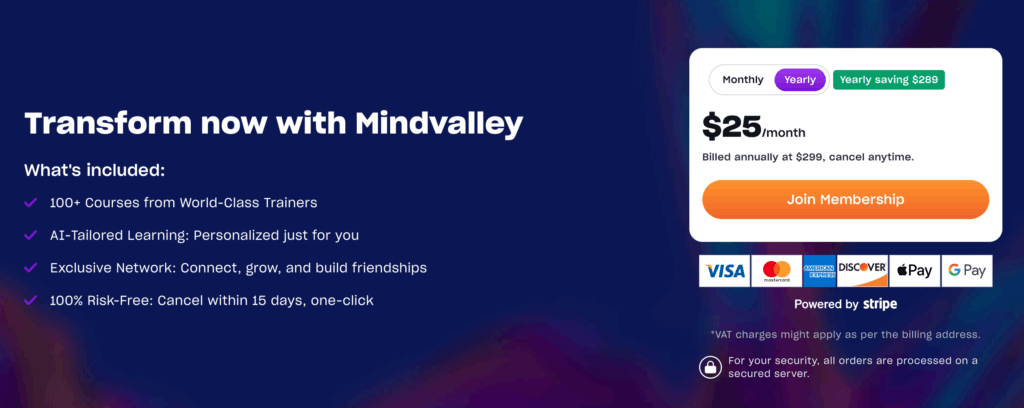
Mindvalley membership costs:
- $49/month (plus local taxes), or
- $299/year (plus taxes) — about 40% cheaper than the monthly option
First-time subscribers get a 15-day money-back guarantee.
Mindvalley also offers free masterclasses: 60–90 minute sessions with course instructors that let you see the teaching style before committing.
For context: Skillshare costs about $36/year and MasterClass about $120/year. Mindvalley is significantly more expensive than both. Whether that’s worth it depends on whether the content aligns with your interests and whether you’ll actually use it.
What Mindvalley Gets Right
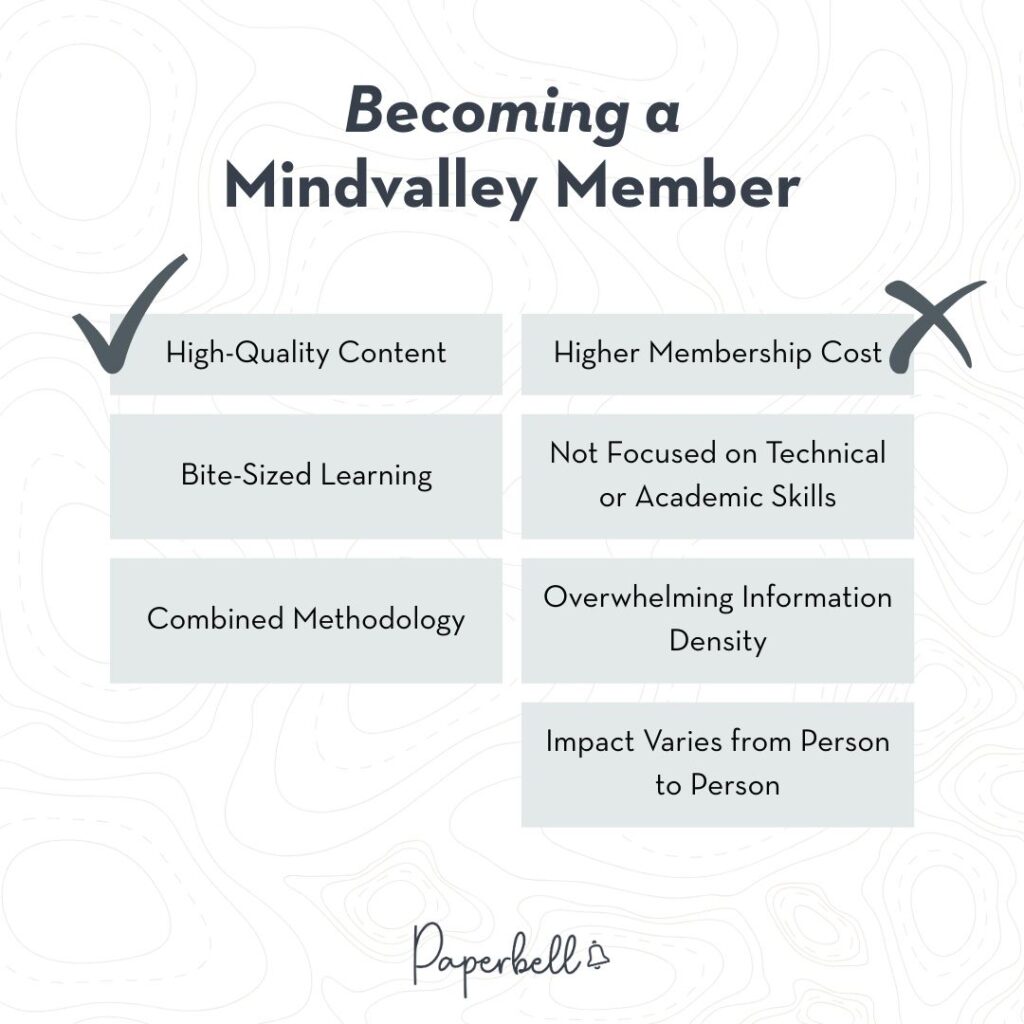
Production Quality
Mindvalley Quests are beautifully produced. Polished visuals, clear audio, thoughtful editing. Behind each program there’s a learning experience designer who helps structure the content — which means complex topics like memory training or behavior change are easier to follow than most self-produced online courses.
The community forum (called “Tribe”) and practical exercises attached to each lesson make the courses more engaging than passive video watching.
Bite-Sized Format That Actually Builds Habits
Daily lessons of 20 minutes are designed to build a consistent learning habit rather than require binge sessions. You can follow one Quest or several simultaneously, and you control the pace. For busy coaches, this format is more sustainable than a 40-hour course that demands a dedicated block of time.
A Wide Range of Methodologies
Mindvalley’s library spans science-backed approaches (the neuroscience in Jim Kwik’s Superbrain Quest), ancient wisdom traditions (breathwork, chakras), and practical frameworks (productivity systems, AI workflows). This breadth appeals to coaches who want exposure to multiple modalities rather than deep expertise in one.

What Mindvalley Gets Wrong
The Price Doesn’t Match the Competition
At $49/month or $299/year, Mindvalley is significantly more expensive than Skillshare ($36/year) and MasterClass ($120/year). The value is there if the content aligns with your needs, but it’s genuinely worth comparing before subscribing. If you’re primarily looking for business skills or technical coaching training, other platforms may serve you better at a lower cost.
No Technical or Business Skills
Mindvalley’s catalog doesn’t include practical professional skills like digital marketing, financial planning, or the specific business mechanics of running a coaching practice. If those are your gaps, you’ll need to look elsewhere regardless of a Mindvalley subscription.
The Volume Can Be Paralyzing
With 100+ Quests, community events, live sessions, and bonus content, the paradox of choice is real. Many members report feeling scattered, jumping between programs without fully applying anything. This is a risk with any broad learning platform, but Mindvalley’s marketing makes every Quest sound essential, which doesn’t help.
Results Depend Heavily on Personal Fit
Mindvalley’s transformation promises are genuine for some people and completely flat for others. Whether a program lands depends on whether the instructor’s approach resonates with how you think. That’s not a flaw exactly (it’s true of most personal development content), but it’s worth knowing before you commit $299.
What Real Mindvalley Members Say
Mindvalley has over 25,000 testimonials on their own website and close to 10,000 reviews on Trustpilot, with a 4.2 average score.
Positive reviewers consistently mention:
- The production quality — “unlike anything else I’ve taken online”
- The community — “I’ve made genuine friendships through the Tribe groups”
- Specific Quests like Superbrain, Becoming Limitless, and the meditation library
- The daily habit — “20 minutes a day felt achievable in a way 3-hour courses never did”
Critical reviewers mention:
- Feeling overwhelmed by the volume and not finishing courses
- Programs that felt more motivational than practical
- Cancellation processes that weren’t straightforward
- The gap between marketing promises and real-world results
The 4.2 Trustpilot score is solid but not exceptional for a platform that positions itself as life-changing.
Is Mindvalley Worth It for Coaches?
The honest answer: it depends on what you’re trying to get out of it.
Mindvalley is worth it for coaches who:
- Want exposure to diverse personal development methodologies to draw from in their own coaching
- Are specifically interested in instructors like Rich Litvin, Marisa Peer, or Michael Neill
- Value the community and live events alongside the content
- Can commit to consistent daily learning without getting scattered by the volume
Mindvalley is probably not worth it for coaches who:
- Are primarily looking for business-building skills or marketing training
- Want a focused, structured certification rather than broad personal development
- Are on a tight budget and need every dollar to go toward client-getting tools
- Are skeptical of spiritual or consciousness-development content
Using Mindvalley for Transformational Coaching Skills
For coaches who want to deepen their ability to create real client change, Mindvalley’s membership includes Quests from master coaches like Rich Litvin and Michael Neill. These go beyond tactics and into the deeper work of holding space and guiding transformation.
If you want to go further, Mindvalley’s ICF-accredited certification programs include live mentoring, supervised practice, and peer sessions, at an additional $3,000–$5,000.

Using Mindvalley for Business Development
The membership includes business-focused Quests that help coaches build professional foundations, including programs like Zero to $100 Million with Miki Agrawal and Mastering Authentic Networking with Keith Ferrazzi. These won’t replace specific marketing or sales training, but they’re useful for mindset and relationship-building work.
Using Mindvalley for Community and Events
Mindvalley offers more than self-paced courses. Through the membership, you can join Quest discussions, participate in the global community, and attend live events. The Mindvalley Coach Summit and live webinars include expert talks, workshops, and networking opportunities that go beyond what the course library offers.
Other Resources for Building Your Coaching Business
Mindvalley can support your personal growth and coaching methodology. But you’ll also need tools and resources specific to building a sustainable coaching business.
Here are a few Paperbell guides that cover the practical side:
- 32 Best Life Coaching Certifications: Compare top free and paid programs to build your credentials
- Life Coaching Website Templates: Build a professional online presence
- Top Life Coaching Services to Offer: Position your expertise clearly
- Best Books for Life Coaches: Deepen your knowledge and craft
- Life Coaching Industry Statistics: Understand the market you’re entering
- 6-Step Coaching Session Template: Improve your sessions and client outcomes
Running Your Coaching Business Alongside Your Learning
Whatever platform you’re learning from, you still need a solid foundation for managing your actual coaching practice. Paperbell handles the admin side: bookings, payments, contracts, client onboarding, and digital resource delivery, all in one place.
- Create and sell custom coaching packages
- Collect contracts, payments, and bookings automatically
- Share resources and session notes through a client portal
- Launch a professional website without needing extra tools
Try Paperbell for free and see how much simpler running your coaching business can be.
Mindvalley Review FAQ
Is Mindvalley coaching worth it?
Mindvalley’s coaching certifications are well-produced and taught by experienced instructors. Whether they’re worth the $3,000–$5,000 price depends on your learning goals and how much you value personal transformation alongside coaching methodology. For coaches who want an ICF-adjacent credential with a strong community, they’re worth considering.
Is Mindvalley a legitimate company?
Yes. Mindvalley is a reputable global learning platform that has been operating since 2002. Their courses feature recognized experts and the platform has a 4.2 rating on Trustpilot from nearly 10,000 reviews. That said, “legitimate” and “right for you” are different questions. Do your research before committing.
Why is Mindvalley so expensive?
Mindvalley’s price reflects the high production quality of their courses, the caliber of their instructors, and the additional features included in the membership: live events, community, and mentoring. Whether that value justifies the cost compared to alternatives depends on how much you’ll actually use it.
Is Mindvalley Superbrain worth it?
Jim Kwik’s Superbrain Quest is one of Mindvalley’s most popular programs and regularly cited in positive reviews. It teaches memory, focus, and learning strategies grounded in neuroscience. If you’re interested in improving your own mental performance — or helping clients with theirs — it’s one of the stronger Quests in the library.
Can you cancel Mindvalley easily?
Mindvalley offers a 15-day money-back guarantee for new subscribers. Some reviewers have noted that the cancellation process requires contacting support rather than a simple self-service option, so it’s worth knowing that going in.

Editor’s Note: This post was originally published in November 2024 and has since been updated in April 2026.