
If you’re exploring professional coaching certifications, you’ve probably come across the Board Certified Coach (BCC) credential. This certification offers instant credibility in a crowded coaching market.
But is it right for you?
In this guide, I’ll break down everything you need to know about BCC certification, including:
- What the BCC certification is
- What the BCC certification includes (and costs)
- Certification and maintenance requirements
- Pros and cons of the BCC certification
- BCC alternatives
What is the BCC Certification?
The Board Certified Coach (BCC) certification is a professional credential administered by the Center for Credentialing & Education (CCE).
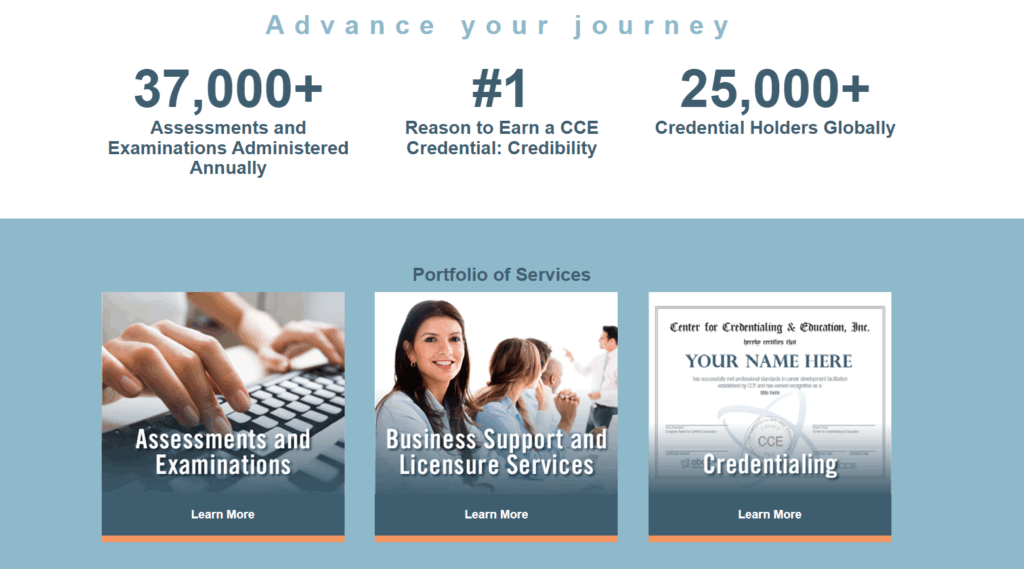
It independently verifies that a coach has met specific competency standards through education, training, experience, and examination.
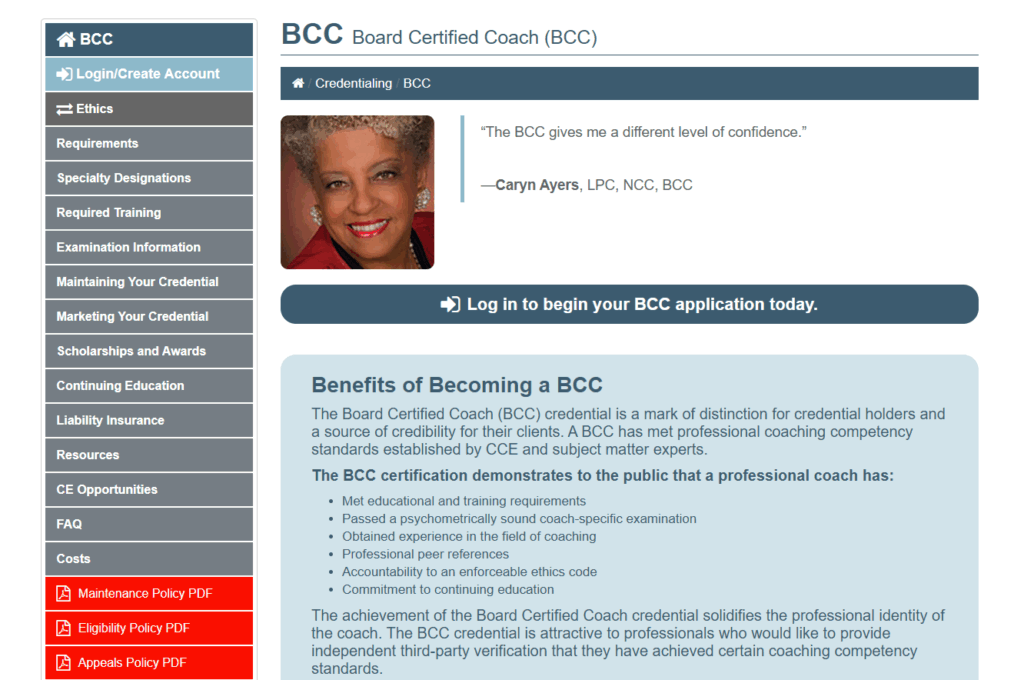
Think of it as your professional stamp of approval. When clients see the BCC designation after your name, they know you’ve:
- Met educational and training requirements set by industry experts
- Passed a comprehensive, psychometrically sound examination
- Gained real coaching experience in the field
- Received professional peer endorsements
- Committed to following an enforceable code of ethics
- Agreed to ongoing continuing education
The BCC certification was designed to address a real problem in the coaching industry. In short, anyone can call themselves a coach, regardless of training or expertise.
This makes it challenging for potential clients to determine who’s actually qualified to help them. The BCC credential solves this by providing third-party verification of your coaching competencies.
How the BCC Works With Your Existing Education
Unlike some other coaching certifications that focus solely on coach training, the BCC takes your existing education into account.
The CCE performed a “gap analysis” between counseling and coaching skills. In doing so, they found significant crossover.
So, let’s say you already have a degree in the social sciences or are a licensed counselor. You may not need as much coach-specific training as someone starting from scratch.
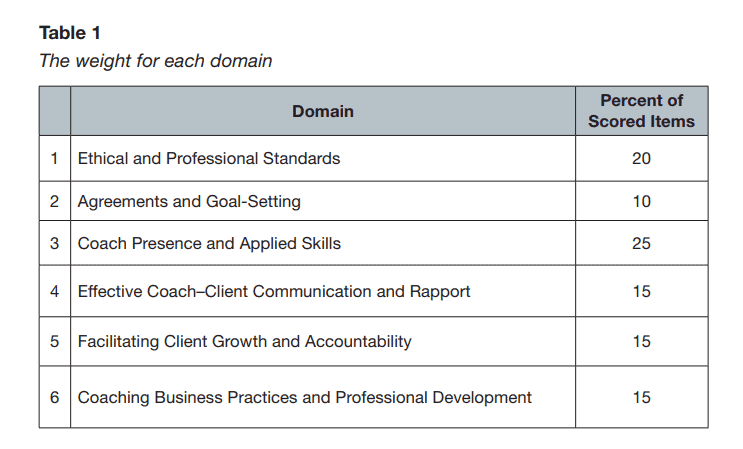
The certification covers 6 primary competency areas:
- Ethical and professional standards
- Agreements and goal-setting
- Coach presence and applied skills
- Effective coach–client communication and rapport
- Facilitating client growth and accountability
- Coaching business practices and professional development
Inclusions of the BCC Certification
When you earn your BCC certification, you’re not just getting a certificate to hang on your wall. Here’s what comes with it:
- Professional Recognition: You can use the BCC designation after your name and display the official BCC logo on your coaching website, business cards, and marketing materials.
- Access to the CCE Credentialing Gateway: This secure online portal lets you manage your certification, update your information, track continuing education credits, and access professional resources.
- Directory Listing: BCC credential holders are listed in the public CCE Credential Holder Search directory. This makes it easier for potential clients to find and verify your certification.
- Ongoing Professional Development: As a BCC, you’ll have access to approved continuing education opportunities and specialty designation options to further develop your expertise.
- Professional Standards and Ethics Support: You’ll have clear guidance on ethical coaching practices through the BCC Code of Ethics and access to resources when ethical questions arise.
Pro tip: Once you’re certified, you can launch your coaching website with scheduling, payments, and messaging built right in using Paperbell. Try it for free to get your own board-certified coach website in minutes.
Cost of the BCC Certification
Here’s the complete breakdown of BCC certification costs:
Initial Certification Fees:
- Application and examination fee: $279
- Application and examination fee for National Certified Counselors (NCCs): $229
- Specialty designation review fee: $30 per designation (optional)
Ongoing Maintenance Fees:
- Annual maintenance fee: $40 per year
- Late fee: $15 if your annual fee isn’t paid by the due date
- Reinstatement fee: $50 plus any past-due balance (if your certification lapses)
You’ll also receive an annual maintenance fee notice about 6 weeks before your credential anniversary date. Paying this fee on time is important to maintaining your active BCC status and your right to use the credential.
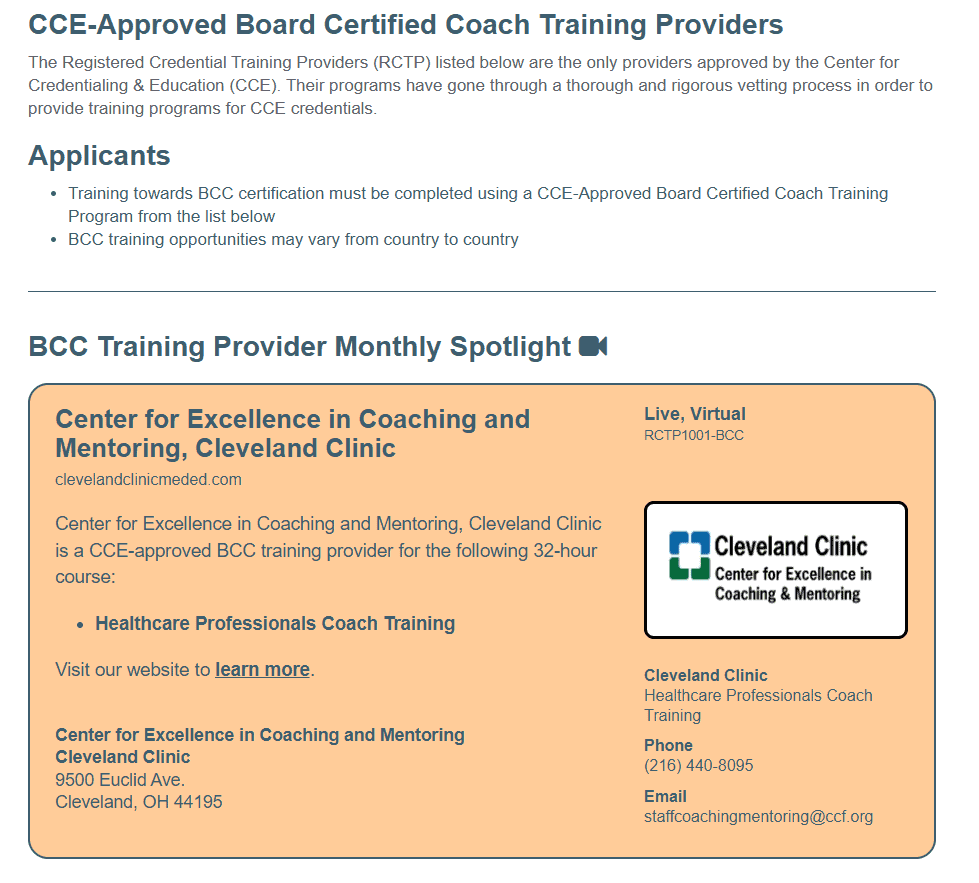
Keep in mind that the above costs don’t include your coaching education. You’ll still need to take training from one of the CCE’s approved providers.
Certification and Maintenance Requirements
Getting your BCC certification is just the beginning. The requirements vary based on your educational background and professional experience, which makes the BCC accessible to coaches from diverse fields.
General Requirements (All Applicants)
First, every BCC candidate needs, at a minimum, a bachelor’s degree in any field from an accredited institution. You’ll submit official transcripts to verify this.
Second, you need 30 hours of post-degree coaching experience. This means actually performing coaching sessions with clients, not just studying coaching.
A professional coach, colleague, or supervisor will verify your experience using the CCE Coaching Experience Form.
Third, you’ll need professional peer references from either:
- A work colleague
- A coaching professional who knows you
- A work supervisor
The person you choose needs to be able to speak to your professionalism and integrity. Additionally, this person cannot be related to you by blood, marriage, or other familial relationship.
Finally, you must pass the Board Certified Coach Examination (BCCE), which I’ll explain more about below.
Training Requirements (Variable by Background)
Your required coaching training hours depend on your educational and professional background:
- If you hold a master’s degree in business, social sciences, or behavioral health AND have an active state license or national certification, you need 30 hours of CCE-approved coach training.
- If you have a master’s degree in business, social sciences, or behavioral health WITHOUT a license, you need 60 hours of CCE-approved coach training.
- If you hold an International Coaching Federation (ICF) Associate Certified Coach (ACC) credential or higher with a bachelor’s degree, you need 60 hours of CCE-approved training.
- All other candidates need 120 hours of CCE-approved coach training.
All coach training must be completed through a CCE-approved Board Certified Coach Training Provider, as mentioned earlier.
The BCC Examination
The Board Certified Coach Examination (BCCE) is a computer-based test. You can take it either in person at a Pearson VUE testing center worldwide or online through the OnVUE platform from a private location.
The exam consists of 12 case studies. Each case study presents a coaching scenario followed by 10 multiple-choice questions, for a total of 120 items.
Of these, 100 are scored, and 20 are field-test questions. You’ll have 3 hours to complete the exam.
The examination tests your knowledge across the 6 BCC competency areas I mentioned earlier. It’s designed to verify you can provide coaching services safely and effectively.
Here’s how the 6 competencies are spread out in terms of weight towards your score:
If you don’t pass on your first attempt, you can retest 90 days later. You’re allowed up to 2 additional test attempts within 2 years of your original application date.
If you fail the BCC exam 3 times or 2 years pass, you’ll need to submit a new application.
Maintenance Requirements
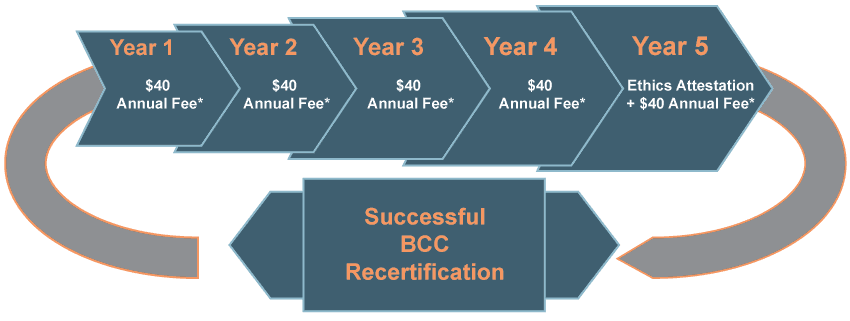
Your board-certified coach credential is valid for 5 years. To maintain it, you must:
- Pay the $40 annual maintenance fee each year
- Complete 70 continuing education clock hours during each five-year cycle
- Of those 70 hours, at least 4 must be in coaching ethics
- If you hold specialty designations, at least 10 hours must be in each specialty area
- Continue adhering to the BCC Code of Ethics
- Report any criminal, civil, or professional disciplinary matters within 60 days
The CCE conducts random audits to verify compliance on the BCC program. If selected for audit, you’ll need to submit documentation for all your continuing education activities.
Keep all your certificates of completion, transcripts, and verification records for at least 5 years after each maintenance cycle ends.
Pros and Cons of the BCC Certification
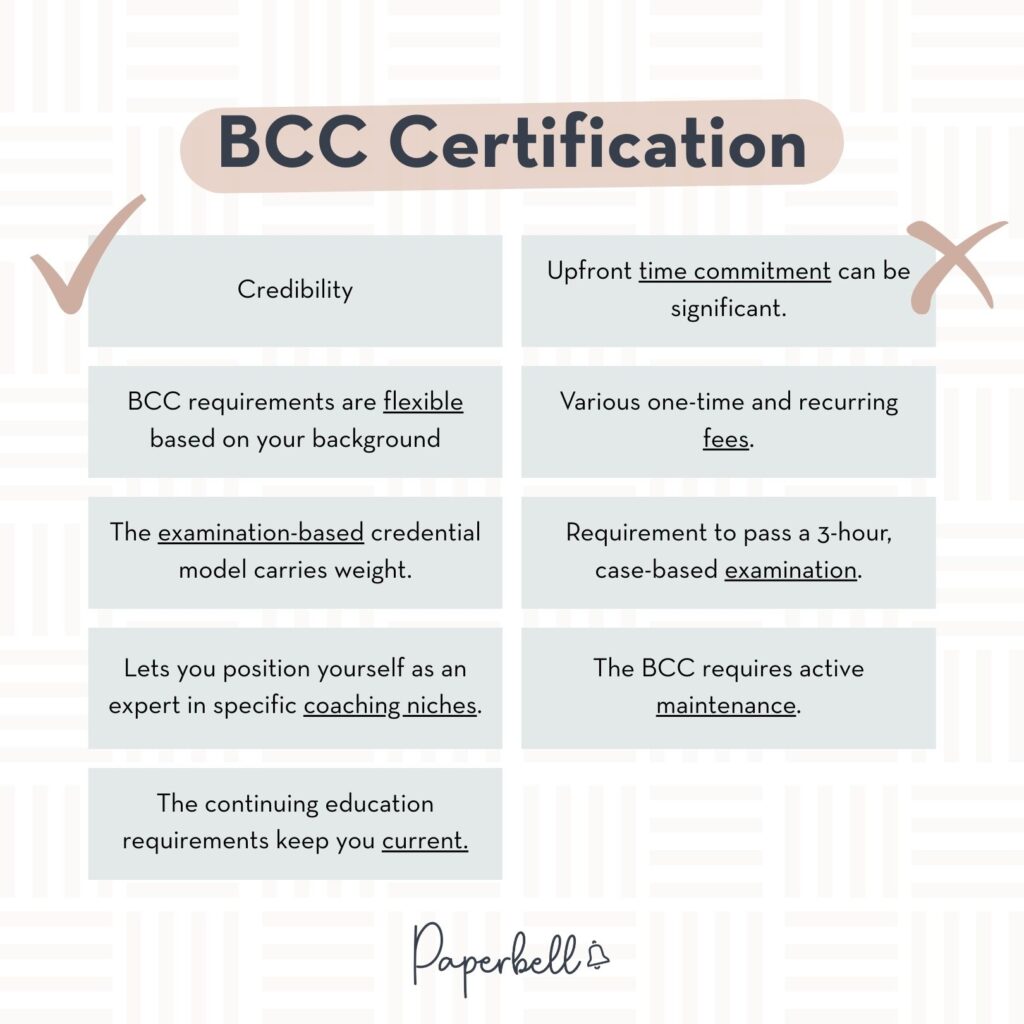
Like any professional credential, the BCC certification has advantages and considerations you should weigh before pursuing it.
Pros
The biggest advantage is instant credibility. In a field where anyone can claim to be a coach, the BCC designation tells clients you’ve met rigorous, independent third-party verification.
This can be the deciding factor when a potential client is choosing between you and an uncertified competitor.
Second, the BCC requirements are flexible based on your background. If you’re already a licensed counselor, social worker, or mental health professional, you can use that education and experience rather than starting from scratch.
The CCE recognizes the overlap between coaching skills and other helping professions.
Third, the examination-based credential model carries weight. Unlike certifications you can earn just by completing a course, the BCC requires you to prove your knowledge through a comprehensive exam.
This examination component adds legitimacy to your credential.
Fourth, the specialty designations let you position yourself as an expert in specific coaching niches. Whether you focus on executive coaching, health and wellness coaching, career coaching, or personal life coaching, you can verify your expertise in that area.
Finally, the continuing education requirements keep you current. The mandatory 70 hours every 5 years ensures you’re staying up-to-date with best practices and evolving coaching methodologies.
Cons
The upfront time commitment can be significant. Depending on your background, you need anywhere from 30 to 120 hours of approved coach training before you can even sit for the exam.
That’s a substantial investment of time.
The costs also add up. Between:
- Application fees
- Examination fees
- Potential specialty designation fees
- Ongoing annual maintenance fees
You’re looking at several hundred dollars initially and $40 every year thereafter for certification alone. You still need to pay for your actual certification training.
The approved training provider requirement limits your options. You can’t just take any coach training program.
The examination can also be a barrier for some. If you’re not a strong test-taker, the requirement to pass a 3-hour, case-based examination might feel daunting.
You get 3 attempts, but failing all 3 means starting over with a new application.
Finally, the maintenance requirements are ongoing. Unlike a degree you earn once and keep forever, the BCC requires active maintenance.
You’ll need to:
- Track continuing education hours
- Pay annual fees
- Potentially face audits of your activities
BCC Alternatives
The BCC isn’t the only coaching certification available. Depending on your goals and background, you might consider these alternatives.
International Coach Federation (ICF)
The International Coach Federation (ICF) is probably the most recognized coaching organization globally. They offer 3 levels of individual credentials:
- Associate Certified Coach (ACC): This entry-level credential requires at least 60 hours of coach-specific training and 100 hours of coaching experience with at least 8 clients.
- Professional Certified Coach (PCC): The mid-level credential requires 125 hours of coach-specific training and 500 hours of coaching experience with at least 25 clients.
- Master Certified Coach (MCC): This is the highest level, requiring 200 hours of training and 2,500 hours of coaching experience with at least 35 clients.
The ICF credentials are globally recognized and highly respected. They’re particularly valuable if you plan to coach internationally or want to be part of the largest global coaching community.
However, ICF certification requires significantly more coaching hours than the BCC, especially for the PCC and MCC levels. The emphasis is more heavily on demonstrated coaching experience and competency rather than academic background.
European Mentoring & Coaching Council (EMCC)
The European Mentoring & Coaching Council (EMCC) is another globally recognized credentialing body. However, it’s more prominent in Europe and the UK than in North America.
EMCC offers four levels of individual accreditation:
- Foundation: For new coaches and mentors who are just starting their business.
- Practitioner: For coaches and mentors with at least two years of experience.
- Senior Practitioner: For experienced practitioners with advanced competencies.
- Master Practitioner: For highly experienced coaches and mentors working at the highest level.
The EMCC credential process is competency-based and includes portfolio assessment rather than examinations. You’ll demonstrate your coaching abilities through a combination of:
- Documented evidence
- Case studies
- Sometimes recorded sessions
One unique aspect of EMCC is its focus on both coaching and mentoring. If your practice includes mentoring elements or you work in European markets, EMCC might be a strong fit.
However, if you’re primarily based in North America, the EMCC credential may not carry the same recognition as ICF or BCC certifications in your local market.
Become a Certified Coach & Start Your Practice
Choosing to pursue BCC certification is a significant step in establishing yourself as a credible, qualified professional coach.
Once you’ve earned your certification, the next step is building a thriving coaching business. And there’s no easier way to simplify this process than by using Paperbell.
Paperbell gives you everything you need to run your coaching practice in one simple platform. You can create a beautiful website to display your coaching packages, accept payments, let clients self-schedule appointments, deliver digital resources, manage client relationships, and so much more.
Try Paperbell for free and see how easy it is to turn your coaching certification into a successful coaching business.
FAQs About BCC Certification
What is a BCC certification?
BCC stands for Board Certified Coach. It’s a professional coaching credential administered by the Center for Credentialing & Education that verifies you’ve met specific education, training, experience, and examination requirements.
What is a BCC in education?
In the coaching context, BCC refers to Board Certified Coach certification. It’s an educational credential that demonstrates you’ve completed approved coach training and passed a competency examination.
How to become a BCC?
To become a BCC, you need a bachelor’s degree minimum, 30-120 hours of CCE-approved coach training depending on your background, 30 hours of coaching experience, a professional endorsement, and you must pass the BCC examination.
What is a BCC qualification?
A BCC qualification is a professional credential that certifies you as a Board Certified Coach. It indicates you’ve met the Center for Credentialing & Education’s standards for coaching competency and professional practice, including their enforceable ethics code.