

You’ve probably heard someone say they work with a life coach. Maybe you’ve even thought about becoming one yourself.
It makes sense. Coaching is one of the fastest-growing careers out there — the industry hit $6.25 billion in 2024, and it’s still climbing. You get to help people change their lives and set your own hours. And you build a business around work that actually matters to you.
But what does a life coach actually do all day? And how do you go from “I think I’d be a good coach” to running a real practice with paying clients?
That’s what this guide is for. We’ll break down what life coaching really looks like and walk through the different types of coaches. Then we’ll give you a practical roadmap for becoming one — including what certification you need (spoiler: maybe less than you think), how much you can earn, and the tools that make launching a practice way easier than it used to be.
What is Life Coaching?
Life coaching is the process of helping clients gain clarity about different aspects of their lives, define clear goals, and find ways to achieve them.
Some clients enter their first coaching session with a clearly defined purpose, but more often than not, they enter with a vague challenge they’re facing. This challenge might show up as:
- A feeling of being stuck
- Being unable to move on from a situation
- Facing the same issues repeatedly without making progress
The life coaching process usually starts with uncovering these challenges and what the real or underlying issue is. The coaching process either ends with this newfound clarity or shifts its focus to a new issue.
It’s normal for the client’s goals to change over time as they go through personal transformation. This isn’t a setback but simply the natural byproduct of developing self-awareness and growing into a new person. When we change our beliefs, needs, and priorities change as well, helping us live more aligned with who we are.
Reflection is one of the most important catalysts for becoming more self-aware, and that’s exactly what a life coach helps their clients with. Professional coaches never impose their own views or solutions on the coachee but rather help them reflect on themselves, gain clarity about their beliefs, and consciously choose what they want.
What Do Life Coaches Do?
Life coaches help people transform their lives using a variety of tools and approaches. They work with clients one-on-one or in groups, guiding them toward positive change and personal growth.
In these sessions, the client sets the agenda, and the coach asks thought-provoking questions to help them gain clarity and move forward. A good coach knows exactly which questions will spark the most insight for each unique situation.
Between sessions, coaches typically:
- Assign coaching exercises that reinforce new habits or perspectives
- Provide accountability to keep clients on track with their goals
- Check in on progress and adjust strategies as needed
- Offer support when obstacles arise
Unless they work in-house for an organization, most life coaches are also small business owners. This means they’re handling everything from creating their services and marketing their business to managing finances and paying taxes, just like any entrepreneur would.
At the heart of it all, most coaches focus primarily on delivering transformative sessions for their clients. They’re constantly improving their coaching skills, developing new methodologies, and expanding their toolbox. Many continue their education throughout their careers, adding complementary approaches like emotional freedom technique (EFT), neuro-linguistic programming (NLP), or breathwork to enhance their coaching practice.
Pro tip: Starting your own coaching practice? Paperbell handles your scheduling, payments, contracts, and client portal — so you can focus on actually coaching. Try it free.
Different Types of Life Coaches
Coaching can take many forms, depending on the coach’s approach and expertise and the area they focus on. These are the most common types of coaches in the industry.
- Business Coaches
- Financial Coaches
- Executive and Leadership Coaches
- Organizational Coaches
- Career Coaches
- Family Life and Relationship Coaches
- Health and Wellness Coaches
- Spiritual Coaches
- Positive Psychology and Mindfulness Coaches
- Confidence Coaches
Within these major categories, you’ll also find coaches with a more specialized focus, such as body-image coaches or divorce coaches. Many of them develop an interest in a particular niche due to something they have experienced in their personal or professional life.
However, just because a coach hasn’t been married, it doesn’t mean that, for example, they can’t be well-versed in relationship coaching for married couples. Their qualifications and ability to ask powerful questions extend far beyond personal experience, whether they’ve been certified and received formal training or not.
[ Read: Types Of Life Coaches: The Top 12 Niches That Clients Love ]
A Day in the Life of a Life Coach
So what does a typical day actually look like when you’re a life coach? It depends on your niche and how you’ve set up your practice, but here’s a pretty realistic snapshot.
Morning: You check your calendar and see three client sessions booked for today. Before the first one, you review your notes from last week’s session with that client. She’d committed to having a difficult conversation with her business partner — you want to follow up on how it went.
Late morning: Back-to-back coaching sessions. One client is working through a career pivot. Another is building confidence to raise her rates. Each session is different, but your job is the same: ask the right questions and help them see what they can’t see on their own.
Afternoon: This is when the “business owner” hat goes on. You draft a social media post, reply to a DM from someone who found you through Instagram, and send a follow-up email to a potential client who booked a discovery call last week. You also spend 30 minutes on a coaching course you’re taking to sharpen your skills.
Late afternoon: One more session — a group coaching call with six clients working through your 12-week program. You lead the discussion, and something clicks for one of the participants. She has a breakthrough about why she’s been self-sabotaging. Moments like this are why you do this work.
Evening: You close your laptop. Tomorrow you’ll prep content for your upcoming workshop. But for now? You’re done. No commute. No boss. No office politics. (Okay, maybe some cat politics if you work from home.)
Not every day looks the same — and that’s kind of the point. Some weeks are session-heavy. Others are more focused on building your business or creating new programs. The flexibility is one of the biggest perks of this career.
Why Should You Work with a Life Coach?
Most people hire a coach because they feel stuck in their life or career, are dealing with difficult emotions, or are going through a life transition. However, there are many other reasons why you should seek help from a coaching professional. For example:
- Going through a career transition
- A lack of fulfillment at work
- Looking for a sense of purpose
- Being stuck with a project
- Feeling creatively drained
- Wanting to be a more effective leader or manager
- Starting a business
- Difficulty making a complex life or career decision
- Being unclear about your true identity
- Lacking motivation for your goals
- Needing help with life planning
- Wanting to increase your income or improve your financial stability
- Facing relationship challenges
- Going through a breakup or grieving a loved one
Human life has various complex challenges, and we all go through difficult periods when we could use a little help.
Coaches can provide much more than just an outside perspective or the comforting presence you normally seek from a friend. From career planning to dealing with personal issues, professional coaches have proven methods and tools to help you, no matter how tough your situation is.
[ Read: Life Coaching Services: 10 Types, Costs & How to Choose One ]
Many entrepreneurs, high-level leaders, athletes, and artists work with one or more coaches on their goals and performance. These people usually have to make high-risk decisions and deal with emotionally or physically challenging situations in their everyday work that are hard to get through on their own.
But life coaching isn’t just for A-list professionals; it’s for anyone who needs clarity and guidance in their lives. Luckily, more and more people realize that asking for help is okay and that investing in themselves pays off in the long run.
Whether you want to learn something specific, build confidence, or find more clarity, working with a life coach can bring you positive changes.
How to Become a Life Coach
Alright, so you’re sold on coaching as a career. Now what?
Here’s the thing — becoming a life coach isn’t like becoming a doctor or a lawyer. There’s no single path and no required degree. No licensing board you have to pass through. That’s both the good news and the overwhelming part.
But after seeing thousands of coaches launch their practices (we’re Paperbell — it’s kind of what we do), here are the five steps that actually work.
Step 1: Pick Your Niche
You might be tempted to coach “everyone” on “everything.” Don’t.
The coaches who build real businesses pick a specific audience and a specific problem. Maybe it’s helping burned-out corporate professionals figure out what’s next. Maybe it’s guiding new moms through the identity shift of parenthood. Maybe it’s money mindset for freelancers.
Your niche doesn’t have to be permanent — you can always evolve. But starting with a clear focus makes everything easier, from your marketing to your ability to get referrals.
Not sure where to start? Think about what people already come to you for advice about. That’s usually a clue.
Step 2: Get Trained
You don’t legally need a certification to call yourself a life coach. But getting trained is still a really good idea — partly for credibility, and partly because coaching is a real skill that takes practice to do well.
The International Coaching Federation (ICF) is the most widely recognized credentialing body. Their programs range from about 60 to 200+ hours of training, depending on the level. Other solid options include the Center for Credentialing & Education (CCE) and the International Association of Coaching (IAC).
Expect to invest anywhere from $2,000 to $15,000 in training, depending on the program. Some coaches start with a shorter program and add more advanced certifications as their business grows.
The bottom line? Certification isn’t required, but training is worth it. At minimum, you need to know how to hold a coaching conversation and ask the kind of questions that actually move people forward — not just give advice.
Step 3: Practice Coaching (For Real)
You can’t learn coaching from a textbook. You learn it by coaching actual humans.
Start by offering free or low-cost sessions to friends, colleagues, or people in your network. Aim for at least 20-30 practice sessions before you start charging. You’re figuring out your style, getting comfortable with silence, and learning to trust the process. (That last one is harder than it sounds.)
Pay attention to what kinds of clients and problems light you up. That’s valuable data for refining your niche.
Step 4: Set Up Your Business
This is where a lot of new coaches get stuck. You know you can coach, but suddenly you need a website, a way to take payments, a scheduling system, contracts, intake forms…
It’s a lot. And it’s the main reason coaches procrastinate on actually launching.
Here’s what you actually need to get started:
- A way for clients to book and pay you — not a patchwork of Calendly, Venmo, and Google Docs
- A simple website that explains who you help and how
- A contract to protect both you and your clients
- An intake form to learn about new clients before your first session
Paperbell handles all of this in one place. You set up your coaching packages, and clients can book, sign your contract, fill out intake forms, and pay — all in one flow. No tech headaches, no duct-taping five different tools together.
You can start with a free account and only upgrade when you’ve got more than one client. Which brings us to…
Step 5: Get Your First Clients
You don’t need a big audience or a fancy marketing funnel to get clients. Most new coaches get their first clients through:
- Their existing network — tell everyone what you’re doing. Seriously, everyone.
- Social media — share your coaching perspective, not just your services
- Free workshops or challenges — give people a taste of what coaching with you feels like
- Discovery calls — offer a free 20-30 minute call so potential clients can experience your coaching firsthand
The hardest part is the first five clients. After that, referrals start coming and you get testimonials. Momentum builds. But you have to start somewhere — and the coaches who launch imperfectly always beat the ones who wait until everything is “ready.”
How Much Do Life Coaches Make?
Let’s talk money — because this is one of the most-Googled questions about coaching, and the answers out there are all over the place.
Life coaching income varies a lot. It depends on your niche, your experience, how you structure your offers, and whether you’re coaching full-time or as a side hustle.
Starting out (Year 1-2): Most new coaches charge between $75 and $150 per session. If you’re coaching part-time while building your practice, you might earn $20,000 to $40,000 in your first year. Full-time coaches who hustle on marketing can hit $40,000 to $60,000.
Established coaches (Year 3-5): Once you’ve got a track record, testimonials, and a steady referral pipeline, rates typically jump to $150 to $300 per session. Annual income for full-time coaches at this stage usually falls between $60,000 and $120,000.
Experienced coaches (5+ years): Coaches who’ve built a strong reputation and a specialized niche can charge $300 to $500+ per session. Add in group programs and corporate contracts, and top earners bring in $150,000 to $300,000+. A smaller number break into the $500K+ range, usually through a mix of one-on-one coaching, group programs, and digital products.
A few things that really move the needle on income:
- Niche matters. Executive and business coaches typically earn more than general life coaches. Health and wellness coaches often start lower but can scale through group programs.
- Packages over single sessions. Coaches who sell multi-session packages (say, a 3-month program for $2,500) tend to earn more and have more stable income than those who charge by the hour.
- Multiple revenue streams. The highest-earning coaches don’t just do one-on-one sessions. They layer in group coaching, online courses, workshops, retreats, or corporate training.
The ICF’s 2023 Global Coaching Study found that the average annual income for coaches in North America was around $62,500. But that number includes part-timers and coaches who are still building their practice. Full-time, established coaches tend to earn quite a bit more.
What is the Difference Between Life Coaching and Therapy?
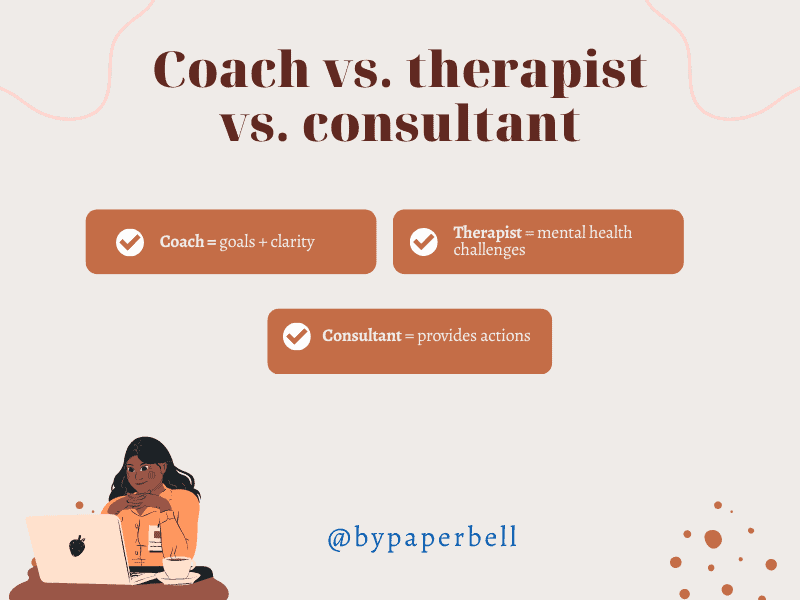
In a nutshell, life coaches focus on future goals and personal growth, while therapists address mental health issues and explore past traumas.
Therapists are often confused with life coaches. These two areas share some similarities in that they help people feel better and progress in their lives. Life coaching and therapy serve different purposes, although they share some commonalities.
When we talk about therapy, we refer to the work of psychiatrists and psychologists, also called therapists or mental health professionals. Here are the difference between the two:
- Psychiatrists are licensed mental health professionals who can prevent, diagnose, and treat mental health conditions. They can perform medical tests and prescribe medication.
- A psychologist is a licensed professional, too, but not a medical doctor. They can’t prescribe medication or diagnose their clients, but they can provide talk therapy, create genograms to identify mental health issues, and help with issues such as anxiety, depression, mood or eating disorders, and addictions.
A life coach, in turn, doesn’t need to be licensed to work with clients. They can get certified at a training institution like the International Coaching Federation (ICF) or the European Mentoring and Coaching Council (EMCC), but it’s not a requirement for them to practice coaching.
What’s common in all three of these service providers is that they all focus on helping people stay mentally well, but their methods largely differ. Therapy usually focuses on managing mental health issues and healing from past trauma. It allows clients to process life events and learn new tools to cope with difficult emotions.
In this sense, therapy normally focuses more on issues triggered by past events, while coaching tends to be more future-facing. Of course, there can be an overlap between both methodologies. But normally, it’s more beneficial for the client to start with therapy around a key issue and then progress into coaching later.
Needless to say, neither is better than the other. They simply provide different tools for change. Clients often go through multiple therapy and coaching processes at specific turning points in their lives.
Example of Therapy vs. Coaching
Let’s say you’ve been losing motivation at work lately and need help figuring out how to feel more inspired about your everyday work.
If you suspect that this might be tied to a larger issue connected to your mental health, a therapist might be a better option. For example, high-functioning depression might go unnoticed behind a facade of performing your daily routine tasks. You may feel that the activities that used to give you joy don’t bring you the same feeling anymore. You always feel chronically tired and lethargic, have prolonged sleep issues, and avoid social activities.
On the other hand, if you’re feeling good about other areas of your life but you’re simply bored with the work you’ve been doing, you may benefit more from coaching. A career coach can help you gain clarity of not just your current job situation but your long-term career path as well, helping you find personal fulfillment.
What is Coaching vs. Counseling?
Coaching focuses on goal-setting and future growth, while counseling addresses emotional issues and healing from past experiences.
Counseling is very similar to therapy; licensed psychologists or therapists perform both. However, counseling is a short-term process with a particular focus problem or situation. It can take a few weeks to a few months, and it’s usually centered around a predefined issue, such as the grief of a loved one.
So, the key difference between counseling and coaching is that counseling helps with mental health issues and healing trauma, while life coaching is more likely to focus on building self-awareness and moving toward personal goals.
What is Consulting vs. Coaching?
Consulting is another profession commonly mistaken for business or career coaching. The most important difference is that a consultant gives their clients the answers they need, while a coach helps them find answers on their own.
A consultant has to have expertise in the area they’re advising, but a coach doesn’t necessarily need to be well-versed in the client’s personal or career situation.
Consultants give instructions; coaches give guidance. If a professional or a team needs out-of-the-box thinking and new perspectives, they will turn to a coach. They will work with a consultant if they need concrete solutions from someone who’s seen the same problems before.
Example of Coaching vs. Consulting
Let’s say that you’re leading a team of professionals, and you’re feeling stuck with a few problems stubbornly hindering your performance as a leader.
A consultant specializing in your area can guide you on what typically works in these situations. They may have experience advising leaders within your field and can suggest industry-specific frameworks.
On the other hand, a leadership coach can help you identify the root causes of your performance struggles, develop strategies to overcome them, enhance your leadership skills, and build confidence. All of these will ultimately improve your effectiveness as a leader.
Ready to Start Your Coaching Practice?
You came here wondering what a life coach does — and now you’ve got the full picture. What the work actually looks like day-to-day, how to get started, what you can realistically earn.
Coaching is one of the few careers where you get paid to help people change their lives. The barrier to entry is lower than most people think, and the demand keeps growing.
You don’t need to have everything figured out before you start. You need training, some practice, and a way to get your first paying client through the door.
Paperbell gives you the business side of coaching — scheduling, payments, contracts, a client portal — all in one place. So you can stop worrying about tech and start doing the work you’re meant to do.
FAQ
What Does a Life Coach Actually Do?
A life coach can help you set and achieve personal or professional goals through guidance, support, and accountability.
What is the Role of a Life Coach?
A life coach’s role is to assist you in identifying your goals, overcoming your obstacles, and creating actionable plans for success.
What is the Difference Between a Life Coach and a Therapist?
Life coaches focus on future goals and personal growth, while therapists address mental health issues and explore past traumas.
Do You Need a Degree to Be a Life Coach?
No. There’s no degree requirement to become a life coach. While many coaches pursue certification through programs accredited by the ICF or similar organizations, it’s not legally required. That said, proper training makes a big difference in the quality of your coaching — and your credibility with clients.
How Long Does It Take to Become a Life Coach?
Most coach training programs take 3 to 12 months to complete, depending on the program and how intensively you study. From there, you’ll want another 2-3 months of practice sessions before you start charging. So realistically? You could be coaching paying clients within 6 to 12 months of deciding to pursue it.
Can You Make a Living as a Life Coach?
Yes — but it takes time and effort to build up. Most coaches don’t go full-time overnight. The ones who succeed treat it like a real business from the start: they pick a niche, invest in training, and show up consistently with their marketing. Full-time established coaches in North America typically earn between $60,000 and $120,000 per year, with top earners making well above that.
Editor’s Note: This post was originally published in November 2021 and has been updated for 2026 with new sections on becoming a life coach and coaching income.