

Looking for done-for-you digital products to add to your coaching business? You’re in the right place. DFY products let you create something once and sell it over and over again — hello, passive income!
Whether you’re a life coach, health coach, or business coach, these ready-made products are one of the smartest ways to diversify your revenue without adding more hours to your calendar.
The digital products market is booming — the creator economy is now worth over $200 billion and growing fast. For coaches, that means there’s never been a better time to package your expertise into products that sell while you sleep.
In this guide, we’ll walk through 8 real examples of done-for-you digital products that coaches are selling right now, plus how to price them and even offer resell rights.
Here’s what we’ll cover:
- What is done-for-you digital marketing?
- What is a done-for-you product?
- 8 done-for-you digital product examples (with tips on how to create each one)
- Done-for-you digital products with resell rights
- How to price your done-for-you products
What is Done-for-You Digital Marketing?
Done-for-you (DFY) digital marketing is the process of selling customizable, ready-made materials that other online business owners can use.
Think workbooks, design templates, and ready-to-go content. Your buyers just customize them and put them to work.
Why do coaches love this model?
- DFY marketing saves you and the users’ time. You do the hard work once and put these digital products up on your coaching website to get recurring sales. And users don’t have to start from scratch.
- Passive income, for real. You can make money while you’re asleep or on a family vacation.
- Buyers can use these products without needing to learn new skills. They don’t have to be experts. They can just customize and use them as they like.
- The margins are wild. Once you’ve created a digital product, there’s almost no cost to sell additional copies — every sale after the first is nearly pure profit.
What is a Done-for-You Product?
In simple terms? A DFY product is something you create once and sell over and over. It’s a ready-to-use resource that saves your buyers time and makes their lives easier.
The best part? Your buyers can use them right away, no learning curve required.
Selling digital products lets you:
- Expand your offerings without significantly increasing your workload.
- Provide additional value to your existing clients.
- Attract new customers who might not be ready for a full coaching package or high-ticket investment.
- Create passive income streams so you don’t have to work actively every time.
Pro tip: Want to sell done-for-you digital products alongside the rest of your coaching offers? Try Paperbell for free and launch your coaching website to sell DFY products, courses, coaching programs, and anything else you’ve got in mind. Your clients get secure access to files through their own login portal — no chasing emails or broken download links.
8 DFY Digital Product Examples from Successful Coaches
Let’s look at some real-life examples of done-for-you digital products that successful coaches, small businesses, and course creators are offering — plus tips on how you can create your own.
1. Social Media Content Calendars
A social media content calendar includes:
- Pre-written posts or templates
- A posting schedule
- Hashtag ideas
- Graphic suggestions
This saves time for busy professionals struggling with consistent posting on their social media accounts. It provides relevant content ideas, captions, and hooks to keep audiences engaged without the daily stress of coming up with new ideas.
How to create one: Use Canva or Google Sheets to design a monthly calendar template with placeholder content for each day. Include 30 days of caption prompts, hashtag sets, and content categories (educational, promotional, behind-the-scenes, engagement). The key is making it easy for the buyer to customize — editable text fields beat static PDFs every time.
Earning potential: Content calendars typically sell for $17–$47, with premium niche-specific versions (like calendars tailored to health coaches or business coaches) fetching $67–$97. Many coaches sell these as monthly subscriptions, creating reliable recurring revenue.
Here’s an example of a social media content calendar by Studio Swain Co. on Etsy:

2. Design Templates & Scripts
These are copywriting scripts and design templates that can be used to improve businesses. They include:
- Website templates
- Sales copy scripts
- Blog content
- Email sequences, and more
Basically, they help your buyers write better and sell more — without staring at a blank page for hours.
How to create them: Start with the scripts and templates you already use in your own business. Your welcome email sequence, discovery call script, or sales page copy can all be templatized. Strip out the specifics, add fill-in-the-blank sections with clear instructions, and package them in a branded PDF or editable Google Doc.
Earning potential: Individual templates sell for $15–$37, while bundles (like a “Complete Sales Copy Kit” with 10+ templates) can go for $97–$197. Email sequence templates tend to be the strongest sellers since they directly help buyers make more money.
Coaches Sarah and Justin of Wake Up To Freedom sell multiple ready-made templates on their Paperbell website — including a 5-day email campaign designed to increase sales, income stream development guides, and evergreen email sales campaign templates.
Here’s an example of design templates by Abi Connick, a website designer and coach:

3. Worksheets and Workbooks
A life coach might offer a bundle of beautifully designed, fillable PDF worksheets covering topics like goal setting, habit tracking, and self-reflection.
Instead of saying “just journal about it” and hoping for the best, you’re giving your clients a clear path to follow. That structure is what turns a vague intention into actual progress.
How to create them: Think about the exercises you walk clients through during sessions. Those “homework” assignments and reflection prompts you give verbally? Turn them into polished, branded worksheets. Use Canva for design, then export as fillable PDFs. A strong workbook typically includes 10–20 pages with a mix of guided prompts, checklists, and space for free-form reflection.
Earning potential: Individual worksheets sell for $7–$15, but workbook bundles are where the money is — coaches regularly price these at $27–$67. Niche-specific workbooks (like a “Career Pivot Workbook” or “Mindset Reset Journal”) perform especially well because they solve a clear, specific problem.
Here’s an example of worksheets by Mindful Coaching Tools, a site that provides helpful resources for coaches:

4. Meal Plans and Recipe Books
Health coaches and nutrition experts can create detailed food plans, recipe collections, and cooking instructions.
Your clients want to eat better, but they don’t want to think about it every single day. That’s where a done-for-you meal plan saves the day:
- They remove the need for daily meal planning and nutritional calculations.
- People can save time on grocery shopping and meal prep.
- Following through on health goals gets a whole lot easier when someone else did the planning.
How to create them: Design a 7-day or 30-day meal plan around a specific dietary approach (keto, plant-based, macro-friendly, etc.). Include a grocery list, prep instructions, and nutritional info for each meal. The more specific your niche, the better — a “30-Day Meal Plan for Busy Working Moms” will outsell a generic “Healthy Eating Guide” every time.
Earning potential: Meal plans typically sell for $19–$47, with comprehensive packages (meal plan + grocery lists + prep guides + recipe book) going for $47–$97. Health coach Stephanie Buttermore sells multiple training and nutrition guides through her Paperbell website, including complete at-home training guides and specialized programs for different fitness levels.
Here’s an example of a recipe book by RecipeTin Eats, a food blogging website:

5. Online Course Templates
Course templates are ready-to-use materials for creating a digital course.
Instead of staring at a blank screen wondering how to organize your course, you start with a proven structure that actually works. Tweak it to fit your content, and you’re good to go.
How to create them: Package the structure of a successful course you’ve already run: module outlines, lesson frameworks, quiz templates, and student workbooks. The value is in your expertise about what makes a course work — the logical flow, the right balance of teaching and exercises, and the pacing that keeps students engaged. Deliver it as a combination of editable Google Docs/Slides and a video walkthrough explaining your methodology.
Earning potential: Course templates are premium products — they typically sell for $47–$197 since they save buyers weeks of work. If you include video tutorials showing how to customize the template, you can charge on the higher end.
Here’s an example of online course templates by Studio Loire:

6. Client Onboarding Kits
An onboarding kit includes everything needed to welcome and start working with a new client. It usually includes a welcome packet template, questionnaires to understand client needs, and a checklist of the first steps to take with a new client.
With these kits, business owners can:
- Get new clients up and running without forgetting anything
- Create a professional first impression
- Gather important information upfront
- Build smoother client relationships from day one
How to create one: Document your own onboarding process from start to finish — the welcome email, intake form, expectations document, scheduling instructions, and any “getting started” resources you share. Then templatize each piece so other coaches can drop in their own details. Include a setup guide explaining the purpose of each component and how to customize it.
Earning potential: Onboarding kits sell for $27–$67, with comprehensive “Business-in-a-Box” versions (onboarding + contracts + follow-up sequences) going for $97–$197. These are high-value because they solve a pain point every growing coach faces — and a great onboarding experience directly impacts client retention.
Here’s an example of a client onboarding kit by Julia on Purpose:

7. Planners & Journals
A productivity expert can create planners to help people become more organized, intentional, and productive.
These can be interactive PDF printables or digital planners, which can include:
- Daily and weekly planners
- Monthly reset planners
- Goal-setting journals
- Habit trackers
- To-do list templates
- Note-taking pages
How to create them: Design your planner in Canva, then export it as a PDF with clickable navigation tabs. The best-selling planners have a clear framework behind them — not just empty boxes, but a system that guides the user. For example, MakseLife sells their planner and workbook bundle through their Paperbell website, built around their signature “8 Life Areas” framework, which gives their product a unique angle that generic planners can’t compete with.
Earning potential: Basic planners sell for $9–$27, but framework-based planners with a unique methodology command $27–$67. Coaches who offer them as subscriptions (a new planner each quarter) can build reliable recurring revenue. One content creator, Shanice on Biz, made $1,200 selling digital planners on Etsy — and that’s without an existing coaching audience to sell to.
Here’s an example of planners by Passion Planner, a website that sells customizable planners:

8. Canva Templates
These are pre-designed graphics and layouts made with Canva, a popular online design tool. They are easily customizable in terms of colors, fonts, and content — no advanced design skills needed.
A branding coach, graphic designer, or Canva creator can create these templates for business owners. They can include templates for:
- Social media posts
- Blog posts and newsletters
- Presentation slides
- Brochures or flyers
How to create them: Design your templates directly in Canva, then share them via Canva template links. This is the easiest delivery method — buyers click the link, and it opens a copy in their own Canva account that they can edit. Focus on creating cohesive sets (matching Instagram posts, stories, and highlights covers) rather than one-off designs. Include a brand guide showing how to swap colors and fonts.
Earning potential: Individual template packs sell for $8–$27, while comprehensive branding kits (social media + website graphics + presentation templates) go for $47–$97. The beauty of Canva templates is they’re fast to create once you have a design system — you can build a new pack in a few hours.
Here’s an example by Faithola, a Canva Template Creator:

The bottom line? Any of these products can work for your coaching business. Pick the one that fits what you already know, create it once, and let it sell.

Done-for-You Digital Products With Resell Rights
Another way to expand your business with DFY products is by offering them with resell rights.
This means buyers can purchase your product and then resell it to their own customers. For your clients, that means the ability to create an additional revenue stream while expanding your reach.
There are different versions of resell rights you can offer:
- Basic resell rights allow buyers to resell the product on their own website, but without passing on the resell rights to their customers or claiming they created it.
- Master resell rights give buyers the ability to not only resell your product as their own, but also pass along resale rights to their customers.
- Private label rights go even further and allow buyers to rebrand the product under their own brand, customize the content, and sell it as their own creation.
When you sell products with resale rights, you’re creating a partnership with your buyers.
They get a ready-made product they can profit from immediately without having to create digital products themselves. And you? Your name gets in front of more people without you doing extra work. That’s brand awareness on autopilot.
This model works particularly well for content templates, planners, worksheets, and educational materials.
For example, Ivory Mix has an entire section of Private Label Rights (PLR) products:
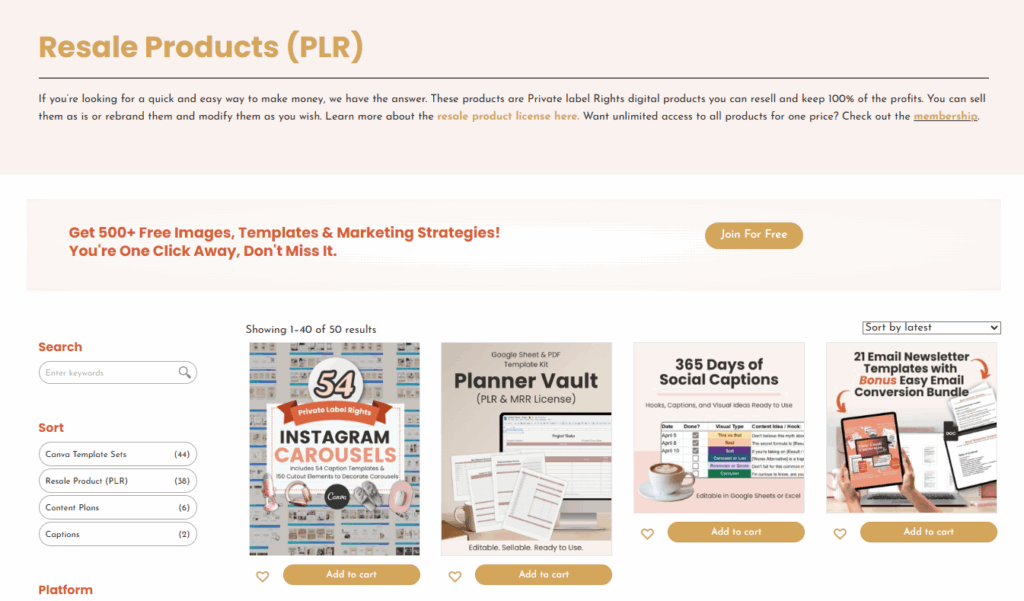
Under this license, anyone could buy any of these PLR products and make any modifications to them before reselling them as their own.
How to Price Your Done-for-You Products
Pricing can feel like a total guessing game, right? Here’s a cheat sheet to take the stress out of it:
- Simple downloads (single worksheets, checklists, basic templates): $7–$27
- Mid-range products (content calendars, workbook bundles, Canva template packs): $27–$67
- Premium products (course templates, business-in-a-box kits, comprehensive systems): $67–$197
Beyond those benchmarks, consider these factors when deciding how much to charge:
1. Value to the Client
Consider how much value your product provides to clients.
- Does it save time?
- How effortless will the process become?
- Will they make more money?
Price it accordingly. If it helps make money, you can usually charge more.
2. Your Expertise and Brand
Your reputation matters here.
If you’re a well-known expert, you can charge more. People pay extra for products from experts they trust. UK-based executive coach Barbara Bates, with over 15 years of coaching experience, sells eBooks and digital products alongside her coaching packages through Paperbell — and her established reputation means clients trust the value of those products sight unseen.
3. Market Research
Look at similar products in your niche and use that as a benchmark.
- How much are others charging?
- Do they include your exact deliverables, less or more?
- How are people reacting to the cost?
- What are they saying about the value they get?
For example, if most people are charging $8 to $15 for a pack of 5-10 Canva templates, you’ll struggle to sell them for $30 or more.
4. Production Costs
Include any costs associated with the creation of your DFY product.
- Was there any software tool you paid for?
- Did you hire someone, like a design or system expert, to help you out?
- Did it take you hundreds of hours to create?
Make sure your price covers these costs and leaves you a profit. The good news? Most DFY digital products can be created with free or low-cost tools like Canva, Google Docs, and free PDF editors — keeping your margins high.
5. Scalability
Are you going to offer tiered pricing, payment plans, or bundle deals?
These can nudge people toward spending more.
- You can sell some features of your product as a standalone or as a whole package.
- You can have a basic, standard, and deluxe version.
- You can also offer a discount if people buy multiple products together.
6. Ongoing Support
If your DFY product includes updates from time to time or ongoing support for users, factor that into your pricing structure. Paperbell lets you automatically deliver updated files to everyone who’s already purchased — so when you refresh your content calendar for a new quarter or update your templates, buyers get the new version without you having to send a single email.
Here’s a simple way to think about pricing:
Start with a price that feels slightly uncomfortable — most coaches underprice their digital products. You can always adjust the price later based on demand. And remember: since digital products have almost zero cost per sale, even a “low” price point generates healthy margins at scale.
Launch Your Done-for-You Products
Selling DFY products is one of the smartest moves you can make as a coach — create once, sell forever. And with Paperbell, launching them is ridiculously easy.
Just upload your products, set your prices, and start selling them right alongside your coaching packages. Your files are delivered securely through each client’s personal login portal — no broken download links, no chasing emails. You can set up automatic delivery on a schedule, bundle digital products with your coaching offers, and even drip content over time.
No juggling platforms, no tech headaches, and zero transaction fees from Paperbell (you connect your own Stripe or PayPal). Coaches on Paperbell have collectively earned over $47 million — and many of them got started with a single digital product.
Try Paperbell for FREE and get your digital products live today.
FAQs About Done-For-You Digital Products
What is an example of a DFY product?
Common examples include social media content calendars, Canva templates, workbooks, meal plans, and client onboarding kits. These are pre-made materials that buyers can customize and use immediately in their businesses, or resell if you provide resale rights.
Are DFY products profitable?
Yes, DFY products are highly profitable because you create them once and sell them repeatedly with almost zero cost per sale. Content calendars sell for $17–$47, workbook bundles for $27–$67, and premium course templates for $47–$197. The key is choosing a niche-specific product that solves a clear problem for your target audience.
What is the best-selling digital product?
The best-selling digital products vary by niche, but templates, planners, and course materials tend to perform well. The key is creating something that saves time and solves a specific problem for your target audience.
What is the done-for-you business model?
The DFY business model involves creating ready-to-use solutions that others can purchase and implement immediately. You do the work once, then sell it multiple times, creating passive income and scalability.
How can coaches use DFY products?
Coaches can use DFY products to diversify income, provide additional value to clients, and attract new customers. They’re ideal for expanding your offerings without increasing workload or creating new passive revenue streams. Many coaches sell digital products alongside their coaching packages on platforms like Paperbell, keeping everything in one place for both themselves and their clients.
How much money can you make selling digital products?
It depends on what you sell and how you market it. But here’s what we see: coaches who build a small catalog of 3–5 products do way better than those banking on a single item. A coach selling a $37 content calendar, a $47 workbook, and a $97 course template — even with just a few sales per week — can pull in $1,000–$3,000/month on the side.
Editor’s Note: This post was originally published in October 2024 and has since been updated for accuracy.