
You’ve watched someone talk themselves out of something they really wanted because the thought of it made their chest go tight. The interview they didn’t book. The pitch they rewrote nine times and never sent.
Maybe that someone was you, once.
Anxiety coaching is the work of helping people who are basically doing okay build practical skills for handling worry, pressure, and low-grade dread.
Here’s the thing. It isn’t therapy. And knowing exactly where that line sits is the most important skill an anxiety coach has.
In this guide, you’ll learn what anxiety coaching covers, where it stops, and the steps to become a successful (and certified) anxiety coach in 2026.
Heads up: some links in this article are affiliate links, which means Paperbell may earn a commission if you buy through them, at no extra cost to you.
What Is Anxiety Coaching?
Anxiety coaching is a type of life coaching focused on helping clients build skills for managing everyday worry, nerves, and stress so those feelings stop running things.
You work on the practical stuff: spotting the situations that reliably wind your client up, building routines that steady them, and holding them accountable to trying the thing they’ve been avoiding.
It’s forward-looking work. A coaching conversation spends its time on what your client wants to do next week, not on why they’ve felt this way since they were nine.
Who Anxiety Coaching Is For
Anxiety coaching is for people who are generally well and functioning, but who feel held back by worry.
Think of the client who’s sleeping fine and showing up to work, but has turned down three speaking invitations because the idea of going on stage makes them queasy.
That’s the lane: worry that’s tied to something specific and hasn’t crossed into clinical territory. Your client wants a plan and someone in their corner, not a diagnosis.
What Anxiety Coaching Is Not
This part matters more than anything else in this guide, so let’s be blunt.
Anxiety coaching is not therapy, and it is not treatment for an anxiety disorder. You don’t diagnose. You don’t treat. You don’t offer what you do as a substitute for licensed care.
Anxiety disorders are real medical conditions, diagnosed and treated by licensed clinicians: therapists, psychologists, psychiatrists, and physicians. If a client shows up with panic attacks, an existing diagnosis, a trauma history, or worry that’s disrupting their daily life, refer them out. Don’t take them on.
Referring out isn’t a failed sale. It’s what makes you trustworthy, and it’s how you build relationships with local clinicians who’ll send clients back your way.
Plenty of anxiety coaches also work alongside licensed care. Your client keeps their therapist for the clinical work and hires you for goals and accountability. That’s legitimate and common, as long as everyone knows who’s doing what.
Our guide to becoming a mental health coach covers the same scope questions across the broader mental wellness space.
What Clients Actually Get Out of It
Coaches sometimes oversell here, so here’s the honest version. Anxiety coaching doesn’t cure anything. It helps clients get better at handling the situations they’ve been dodging.
Clients usually come to an anxiety coach hoping for a few specific things. A toolkit they’ll actually use: breathing routines, pre-event rituals, a way to break one big scary task into a handful of small, unscary ones. An easier time speaking up, once they’ve practiced naming what they need, so conversations with partners and colleagues stop feeling so loaded. More of a sense of control over their choices, not because the nerves disappeared but because they’ve proven to themselves they can act anyway. And movement on whatever they’ve been stalling on: the promotion, the side business, that email that’s been sitting in drafts for a month.
If a client needs symptom relief from a diagnosed condition, that’s a clinician’s job. If they need help doing the thing they keep not doing, that’s yours.
Pro tip: Use Paperbell to create anxiety coaching packages to kickstart your coaching business. It’s a great way to test your offer and get the initial results.
Anxiety Coach vs. Therapist: What’s the Difference?

Anxiety coaches and therapists both sit across from someone struggling with worry. That’s where the overlap ends.
Therapists:
- Licensed professionals, usually with a master’s degree or doctorate in psychology, counseling, or social work
- Diagnose and treat mental health conditions, including anxiety disorders
- Complete supervised clinical hours and answer to a state licensing board
- Often work backward into a client’s history to understand where a pattern came from
Anxiety coaches:
- No degree or license legally required in most places
- Can get certified by the International Coaching Federation (ICF), which is optional but signals you’ve been trained
- Focus on goals, habits, and accountability, never diagnosis or treatment
- Work forward from where the client is today
Career path considerations:
- Therapist to coach: a fairly easy addition, since the listening skills transfer
- Coach to therapist: years of graduate education, supervised hours, and licensing exams
Your Triage Rule: When to Coach and When to Refer
Every anxiety coach needs a rule they can apply on a discovery call, before taking anyone’s money. Here’s a simple one.
Anxiety coaching is likely a good fit when:
- The worry showed up around something specific and recent: a new role, a move, a wedding, a return to work.
- Your client is functioning. They’re working, sleeping most nights, and their relationships are intact.
- They’re asking for structure and accountability, not symptom relief.
- They already have a therapist and want a coach for the goal side of things.
Refer to a licensed professional when:
- They mention panic attacks, or constant worry with no obvious trigger.
- They have a diagnosed anxiety disorder that nobody is currently treating.
- The anxiety is tied to trauma, grief, or a major loss.
- It’s affecting daily function: skipping work, avoiding leaving the house, not eating or sleeping.
- Substance use is involved.
- They mention self-harm or thoughts of suicide. Stop, share crisis resources, and refer immediately. This one isn’t a judgment call.
When you’re unsure, refer. A coach who says “I don’t think I’m the right person for this, but here’s who is” earns more respect than one who takes the booking anyway.
Write your scope down before you need it. Put it in your intake form, say it on discovery calls, and repeat it in your contract.
Therapists treat anxiety clinically. Coaches help generally-well clients build skills and take action. Related work like stress coaching sits in the same non-clinical lane, and many anxiety coaches do both.
Should You Become an Anxiety Coach?
Anxiety coaching is a growing field, and it’s no wonder why. According to the American Psychiatric Association, anxiety disorders affect nearly 30% of adults at some point in their lives.
Read that carefully, though. It’s a stat about diagnosed disorders, and those belong to clinicians. Just outside that 30% sits a much bigger group whose worry never reaches a diagnosis and who still want help handling it.
But before you jump in, there are a few things to think about.
Do You Have What It Takes?
Being a good anxiety coach takes patience, real empathy, and the discipline to sit with someone’s discomfort without rushing to fix it.
It also takes a quality that plenty of enthusiastic new coaches don’t have yet: the willingness to say no to a client you can’t ethically serve.
Are You Ready To Commit?
Becoming an anxiety coach doesn’t happen overnight. Training takes months, and building a client base takes longer.
You’ll spend that time learning coaching skills, not clinical ones: powerful questions, active listening, goal-setting frameworks, and the ethics around scope and referral. Learning to treat anxiety disorders is a different education entirely, and it belongs to licensed clinicians.
Can You Handle The Pressure?
Coaching people through worry can be draining, especially when a client isn’t moving as fast as they hoped. Most coaches also work solo, without a supervisor down the hall to sanity-check a tricky call.
You’ll have to hold a firm line sometimes too, whether that’s declining a client or telling someone their goal needs to change. Getting clear on your professional boundaries as a coach early saves a lot of awkwardness later.
Are You Passionate About Helping Others?
At the end of the day, making a positive difference in someone’s life should be the main motivation here.
If helping people do the things that worry has been talking them out of sounds genuinely satisfying to you, give it a shot.
How to Become an Anxiety Coach
Let’s walk through setting up your own anxiety coaching business and landing your first client.
1. Choose your anxiety coaching niche
Deciding on a specific niche lets you get genuinely good at one kind of conversation instead of vaguely okay at all of them.
Some niches you can serve on your own: social nerves coaching (building confidence around networking, dating, and speaking up in meetings), performance coaching (for clients who freeze before pitches, interviews, auditions, or stage time), work stress coaching (deadline pressure, difficult managers, the Sunday night dread that ruins the weekend), and life transition coaching (new parents, career changers, anyone whose worry showed up alongside a big change).
Other niches only work alongside licensed care. Some coaches specialize in supporting clients who already have a diagnosis and an existing treatment relationship. The client keeps their clinician for the clinical work, and you handle goals and accountability. You never step into the treatment role.
That includes things like Generalized Anxiety Disorder (GAD) support coaching, for clients who’ve received that diagnosis from a healthcare professional and are being treated for it; Post-Traumatic Stress Disorder (PTSD) support coaching, always in parallel with a licensed clinician and never instead of one; and Obsessive-Compulsive Disorder (OCD) support coaching, where the same rule applies: your client is under professional care, and you support the goal-setting side.
If you go this route, be upfront that you’re a coach and not a clinician, and get comfortable asking “who’s on your care team?” during the discovery call.
You can also niche by who your clients are rather than what they’re dealing with: college students, people going through a divorce, or high-achieving women facing burnout.
2. Come up with compelling anxiety coaching offers and packages
Build your offer around the change your client wants to make. If you work with university students, it could be:
“I’ll help you get steady enough to walk into your exams without a week of dread beforehand.”
Then decide how many sessions it takes to get someone there, how often you’ll meet, and what support they need in between:
- Guided meditation recordings
- Weekly check-in assessments
- Voice note coaching
- Group coaching
- Journal prompts
These extras can be built into your coaching packages and help you stand out from other anxiety coaches in the same niche.
Your package should also answer how many sessions your client gets, whether there’s a deadline to book them, and whether payment plans are available.
If you use Paperbell, you set these up once and reuse them with unlimited clients.
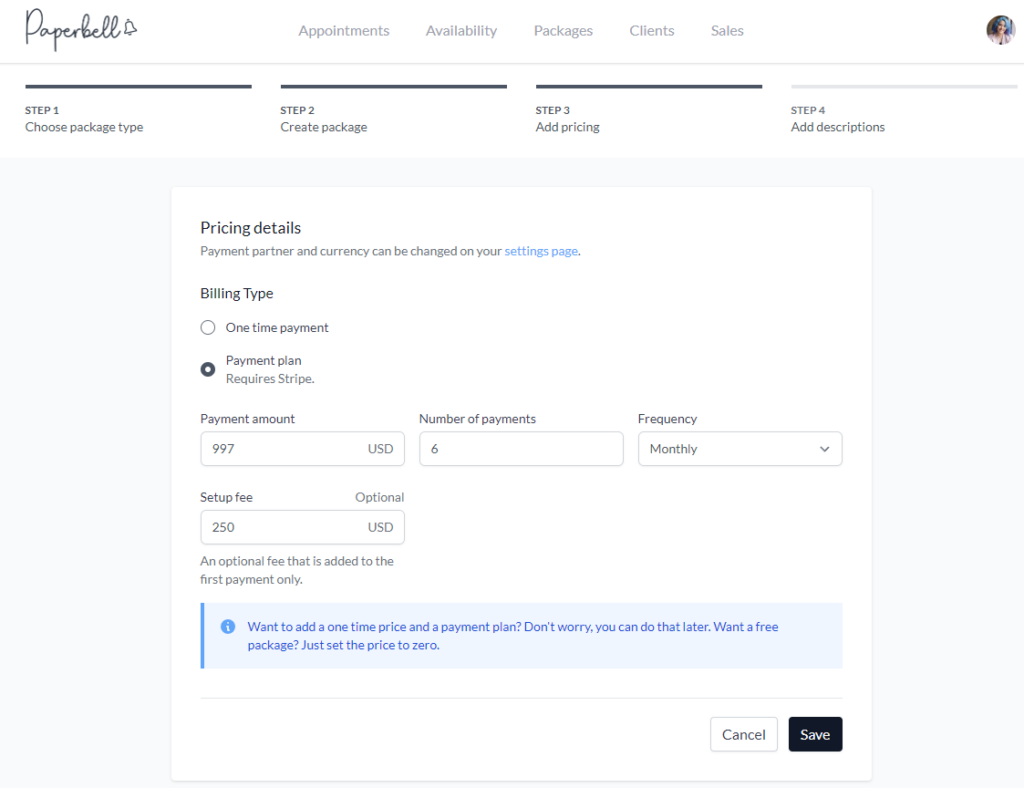
Here’s another way to think about it. Your offer is the “sizzle” that sells the coaching. Your package is the admin detail underneath.
3. Find your first anxiety coaching client
Start with your personal network. Ask whether anyone knows someone putting off something big because of nerves.
You can also list yourself on Coach Compare so people searching for an anxiety coach can find your profile.
When you land that first client, put everything into helping them.
Why?
Because they set the pattern for how you run your business. And you get a testimonial out of it.
4. Establish a marketing strategy
The scrappy tactics that land your first few clients only take you so far. Finding more anxiety coaching clients means reaching a bigger audience online.
There’s no universal answer. Your approach should depend on what you enjoy, what you’re good at, and where your ideal clients hang out.
Blogging might be perfect for someone who loves writing. But if you’re great on camera and hate writing?
Then blogging probably isn’t your move.
Here are some of our favorite strategies for getting more anxiety coaching clients:
- Start a blog: Write about what your ideal audience is searching for, then use SEO or Pinterest to drive traffic to it.
- Become a LinkedIn expert: You can get coaching clients on LinkedIn by posting and engaging with the people you want to work with.
- Make TikTok videos: Is video your thing? You can get leads on TikTok.
- Grow your Instagram following: Not a fan of LinkedIn or TikTok? Instagram is another solid platform for anxiety coaches.
- Run Facebook ads: This costs money, but it reaches a bigger audience fast. Ads won’t fix a broken message, though they’ll tell you quickly whether yours is broken.
- Launch a coaching newsletter: Here are 10 lead magnet ideas to help you start your anxiety coaching email list.
- Guest on other people’s podcasts: Ideal for coaches without an audience of their own yet.
One note specific to this niche: watch your language. Promising to “cure” anxiety or “eliminate” panic strays into claims only a licensed professional could responsibly make. Talk about the actions your clients take, not the symptoms you’ll remove.
Get Certified as an Anxiety Coach
Worth knowing before you go looking: there’s no anxiety coach license, and no single body that certifies anxiety coaches specifically.
What most coaches do instead is earn a general coaching credential and apply it to an anxiety niche. The usual route is the International Coaching Federation (ICF), which sets global standards and is the closest thing the industry has to a recognized benchmark.
One naming note, since it trips people up: older articles still call it the International Coach Federation and point at its old web address.
Understanding ICF Certification Levels
The ICF offers three credential levels. At the time of writing, it lists:
- Associate Certified Coach (ACC): the entry level, requiring 60+ hours of coach-specific education and 100+ hours of coaching experience.
- Professional Certified Coach (PCC): for coaches with more mileage, requiring 125+ hours of education and 500+ hours of experience.
- Master Certified Coach (MCC): the advanced level, requiring 200+ hours of education and 2,500+ hours of experience. You also need to hold, or have previously held, a PCC.
Every level also asks for mentor coaching hours on top of your training. Requirements do get revised, so check the ICF’s current credentials overview before building a plan around any specific number.
Finding an accredited training program
To get ICF credentialed, your training has to come from an ICF-accredited program.
Programs are accredited at three levels that map to the three credentials: Level 1 is the ACC pathway, Level 2 the PCC pathway, and Level 3 the MCC pathway. Match the program level to the credential you want, because starting at Level 1 when you’re aiming for a PCC means doing it twice.
You can browse accredited programs through the ICF’s own training program directory. Don’t hunt for an anxiety-specific one, because there isn’t one. Search for general life coaching or mental wellness training, then read the curriculum for two things: does it cover working with anxious clients, and does it teach you where coaching stops?
That second question is the one most coaches forget. Our guide to mental health coach certification covers what to look for, and our list of the best life coaching training programs covers options that certify you in 12 months or less.
Tips on Choosing a Coaching Program
When you’re comparing programs, look at:
- Curriculum: Does it cover working with anxious clients?
- Scope and ethics training: Does it teach you when to refer out? In this niche, that’s not optional.
- Instructors: Look for experienced coaches with real background in mental wellness work.
- Fees and financial aid: Compare tuition and ask about scholarships or payment plans.
- Schedule and format: Online, in person, or a mix.
Earning your certification
To become an ICF-certified anxiety coach, you complete the required training hours for your target level, log your coaching experience hours, and finish your mentor coaching.
Then there are two more gates. You submit a recorded coaching session for performance evaluation, so an assessor can hear you coach. And you sit the ICF Credentialing Exam, which tests your grasp of the ICF core competencies and code of ethics. If you’re reading older guides, that exam replaced the Coach Knowledge Assessment (CKA).
Once you’re through, you have a credential clients recognize. What it doesn’t give you is clinical authority, and your marketing should reflect that.
Best Anxiety Coach Certifications
Need a starting point? Below are reputable programs worth looking into. None is an anxiety-specific credential, because that’s not how the coaching world works. They give you solid general coach training you can apply to an anxiety niche.
1. Coach Training Alliance Certified Coach Program
This well-established program is ICF accredited at Level 1 and covers general coaching skills for any niche.
Coach Training Alliance certifies it as 60 hours of approved coach-specific training inside a full program of roughly 75 hours. It runs remotely over 22 weeks, which they describe as about six months with breaks for holidays, and classes are capped at 12 participants.
What’s included:
- Live teleconference classes in small groups
- Self-study materials through their Coach Training Accelerator
- Group mentoring
- Practice coaching with real clients
Tuition is listed at $3,897 at the time of writing, though prices change. Since it’s a Level 1 program, it’s the ACC pathway, so you’d be starting a rung low if your goal is a PCC.
2. iPEC Core Energy Coaching Certification Program
iPEC runs a much bigger program, totaling 320+ hours over roughly 7 to 10 months. It’s built around three main live training modules, in person or virtual, with self-study and mentor sessions in between.
The curriculum centers on their Core Energy Coaching methodology, which works on the beliefs and emotions underneath a client’s behavior. That transfers naturally to anxiety coaching, since so much of the work is about what a client believes will happen if they do the scary thing.
iPEC’s program is ICF accredited, and iPEC positions it as a pathway toward the Professional Certified Coach (PCC) credential. Graduates certify at PCC skill level and can apply for the credential once they’ve logged 500+ coaching hours.
Finish the program and iPEC also awards you two of its own credentials: Certified Professional Coach (CPC) and Energy Leadership Index Master Practitioner (ELI-MP). Their COR.E Dynamics Specialist certification is a separate advanced add-on rather than part of the base program.
3. IACET-accredited continuing education
This one is different from the others, and it’s worth understanding why.
IACET, the International Accreditors for Continuing Education and Training, doesn’t certify coaches. It’s a nonprofit that accredits the organizations providing continuing education, and it created the original Continuing Education Unit (CEU).
So there’s no IACET certification to earn. What you get is a quality filter. When you’re topping up with short courses on stress management or emotional intelligence, an IACET-accredited provider has been measured against a recognized standard rather than just marketing itself well.
One naming quirk: for years it stood for the International Association for Continuing Education and Training, and both versions still appear on its own site.
4. Erickson Coaching International: The Art & Science of Coaching
Erickson’s flagship program is built on a solution-focused methodology, which Erickson describes as grounded in neuroscientific principles.
That’s a natural fit for this niche. Solution-focused coaching spends its time on where a client wants to get to and what’s already working, instead of picking apart the problem, which is a useful instinct when the problem is worry.
It’s ICF accredited at Level 1 (the ACC pathway) and Level 2 (the PCC pathway), with a Level 3 for coaches heading toward an MCC. You can take it online, in person at locations around the world, or as a mix.
Erickson also offers a separate Neuro-Linguistic Programming (NLP) Practitioner Certification. That’s its own course rather than part of The Art & Science of Coaching, so don’t assume one includes the other.
Anxiety Coaching FAQs
Is anxiety coaching the same as therapy?
No. Therapy is clinical care from a licensed professional who can diagnose and treat anxiety disorders. Anxiety coaching is a non-clinical service focused on goals, habits, and accountability for clients who are generally well.
Therapy often looks backward to understand where a pattern started. Coaching looks forward. Some clients do both at once, with a therapist handling the clinical side and a coach handling the goals.
What does an anxiety coach actually do?
An anxiety coach helps clients identify the situations that reliably wind them up, build practical routines for those moments, and take action on things worry has been talking them out of.
In a typical session you’d review what they tried since last time, work through what got in the way, and agree on the next steps. You’re not analyzing their childhood or interpreting symptoms. You’re helping them move.
Can an anxiety coach diagnose or treat an anxiety disorder?
No, and this one has no gray area. Diagnosing and treating anxiety disorders is restricted to licensed clinicians such as therapists, psychologists, psychiatrists, and physicians.
Coaching isn’t a licensed profession, so a coach who diagnoses or offers treatment is working outside their scope. If a client describes panic attacks, an untreated diagnosis, trauma, or anxiety that’s disrupting daily life, refer them out. You can still work with them later, alongside their clinician.
Do you need a certification to become an anxiety coach?
Legally, in most places, no. Coaching isn’t regulated the way therapy is, so there’s no license standing between you and your first client.
Practically, certification does a lot of work for you. It teaches you a methodology instead of leaving you to improvise, and it covers the scope and ethics questions this niche demands. It also reassures clients who are careful about who they let near a sensitive topic.
How much does it cost to become a certified anxiety coach?
It varies a lot, and most providers don’t post a public price. Coach Training Alliance lists tuition of $3,897 at the time of writing. iPEC and Erickson quote on request, so you’d need to speak to an admissions advisor.
Budget for extras on top of tuition. The ICF charges its own application and exam fees, and mentor coaching hours are sometimes billed separately.
Does anxiety coaching actually work?
It depends entirely on what you’re asking it to do.
For a generally-well client who wants structure, accountability, and a push to stop avoiding something, coaching is a good fit. For a diagnosed anxiety disorder, the treatments with real clinical evidence behind them sit with licensed professionals, not coaches.
Coaches who are honest about that distinction tend to do better, not worse. Clients can tell the difference between someone selling a cure and someone offering to help them take the next step.
Become a Successful Anxiety Coach
Becoming an anxiety coach takes dedication, good training, and a clear head about where your work ends and a clinician’s begins.
Get that right and you build something genuinely useful: a practice that helps people who are doing okay do a bit better, and sends everyone else to the professionals who can help them.
The other half of the job is keeping the business side from eating your week. That’s where Paperbell comes in, handling your bookings, payments, contracts, intake forms, and client notes in one place.
Editor’s note: This post was originally published in 2023 and has been updated for 2026.
Ready to spend less time on admin and more time coaching? Try Paperbell for free.