

You sat down to write one Instagram caption for your coaching business. Two hours later you’re still staring at a blinking cursor, you’ve rewritten the first sentence eight times, and ChatGPT gave you something that sounds like a HR memo.
Sound familiar?
The problem isn’t ChatGPT. It’s that most coaches were taught to use AI like a vending machine: paste a one-liner, hope something useful drops out. In 2026, the coaches who actually save time with AI are running chains of prompts and building Custom GPTs that already know their brand voice.
In this guide, you’ll get the full toolkit:
- 90 ChatGPT marketing prompts for coaches, sorted into 6 categories
- 10 multi-step AI workflows for 2026 (the agents and prompt chains that replace 5+ one-off prompts)
- 5 Custom GPTs every coach should build, with setup notes
- An honest look at when to use ChatGPT vs. Claude for marketing
- A 6-question FAQ on prompts, GEO, and how AI is actually changing coaching marketing this year
What are ChatGPT marketing prompts for coaches? ChatGPT marketing prompts for coaches are pre-written instructions that turn ChatGPT into a marketing assistant for your coaching practice. This is for tasks like writing social posts, drafting emails, generating content ideas, and now in 2026, running multi-step workflows like content research agents.
The 5 most useful prompts to start with:
- The audience-pain-point prompt: uncover the exact words your ideal client uses about their problem
- The brand-voice training prompt: teach ChatGPT how you actually sound
- The blog-to-social repurposing prompt: turn one long-form post into a week of content
- The email sequence prompt chain: generate a full welcome series from one strategy doc
- The lead-magnet outliner: go from idea to first draft in 3 chained prompts
You’ll find all five (and 85 more) below.
What Are ChatGPT Prompts?
ChatGPT prompts are specific instructions you give ChatGPT to generate a response. They might be questions you want answered, requests for pro/con lists, a brief for content ideas or an entire marketing strategy, outlines for copywriting, or (new in 2026) multi-step workflows where each prompt builds on the last.
To get useful output, you need to clearly communicate your intent, ask specific questions, and provide as much context as possible.
For instance, if you want ChatGPT to help you write a marketing email for your coaching services, your prompt might include your target audience, your coaching niche, the tone of voice you want, examples of successful emails you’ve written before, an email framework to follow, and the specific details to highlight.
How can you use ChatGPT for marketing your coaching business? Ask it to:
- Generate ideas for your marketing campaigns
- Draft emails and subject lines for your email campaigns
- Come up with new names for your coaching packages
- Generate copy for a Facebook ad
- Create outlines for your blog articles
- Write social media captions
- Come up with new taglines for your website
- Get new suggestions for workshop or webinar topics
- Generate new coaching questions and exercises for your clients
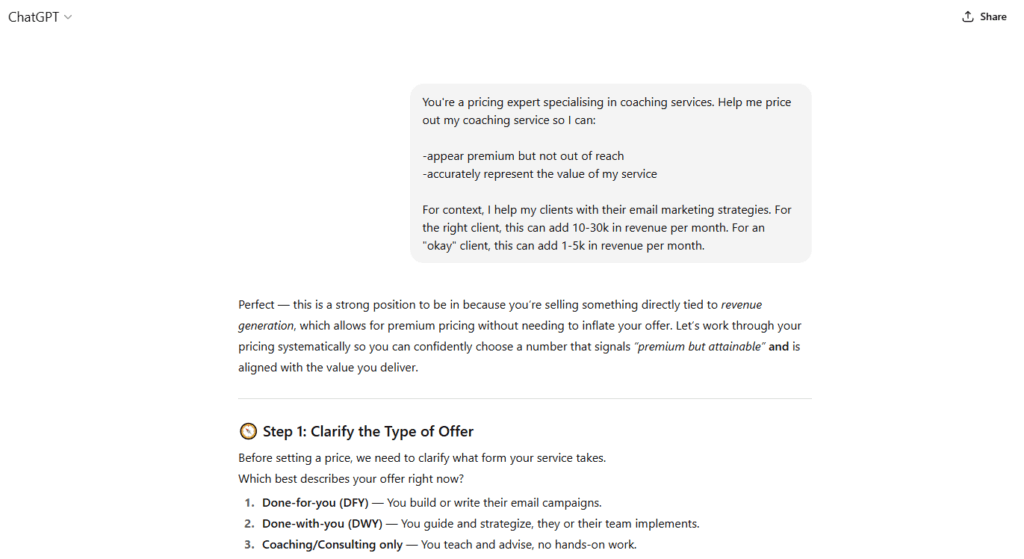
- Figure out how to price your coaching services
Pro tip: Want to save even more time running your coaching business? Try Paperbell for free to launch a beautiful coaching website, manage scheduling and payments, share your offers, and manage your clients from a single platform.
The Benefits of Using ChatGPT Prompts for Marketing Your Coaching Business
1. It Saves You Time (When Used Right)
Once you get the hang of it, ChatGPT can save you time by generating a long list of ideas or completing marketing tasks in seconds. It can also:
- Lay out the data and insights you need to make marketing decisions
- Get you started with your copywriting process or campaign planning
- Run a competitor analysis
- Help you get work done hands-free (via voice mode)
It takes some time to learn how to use AI tools to automate marketing tasks, but by the time you get through this article, you’ll know how to do just that.
[ Read: How To Use AI for Coaches (Without Losing What Makes You Unique) ]
2. It Helps You Overcome Writer’s Block
There’s nothing worse than sitting in front of a blank page, not knowing where to start. A strong structure and outline for your posts and web pages can get you unstuck and make writing easier.
ChatGPT can help you brainstorm that structure. Instead of creating content ideas or an article outline from scratch (which takes up a lot of brain space), you can ask your AI buddy to do it for you.
3. It’s a Free (or Low-Cost) Solution
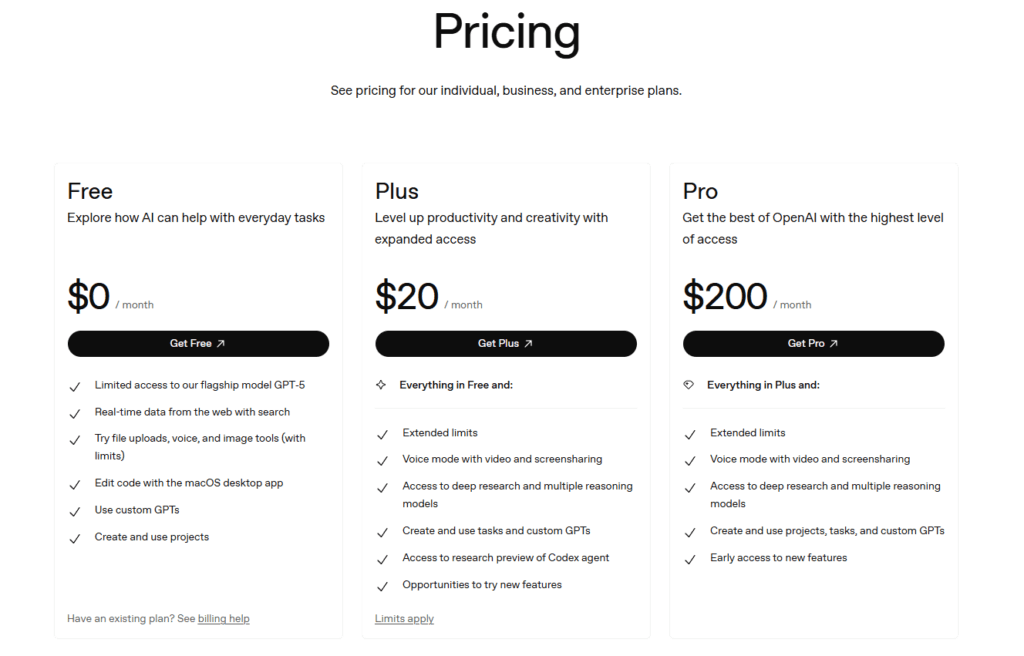
ChatGPT has a free plan with limited access to current models. If you want extended usage, voice mode, image generation, and the ability to build your own Custom GPT, you’ll need to upgrade to the paid Plus, Pro, or Business plans. For most solo coaches, the entry-level paid plan more than pays for itself in the first week of regular use.
The Downsides of Using ChatGPT Prompts for Marketing Your Coaching Business
1. It’s Not Error-Free
ChatGPT isn’t perfect. You still need to proofread the text it generates and look out for wrong information.
You also need to fact-check what it suggests using reliable sources and make sure you cite proprietary concepts and ideas properly to avoid legal trouble. Like all large language models, ChatGPT is known to “hallucinate,” generating false events, statistics, or sources that sound plausible but aren’t real.
Even with built-in browsing, current models can lag behind on breaking news and very recent industry developments. For timely content, always verify against a primary source.
2. It Doesn’t Think Like a Human
ChatGPT is great at churning out data but lacks the contextual thinking and emotional intelligence that help marketing campaigns land.
If you don’t edit what it suggests and think through your campaigns critically, AI-generated content can seriously damage your brand image.
Here’s another way to think about it: OpenAI and other large language model (LLM) creators may call their products “AI,” but in reality, they aren’t a “true” artificial intelligence. The way they work is more closely related to a much more powerful version of the text predictor on your smartphone.
This means these models are incapable of producing genuinely unique ideas. And unique ideas are what will help you stand out from other coaches.
3. Low Ranking for Your SEO Campaigns
In the last few years, Google has become increasingly adamant about ranking content with the E-E-A-T factors in mind:
- Experience
- Expertise
- Authoritativeness
- Trustworthiness
In the article linked above, Google mentions that Trustworthiness is the most important factor. How trustworthy can an article be if it’s written entirely by a machine known to hallucinate facts and lacks the lived experience that makes coaching content valuable?
This is especially true for legal and medical content, where misinformation can do real damage (business and health coaches, beware). So while it’s tempting to outsource your blog to ChatGPT while you chill on a beach, those margaritas have to wait. The coaches winning in search right now use AI to draft and structure, then add their own voice, examples, and client stories on top.
How to Create Effective ChatGPT Marketing Prompts
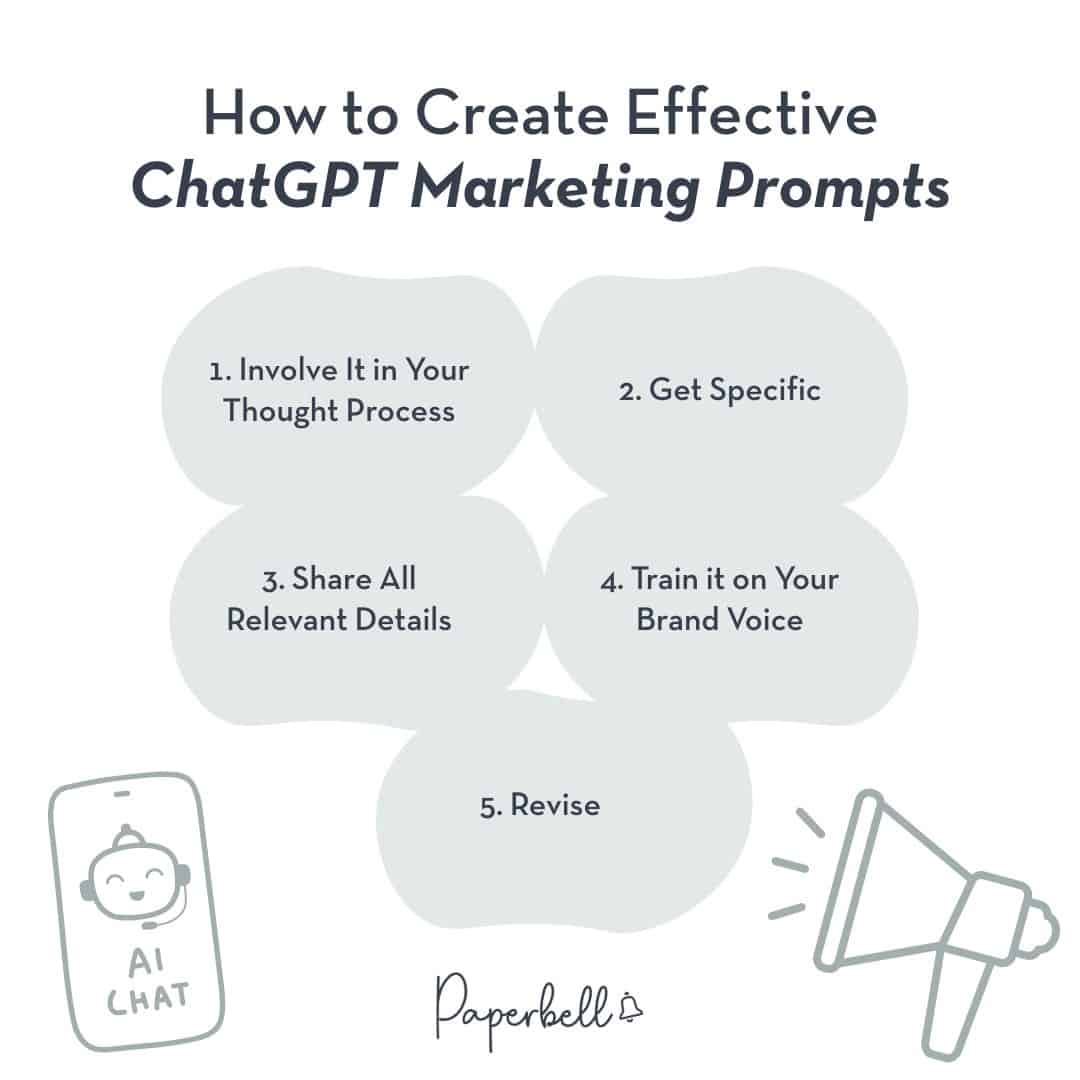
1. Involve It in Your Thought Process
Thinking in a vacuum is tiring. ChatGPT is always there to brainstorm with you. You can ask it to break down marketing processes, spill out new content ideas, evaluate the pros and cons of an initiative, or analyze a piece of copy that performed well and explain why.
Here’s a prompt that works well for analysis:
You are an expert email marketing strategist for the coaching industry.

Analyze the following marketing email and tell me:
1. What makes this email effective?
2. Give me 3 ideas to apply this framework to an email promoting my [niche] coaching services to [target audience].

Email to analyze:
[paste email here]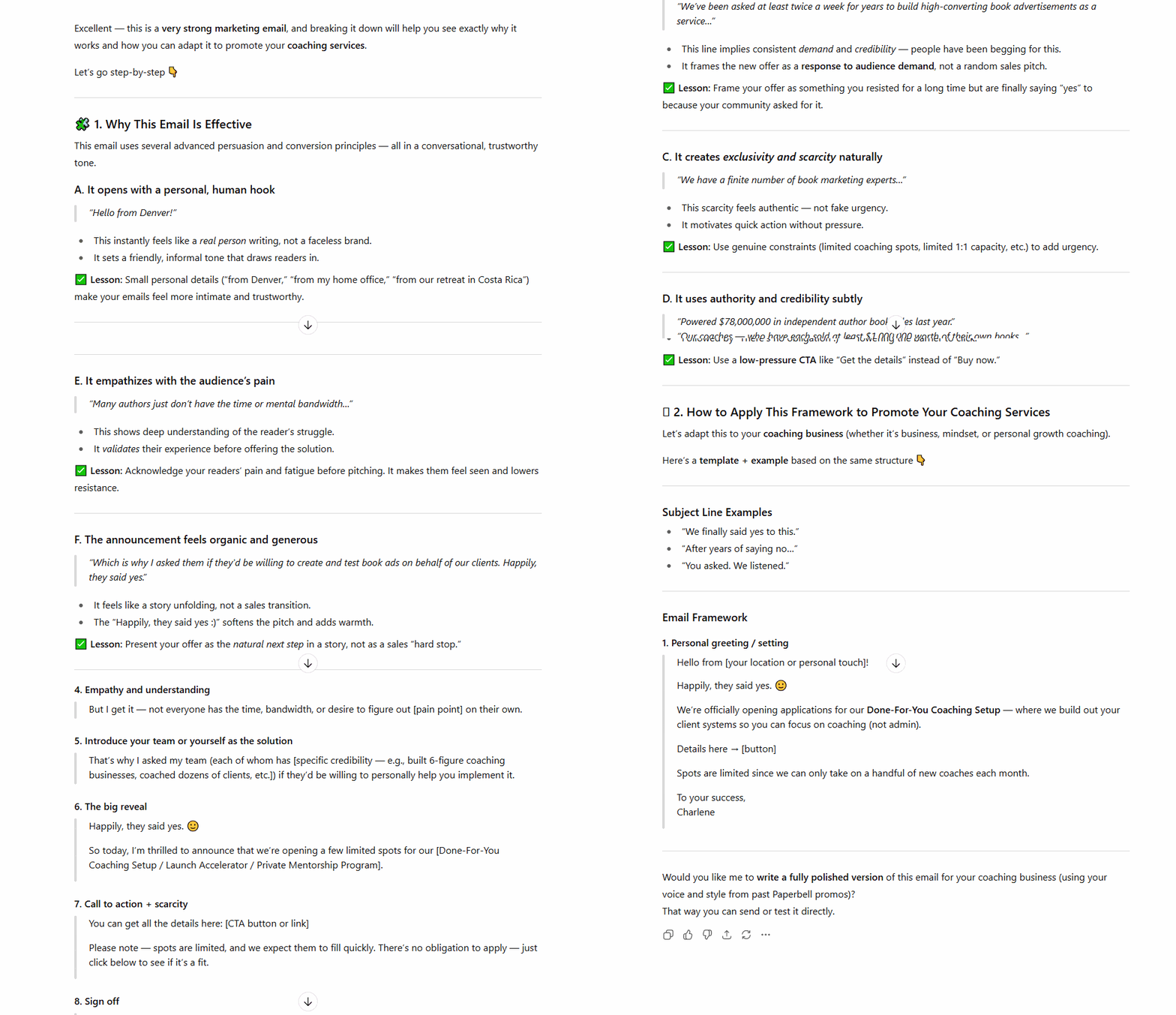
2. Get Specific
One of the secret ingredients of engaging content is specificity. Generic, vague messages are a turn-off for your target audience because they make it sound like you’re not speaking to them.
If you’re just asking for “a generic post for social media,” the output will be nothing short of blah.
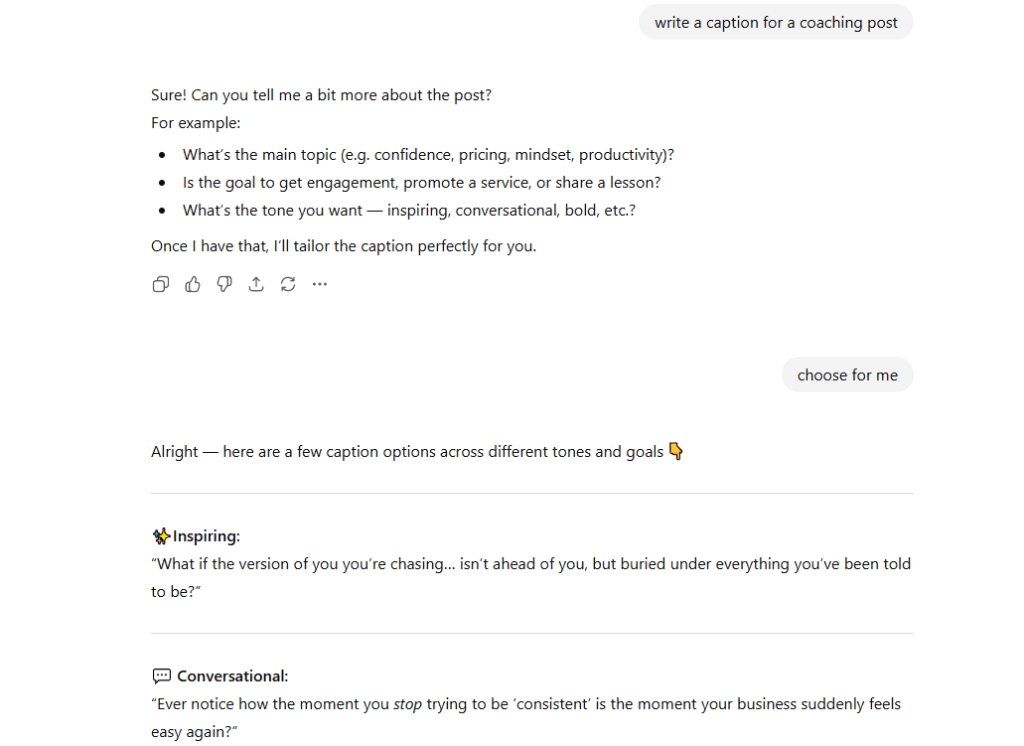
Specify the topic, audience, and angle, and the caption gets tailored accordingly.
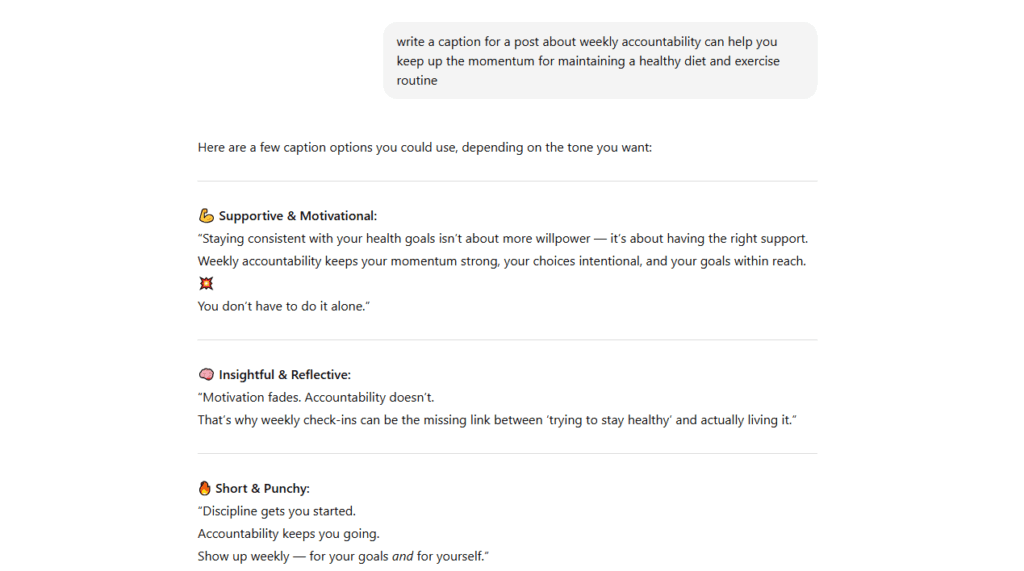
3. Share All Relevant Details
The more ChatGPT knows about your campaign, the better it tailors its suggestions. Let it know about:
- Format: social media post, article outline, tagline, or email template?
- Length: how many words? How many options?
- Other successful examples: the more ChatGPT sees what good looks like, the better your output will be.
- Target audience: who is the campaign addressing? What pain points does your product solve?
- Your brand and services: your specialization, your offers, and the product this campaign revolves around.
- Your actual knowledge: braindump what you know about the topic. Let it organize, not invent.
Today’s models have a much larger context window than the first ones, which means you can insert a lot more input data into your prompts than before. Paste in whole client transcripts, past blog posts, your offer pages.
4. Train it on Your Brand Voice
Tonality isn’t really relevant for ideation and planning, but it is for your copy. In most cases, the problem isn’t with the facts ChatGPT suggests but with the tone.
You can describe your tone of voice (humorous or serious, formal or casual, irreverent or respectful, matter-of-fact or enthusiastic) and you can give it examples of your previous writing that best resemble what you’re looking for. Better yet, build a Custom GPT pre-loaded with your voice samples (more on that below).
5. Revise
Working with ChatGPT is a lot about trial and error. The prompts below will give you a head start, but you’ll still tweak them to get the results you want. If the first output isn’t quite it, you can edit your prompt to be more specific, ask ChatGPT to regenerate, or type “go deeper on point 3” to get more detail on a specific section.
10 Multi-Step AI Workflows for 2026
Here’s the shift that separates 2026 from 2024: the coaches getting the most out of ChatGPT aren’t writing better one-off prompts. They’re chaining prompts into workflows: small assembly lines where the output of one prompt feeds the next.
Some of these are now possible inside ChatGPT as “agents” that run multi-step tasks autonomously. Others you run manually in one chat thread, copy-pasting the output of each step into the next. Plug in your niche, audience, and offer where indicated.
1. The Content Research Agent
Goes from “I should write about X” to a researched, audience-aware outline in 6 chained prompts.
STEP 1: Describe my ideal client for [niche] coaching: their demographic, where they hang out online, and the 5 biggest frustrations they have about [topic area].

STEP 2: Based on that profile, list 10 questions this audience is actively Googling about [topic]. Group them by search intent.

STEP 3: I'm planning to write about [chosen subtopic]. Compare what's already ranking on page 1 of Google for that query. What angle is missing?

STEP 4: Based on that gap, write an outline (H2s and H3s) for a 2,000-word blog post that I'm uniquely positioned to write as a [niche] coach.

STEP 5: Draft the introduction and first H2 in my voice: [paste 2-3 paragraphs of your existing writing].

STEP 6: Critique that draft. Where does it sound generic? Where could I add a real client example?
2. The Email Sequence Factory
One chain produces a 9-email funnel (4 welcome, 3 nurture, 2 re-engagement). Each email knows what the previous one said.
STEP 1: I'm building an email sequence for new subscribers who downloaded my [lead magnet] about [topic]. The goal is to enroll them in [coaching offer, $X]. Map out a 9-email sequence with the strategic purpose of each email.

STEP 2: Write welcome email 1 (sent immediately). Tone: [warm/direct/etc]. Length: under 200 words.

STEP 3: Now write welcome emails 2-4 (sent on days 2, 4, 7). Each should pick up where the previous email left off, without repeating content.

STEP 4: Write the 3 nurture emails (weeks 2-4). Focus on case studies and reframes, not selling.

STEP 5: Write the 2 re-engagement emails for subscribers who haven't opened in 30 days.
3. The Podcast Outreach Workflow
Finds shows in your niche, identifies the host, and writes a personalized pitch for each. Use with ChatGPT’s browsing for live data.
STEP 1: Find 15 active podcasts whose audience matches [my ideal client]. Include show name, host name, episode count, and a one-line description.

STEP 2: For the top 5, summarize the host's recent episode topics and identify a theme or angle I could speak to as a [niche] coach.

STEP 3: Draft a 150-word pitch email for podcast #1. Reference a specific recent episode. Suggest 3 angles I could bring. Sign off as [my name, credentials].

STEP 4: Now do the same for podcasts 2-5, varying the angle and opening line so I'm not sending the same email five times.
4. The LinkedIn Content Engine
One strategy prompt produces a week of LinkedIn content: 3 posts, 1 newsletter, 5 thoughtful comments on other people’s posts.
STEP 1: I'm a [niche] coach. My LinkedIn audience is [describe]. My core message this month is [theme]. Suggest 5 content angles I could rotate through.

STEP 2: Pick angle 1 and write 3 LinkedIn posts (each 100-180 words) that approach it from different angles: a personal story, a contrarian take, and a practical how-to.

STEP 3: Write a 600-word LinkedIn newsletter on the same theme, with a clear hook, 3 sub-points, and a call to action to book a discovery call.

STEP 4: Suggest 5 LinkedIn posts (from leaders in adjacent niches) where I could leave a thoughtful comment that positions my expertise. Give me the comment for each.
5. The Lead-Magnet Builder
Goes from “I need a freebie” to a first draft of the actual lead magnet in 3 prompts.
STEP 1: My ideal client struggles with [pain point]. Give me 10 lead-magnet ideas (templates, checklists, mini-courses, audits) that solve a specific subset of that problem in under 15 minutes.

STEP 2: I'll go with idea #[X]. Outline it: cover page, intro, 5 sections, conclusion, soft CTA to book a call.

STEP 3: Write section 1 in full. Keep paragraphs under 3 sentences. Add a worksheet question at the end.
6. GEO-Optimized Content (Writing to Be Cited by AI Overviews)
Generative Engine Optimization (GEO) is writing content that AI tools (Google’s AI Overviews, Perplexity, ChatGPT) actually quote in their answers. Because more and more searches end without a click, being cited inside the AI answer is now part of your visibility strategy.
I want to write a blog section that's likely to be quoted by AI Overviews for the query "[target query]".

Use these GEO patterns:
- Open with a 40-60 word direct definition of the term in a single paragraph
- Follow with a numbered list of 5 specific items (AI loves quoting lists)
- Include 1 statistic with a real source link
- Use the exact phrase from the query in the H2

Topic: [your topic]
Audience: [your ideal client]
7. The Webinar Funnel
Generates the full funnel for one webinar: registration page, 3 reminder emails, replay follow-up, and post-webinar offer email.
STEP 1: I'm hosting a free webinar titled "[title]" for [audience]. The 3 main teaching points are [X, Y, Z]. Write the registration page copy: headline, sub-head, 3 bullet benefits, hosted-by section, and the CTA.

STEP 2: Write 3 reminder emails: one week before, one day before, one hour before. Each should add a different angle of value (so people don't tune out).

STEP 3: Write the replay email for people who registered but didn't show up.

STEP 4: Write the offer email for people who watched the whole thing (includes a special bonus for booking within 48 hours).
8. The Course Module Outliner
One chain takes you from client transformation to a full course outline with lessons and exercises. For coaches building or refreshing a signature program.
STEP 1: The transformation my course delivers is: from [Point A] to [Point B] for [audience]. Map the 5-7 internal shifts a client has to make to get there.

STEP 2: Turn those shifts into 5-7 modules. Give each module a benefit-driven title.

STEP 3: For module 1, outline 4 lessons. For each lesson, suggest: a teaching concept, a worksheet exercise, and a reflection prompt.

STEP 4: Now identify the most likely point a student will get stuck. Suggest a bonus mini-lesson to keep them moving.
9. Customer Voice Mining
Turn 5-10 client testimonials into a copy bank you can pull from for every sales page, email, and ad for the next year.
STEP 1: I'm pasting in [N] client testimonials below. Extract the exact phrases clients use to describe:
- Their state BEFORE working with me
- Their state AFTER working with me
- What surprised them about the process
- What they almost didn't sign up for

STEP 2: Group those phrases by theme. Bold the strongest, most quotable lines.

STEP 3: For each theme, draft 3 short copy snippets I could use as sales-page subheads, email subject lines, or ad headlines.
10. The Repurposing Factory
Turn one long-form piece (blog post, podcast, webinar) into a week of distribution: 5 social posts, 1 email, 3 Instagram carousels.
STEP 1: Here's my long-form piece: [paste blog post or transcript]. Identify the 7 most valuable insights, the 3 most quotable lines, and 1 surprising story.

STEP 2: Turn the 7 insights into 5 short social posts (LinkedIn-friendly, under 150 words each), each with a different hook.

STEP 3: Turn the surprising story into a 200-word email newsletter with a soft CTA.

STEP 4: Outline 3 Instagram carousel posts (6 slides each) using the 3 quotable lines as anchor slides.
ChatGPT vs. Claude for Marketing — When to Use Each
Most coaches now have ChatGPT and Claude open in two browser tabs. They’re not interchangeable. Quick rules of thumb based on what each tool actually does well:
- Use ChatGPT for: image generation (DALL-E built in), voice mode for hands-free brainstorming, building Custom GPTs to share with your team or clients, anything that needs to browse the live web, and casual back-and-forth ideation.
- Use Claude for: long-form writing (blog posts, sales pages, ebooks), analyzing big documents (paste in your whole offer page or a 60-page client transcript), refining tone in a way that doesn’t drift toward sounding generic, and any task where you’d rather the AI ask a clarifying question than guess.
The honest version: if you can only afford one paid plan, pick the one that matches your bigger weekly task. Coaches who write a lot of long-form content lean Claude. Coaches who need to produce a lot of varied marketing assets (images, posts, ads, voice notes) lean ChatGPT. Most of the prompts in this guide work in both, you just need to paste them in.
5 Custom GPTs Every Coach Should Build
A Custom GPT is a version of ChatGPT you’ve pre-loaded with instructions, examples, and reference files. You build it once, then use it forever. No more pasting the same context every time you open a new chat. You need a paid ChatGPT plan to build them, but using GPTs others have built is free.
Here are the five every coach should have in their sidebar:
1. Your Brand-Voice GPT
The single most useful Custom GPT for a coach. Upload 10-20 samples of your best writing: emails, blog posts, social captions, transcripts of you speaking. In the instructions, describe your tone, your sentence rhythm, your favorite words, the words you’d never say. From then on, every draft you generate from this GPT sounds like you instead of like a press release.
2. Lead Magnet Drafter
Pre-load it with your offer details, ideal client profile, and a few examples of lead magnets you’ve liked. When you have a new freebie idea, this GPT spits out a full outline and first draft tailored to your audience.
3. Content Calendar Planner
Load it with your monthly themes, your audience’s recurring questions, and your content pillars. Ask it for a 30-day calendar across whichever channels you use, and it returns a planner you can paste straight into Notion or Trello.
4. Email Strategist
Upload your past high-performing emails plus the structure of your funnel. Use it whenever you need a new welcome sequence, sales email, or re-engagement campaign. It’ll match your voice and reference your existing offers correctly.
5. Social Post Repurposer
The “I just wrote a blog post and now I need to post about it 12 times” GPT. Pre-load it with your channel mix (LinkedIn, Instagram, TikTok, threads, whatever) and your hook formulas. Paste in any long-form piece and get back a week’s worth of platform-specific posts.
Setup tip: When you build each GPT, the “Instructions” field is the most important box. Be specific about role, tone, what to do, what to avoid, and what format to output. Then add 3-5 example outputs you’d consider great. That’s what turns a generic GPT into one that actually sounds like your business.
90 Best ChatGPT Prompts for Marketing Your Coaching Business
How To Use These Prompts For Maximum Efficiency
The prompts below aren’t meant to be copy-pasted as one-liners. Use them as a starting point to help ChatGPT think like you do.
To get the most of them:
- Follow the above guidelines to create effective prompts: Don’t just paste the single line. Layer in your niche, audience, and brand context every time.
- Ask for variations: Today’s models are great at giving you options. Don’t settle for a single version. Ask for 5 and pick.
- Turn ideas into systems: Rather than treating each prompt as a one-off, think in terms of chains (see the 10 workflows above). Use one content prompt to build a 30-day social media calendar, not just a single post.
- Refine iteratively: Don’t settle for the first draft. Give feedback, tighten, and build layered prompts that improve with each round.
- Layer in your personality: Even the most advanced AI can’t replace your unique story, experience, or voice. Once you generate the first draft, add your personal examples, favorite metaphors, or stories from real clients.
15 ChatGPT Prompts for Defining the Brand Identity of Your Coaching Business
Use these when you’re starting out or rebranding. Best used in sequence: nail your audience and mission first, then move to visual and messaging work.
- Brand name:
Generate a list of unique brand names for a coaching business focused on [specific niche], and serving [target audience]. Mix descriptive, metaphorical, and one-word options. - Target audience persona:
Build a detailed persona for the ideal client of my [niche] coaching business. Include demographics, daily routines, top 5 frustrations, and the exact words they'd use to describe their problem. - Mission statement:
Suggest 5 mission statement options for my coaching business that communicate [purpose and values]. Each under 25 words. - Tagline:
Craft 10 memorable taglines that encapsulate my coaching offer: [insert specialization and services]. Vary the tone. - Origin story:
Develop a narrative from the following details that tells the story of how my coaching business came into existence: [insert details]. - Brand voice:
Define the tone and style for a [niche] coach speaking to [audience]. List 5 words my voice IS and 5 words my voice IS NOT. - Brand personality:
Define the personality traits (e.g., friendly, professional, innovative) that fit my [niche] coaching brand, and how each would show up in marketing. - Color palette:
Suggest a brand color palette that reflects trust, growth, and warmth for my coaching brand. Include hex codes. - Logo design:
Describe a logo design that combines [symbol/element] with [symbol/element] to represent my coaching business. - Visual language:
Suggest visual elements (icons, patterns, photography style) I can use consistently across my coaching brand materials. - Design elements:
Recommend design ideas for business cards, lead magnets, slide decks, and Instagram templates. - Font styles:
Recommend font pairings for my coaching brand that convey [insert brand values]. - Brand partnerships:
Suggest brand partnerships or collaborations that align with [brand values] and reach my ideal client. - Brand consistency:
Outline a strategy for maintaining a consistent and engaging online presence for my coaching brand. - Brand evolution:
Describe how my coaching brand could evolve over 3 years while keeping its core values.
15 Marketing Prompts for ChatGPT That Help Develop a Campaign for a Coaching Product
Use these when you have a specific coaching product to sell such as a program, group offer, or intensive. Run through them in order to go from objective to launch plan in one session.
- Campaign Objective:
List possible campaign objectives to evaluate for [coaching product], and rate each by realistic difficulty in the next 90 days. - Marketing channels:
What channels should I prioritize for selling [coaching product] to [target audience]? Rank by likely ROI for a solo coach. - Marketing funnel:
Describe a marketing funnel that converts free sign-ups into paying customers for [coaching product]. - Timeline:
Build a realistic launch timeline for [coaching product], including content, email, and social tasks week by week. - Target Audience Definition:
Describe the characteristics, interests, and pain points of the ideal audience for [coaching product]. Include what they're currently doing instead and why it's failing. - Unique Selling Proposition (USP):
Generate a compelling statement highlighting the unique benefits that set [coaching product] apart from similar products. - Content Strategy:
Outline a content strategy for the [coaching product] launch — blog topics, social media posts, and video content. Map each to a funnel stage. - Email Sequence:
Create a storyboard for an email sequence selling [coaching product]. Note the goal and CTA of each email. - Landing Page Structure:
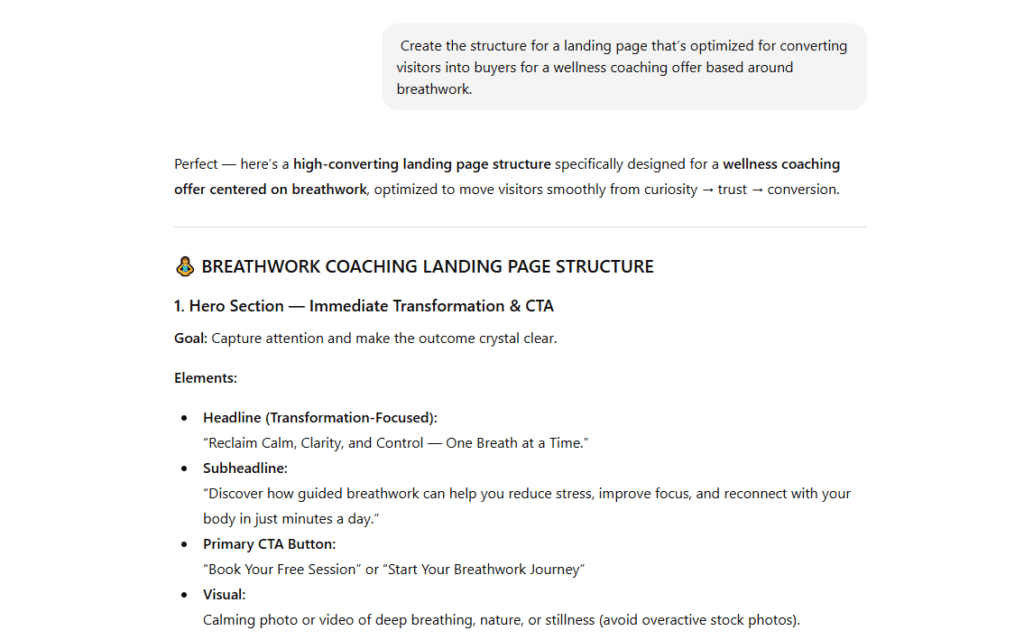
Create the structure for a landing page that's optimized for converting visitors into buyers for [coaching product].
- Influencer Collaboration:
Suggest potential influencers or thought leaders in [niche] who could collaborate to extend the campaign's reach. - Limited-Time Offer Copy:
Write copy for a limited-time offer attached to the coaching product, creating a sense of urgency. - Interactive Campaign Element:
Propose an interactive element, such as a quiz or assessment, that engages the audience and encourages participation. - Ad campaign:
Give me 10 short ad copy variations for a campaign selling [coaching product]. - Free event ideas:
Develop an idea for a webinar or workshop that can serve as a key component of the marketing campaign for [coaching product]. - Analytics:
Suggest KPIs and metrics to measure the effectiveness of my marketing campaign.
15 ChatGPT Prompts for Your Content Marketing Efforts
These cover the ongoing content you create to stay visible and build trust with your audience. Use them for weekly content planning, channel-specific copy, and whenever you’re stuck on what to post next.

- Social Media Hashtags:
Create a list of relevant hashtags for social media posts related to [coaching brand/product]. Group by reach. - Social Media Bio:
Create a concise and engaging bio for the coaching business's social media profiles. - LinkedIn content:
Create a 30-day social media content plan for a [niche] coaching service on LinkedIn, including post types and one weekly newsletter idea. - Video scripting:
Craft an attention-grabbing 90-second script for a short-form video about [topic], aimed at [audience]. - X Content:
Write a series of tweets to boost awareness of a [niche] coaching program. - Infographics:
Outline an infographic on the benefits of hiring a business coach for entrepreneurs. - Email newsletters:
Generate content for an email newsletter promoting a time management coaching workshop. - Podcast episodes:
Write a podcast script discussing stress management tips for a mental health coaching business. - Instagram captions:
Draft an Instagram caption for a motivational quote related to fitness coaching. - Webinars:
Brainstorm ideas for a webinar promoting a leadership coaching program. - Pinterest:
Craft a Pinterest description for an infographic on achieving work-life balance through coaching. - Facebook:
Generate a Facebook post introducing a new coaching package for productivity improvement. - Ebooks:
Develop an outline for a downloadable ebook on nutrition coaching tips for a healthier lifestyle. - Short-form video series:
Generate 10 ideas for a 30-second video series showcasing a day in the life of a coaching client. - Threads / X long-form:
Draft a 7-post thread on the biggest mindset shift I help my [niche] clients make. Build toward a soft CTA in the final post.
15 ChatGPT Prompts for Website and Blog Post Copy
Use these for your website pages, blog strategy, and individual articles. They’re especially useful when building or refreshing your site, or when you need to produce blog content regularly without staring at a blank page.
- Blog post ideas:
Generate engaging blog post ideas for promoting a life coaching business that target searches my ideal client is making. - Meta descriptions:
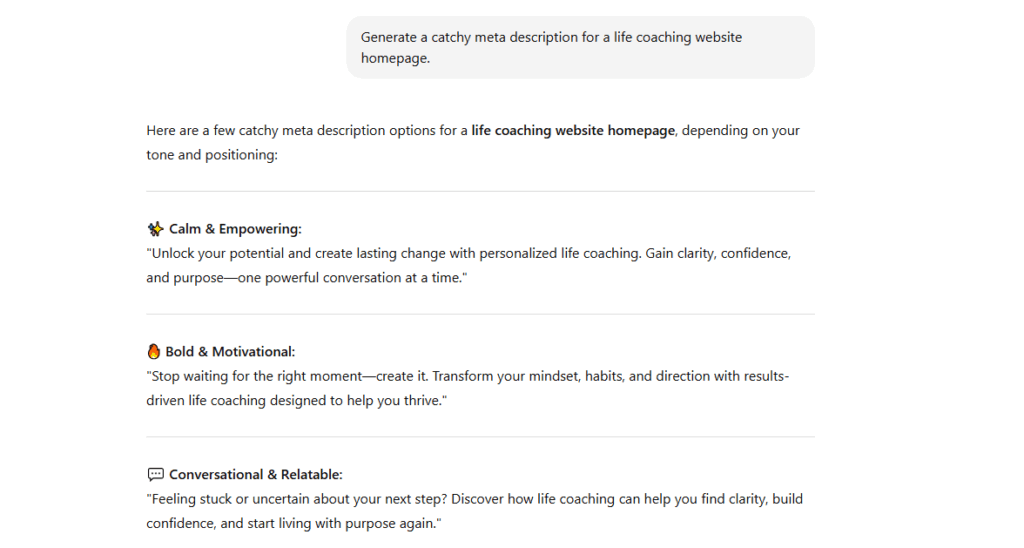
Generate a catchy meta description for a life coaching website homepage, under 155 characters.
- Outlines:
Create an outline for a blog post about the benefits of executive coaching for professionals. Include intro hook, sections, FAQ, and conclusion. - Content generation:
Write out the following section of this outline in an informal but matter-of-fact tone: [insert outline]. - Blog post introduction:
Write 3 short intro variations for a blog post about stress management and how coaching helps. Each should open with a relatable scenario, not a definition. - Revisions:
Rewrite this excerpt from a blog post with more detail and concrete examples about [topic]. - Expanding listicles:
Suggest 10 more ways single moms can manage their time better for a listicle. - Reviews:
Evaluate the pros and cons of using [software name] for a solo coach. - Headlines:
Give me 10 SEO-friendly headline ideas for an article about the latest health and wellness trends. Start with a number, max 70 characters. - Website structure:
Create an effective structure for a brand website of a health and wellness coach. - Hero section:
Write three variations for the hero section on a website focusing on career coaching. - About page:
Generate a narrative-style biography from the following resume that positions me as the obvious coach for [audience]: [insert coaching resume]. - Services section:
Write short descriptions for the following career coaching services to be placed on a website: 1-on-1 coaching, group coaching, and 6-month intensive with accountability. - Website section copy:
List 10 unique selling propositions for a coaching program focused on self-love and confidence. - Testimonial template:
Create a template I can share with past coaching clients to ask for a concise but convincing testimonial.
15 ChatGPT Prompts for Email Marketing & Communication
These cover both marketing emails (newsletters, promos, sequences) and the day-to-day client communication that takes up more time than most coaches expect. Use the client communication prompts as templates you customize once and reuse across your practice.
- Onboarding email:
Write a short welcome email for a new client with a link where they can settle their payment and book their first session. - Follow-up email:
Write a 100-word follow-up email for a client who missed paying their coaching fees. - Session confirmation:
Write a short email confirming the date and time of a coaching session booked with a client. - Firing a coaching client:
Write a short, professional, matter-of-fact email to end the engagement with a client who has been repeatedly breaking our contract terms. - Session outputs:
Generate a 300-word coaching session summary from the following audio transcript: [insert transcript]. - Session materials:
Write a short email for a coaching client with a link to the materials included in their coaching package. - Subject lines:
Compose 10 engaging subject lines for a coaching newsletter about setting and achieving goals. - Email funnel copy:
Generate an opening paragraph for a welcome email to new subscribers of a life coaching blog. Friendly, not corporate. - Accountability emails:
Write a follow-up email to a coaching client expressing encouragement and tracking progress on [goal]. - Reminder email:
Write a friendly reminder email to coaching clients about an upcoming group coaching session. - Sales email:
Write an email reaching out to previous clients with a new coaching package. Lead with their result from our last engagement. - Content promotion for an email list:
Write a short email announcing a new blog post on productivity tips. Tease 2 takeaways. - Email newsletters:
Write an email to coaching clients sharing insights on overcoming common mindset challenges. - Signature ideas:
Give me 10 friendly signature ideas I can use when sending emails to my health coaching clients. - Newsletter ideas:
Generate 10 newsletter ideas I can send to my email list about the abundance mindset.
15 ChatGPT Prompts for Public Relations
Use these to get your name and expertise in front of new audiences without paid ads. PR prompts work best when you have a launch or campaign coming up. Pair them with the Podcast Outreach Workflow (#3) above for maximum reach.
- PR strategy:
Share the pros and cons of common PR strategies coaches use (podcast tours, guest articles, awards, HARO/Qwoted, partnership swaps). - Marketing events:
Generate ideas for free events or webinars to promote my coaching brand and connect with my audience. - Elevator pitch:
Create a PR pitch highlighting my unique coaching approach and success stories for media outreach, based on the following bio: [insert coaching bio]. - Press release:
Draft a press release announcing the launch of a new coaching product and how it solves [problem] differently from anything else on the market, based on these points: [bullet points]. - Media coverage:
Suggest 10 long-standing coaching magazines, podcasts, or substacks that have featured coaches in the past and would be relevant to my niche. - Coaching bio:
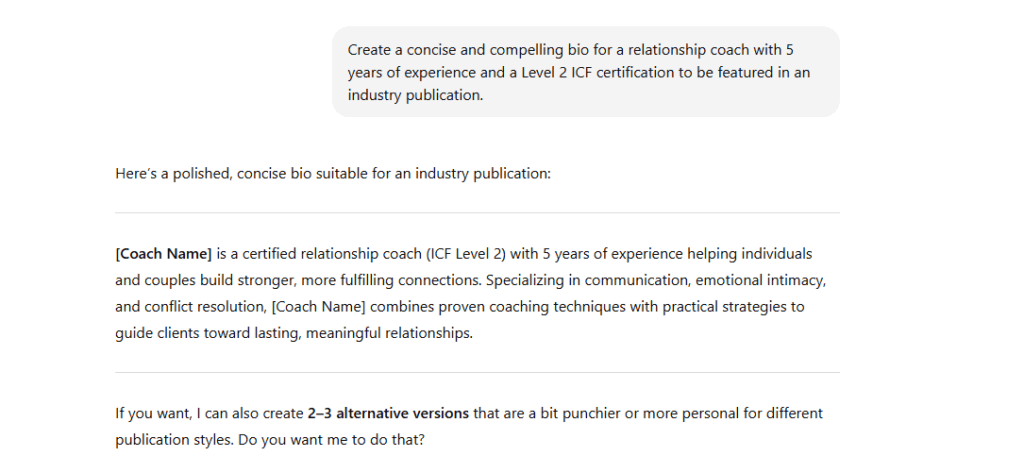
Create a concise and compelling bio for a relationship coach with 5 years of experience and an ICF certification, to be featured in an industry publication.
- Case studies:
Draft a social media announcement sharing a recent client success story and its impact. - Awards announcement:
Craft an announcement for winning an industry award or recognition as a business coach, focused on gratitude and announcing new client intake. - Article submissions:
Suggest ideas for article submissions I can pitch to leading coaching magazines. - Press outreach:
Draft an email to connect with a journalist or reporter to establish an ongoing relationship for future coverage. - LinkedIn posts:
Write a LinkedIn post showcasing my expertise in adoption coaching. - Partnerships:
Compose an email pitch to invite a creator in an adjacent niche to experience my coaching services in exchange for an honest share to their audience. - Affiliate marketing:
Write an email to a newsletter editor proposing a collaboration to feature my coaching services in their newsletter. - Podcasting:
Give me 10 ideas for new podcasts I can start as a spirituality coach to showcase my perspective and expertise. - Talking points:
Generate talking points I can use during a webinar interview about [topic].
Automate Your Coaching Business with Paperbell
You’ve now got 90 ChatGPT prompts, 10 multi-step workflows, and 5 Custom GPTs to work with. The next obvious thing to tackle: automating how you actually run the business.
Paperbell takes care of your contracts, scheduling, payments, and client onboarding so you can focus on coaching, not admin. Try Paperbell for free to launch your coaching website in minutes.
FAQ
What are the best ChatGPT prompts for marketing a coaching business?
The best prompts include four elements: a clear role for ChatGPT (e.g. “act as an email marketing strategist”), context about your niche and audience, a specific output format, and an example of what good looks like. Avoid one-line “write me a social post” prompts. They produce generic, forgettable content. Use the 90 prompts in this guide as starting points and layer in your niche, audience, and brand voice every time.
How do I write a ChatGPT prompt that gets useful marketing copy?
Structure your prompt with role + context + format + example. Tell ChatGPT who it is, describe your audience and offer in detail, specify the format and length, and paste in 1-2 examples of similar copy you’d consider great. Then iterate: ask for 5 variations, pick the best one, and ask ChatGPT to revise it.
Should I use ChatGPT or Claude for marketing content?
Use ChatGPT for image generation, voice-mode brainstorming, Custom GPTs, and tasks that need live web browsing. Use Claude for long-form writing, analyzing big documents (paste in a 60-page transcript), and refining tone without drifting toward generic. Most coaches who use AI seriously keep both open. If you can only afford one, pick the tool that matches your bigger weekly task.
What are AI marketing workflows and how are they different from prompts?
A prompt is a single instruction. A workflow is a chain of prompts where each one builds on the last (audience research, then content gap, then outline, then draft, then critique, then revision). Instead of opening a blank chat 12 times a week, you run one workflow that produces a finished marketing asset in a single sitting. The 10 workflows in this guide are templates you can adapt to your niche.
Can ChatGPT replace a marketing strategist for my coaching business?
No. ChatGPT is excellent at executing on a strategy and producing first drafts, but it can’t tell you which audience to focus on, which offer to lead with, or how to position yourself. Those decisions still need a human who understands your business and goals. Use ChatGPT to execute and iterate on the strategy you already have, not to replace it.
What’s GEO and how does it affect coaching marketing in 2026?
GEO (Generative Engine Optimization) is the practice of writing content that AI tools like Google’s AI Overviews, Perplexity, and ChatGPT cite in their answers. As more searches end without a click, getting quoted inside an AI answer is becoming as important as ranking on page 1 of Google. The pattern that wins: clear definitions in the opening paragraph, numbered lists of specific items, stats with source links, and exact-match keyword phrases in your H2s. See workflow #6 above for the prompt template.
Editor’s Note: This post was originally published in December 2023 and has been substantially updated for 2026 with 10 multi-step AI workflows, 5 Custom GPT recommendations, a ChatGPT vs. Claude comparison, and a refreshed prompt library.