

How to Become a Spiritual Coach in 2026: Training, Income & Building a Practice
You feel called to do something that goes deeper than goal-setting and task lists. You want to help people find meaning, reconnect with what matters, and move through life with more clarity and intention.
That pull toward something more purposeful? It might be pointing you toward a career as a spiritual coach.
Spiritual coaching is one of the more nuanced paths in the coaching world, partly because the word “spiritual” carries a lot of different meanings for different people. But it’s also one of the most rewarding, because the work tends to go right to the heart of what clients are struggling with.
In this guide, we’ll walk through exactly what spiritual coaching is (and what it isn’t), what it takes to get started, how to find your niche, how to get certified, and how to build a practice that’s both meaningful and financially sustainable.
What Is a Spiritual Coach?
A spiritual coach helps clients explore questions of meaning, purpose, and personal values. The work might involve examining what a client believes about themselves, what gives their life direction, how they want to show up for the people they love, or how to move through a major life transition with more groundedness.
What it’s not is equally important to understand:
- Not therapy or counseling. Licensed therapists and counselors are trained to diagnose and treat mental health conditions. Spiritual coaches don’t diagnose, treat, or prescribe anything. If a client is dealing with clinical depression, trauma, or a mental health condition that requires professional support, that’s a referral situation, not a coaching situation. Knowing where that line is, is part of what makes a good spiritual coach.
- Not psychic or mediumship services. Spiritual coaching doesn’t involve predictions, fortune-telling, or communicating with the deceased. It’s a forward-facing, evidence-based practice grounded in the client’s own values, experiences, and goals.
- Not religious counseling or pastoral care. Spiritual coaching isn’t tied to a specific faith tradition or belief system. A good spiritual coach works within whatever framework the client brings, not the coach’s own.
What ties it together: spiritual coaching helps clients connect what they believe about life’s deeper meaning with how they actually live day to day. The International Coaching Federation (ICF), which sets the global professional standard for the coaching industry, describes coaching broadly as “a thought-provoking and creative process that inspires clients to maximize their personal and professional potential.” Spiritual coaching applies that framework to questions of meaning, values, and inner purpose.
So if you’ve been wondering whether this is a legitimate profession: yes. It’s a real coaching specialty, practiced by trained and credentialed coaches around the world.
Why Become a Spiritual Life Coach?
The coaching industry has grown significantly over the past decade. Global coaching market research consistently places the industry in the multi-billion dollar range, and demand for personal development coaching continues to climb.
But beyond the market size, spiritual coaching attracts practitioners for more personal reasons:
- The work feels meaningful. You’re helping people get unstuck at the level of values and purpose, not just scheduling and productivity.
- Clients are deeply motivated. People who seek spiritual coaching are often at genuine turning points in life. That makes the coaching relationship rich and the progress visible.
- You can build it around your own values. Whether you’re drawn to mindfulness-based approaches, Jungian frameworks, or nature-based practices, there’s space to create a coaching approach that reflects who you are.
- The flexibility of a coaching practice. You choose your niche, your clients, your hours, and your rates. You’re the one in charge.
One coach who’s built this kind of practice is Layla el Khadri, a well-known spiritual coach who blends inner work with practical business coaching for conscious entrepreneurs. Her practice is a useful illustration of what intentional niching looks like in this space. She has a clearly defined audience and a clear point of view, which is exactly what separates coaches who build thriving practices from those who stall out early.

Skills You Need to Become a Spiritual Coach
Certification matters (more on that below), but certain qualities make someone genuinely good at this work. The coaches who do well tend to have:
- Deep listening skills. Not just waiting for your turn to talk, but the kind of listening that catches what the client hasn’t quite put into words yet.
- A non-dogmatic approach to spirituality. Your job is to work within your client’s framework, not introduce your own. If you can only coach clients who share your specific beliefs, your niche is very narrow and the relationship will run into walls fast.
- Comfort sitting with uncertainty. Spiritual questions don’t resolve neatly. Clients working through grief, identity shifts, or purpose questions need a coach who can stay present without rushing to an answer.
- Coaching fundamentals. Powerful questioning, the ability to reframe, knowing when to challenge vs. support, and how to create accountability. These apply in every coaching niche, including this one.
- Self-awareness about your own beliefs. You don’t need to have everything figured out. But you do need to know where your own perspective might unconsciously shade how you show up for clients, and how to keep it out of the way.
- Business basics. Spiritual gifts don’t pay the rent on their own. Running a practice means marketing, managing clients, pricing your work, and handling the administrative side. (Good news: tools exist to make most of this straightforward.)
How to Become a Spiritual Coach
There’s no single required path into spiritual coaching. What matters most is combining real coaching skills with a grounded understanding of spiritual frameworks. Here’s how most coaches build toward it.
1. Choose Your Spiritual Coaching Niche
Spiritual coaching covers a lot of ground. Getting specific about who you serve and what you help them with makes everything easier, from marketing to client conversations to knowing when a referral is the right call.
Some directions spiritual coaches take:
- Life transitions — supporting clients through loss, career pivots, relationship changes, or major identity shifts
- Purpose and meaning — helping clients who feel disconnected from what they’re doing with their lives rediscover direction
- Mindfulness and presence — bringing contemplative practices into coaching to help clients access different ways of thinking about their situations
- Values alignment — working with clients who feel like their daily life doesn’t match what they actually believe or care about
- Conscious entrepreneurship — for clients building businesses and wanting to do it in a way that reflects their deeper values (this is a growing niche)
You don’t have to lock in your niche before you start coaching, but having a direction shapes everything from your website to your first client conversations.
2. Develop Your Coaching Process
What does working with you actually look like? Spiritual coaching is vague to most prospective clients, which means your process is how you make it concrete and trustworthy.
Think through:
- How long does your coaching engagement last (6 weeks, 3 months, 6 months)?
- How often do sessions happen and for how long?
- What practices, frameworks, or tools do you bring in: journaling, somatic awareness, meditation, values exercises?
- How do you measure progress with clients on something as intangible as spiritual growth?
You’ll iterate on all of this. But having a starting framework means you show up to early client conversations with something coherent to describe, rather than trying to explain it from scratch every time.
3. Create Coaching Packages
Package your coaching into defined engagements rather than selling single sessions. It’s better for the client (they get a complete arc of support, not isolated check-ins), and it’s better for your income (predictable, not session-by-session). For help designing package structures and setting your rates, see our guide to life coaching packages.
A basic structure many spiritual coaches use: a 3-month engagement with bi-weekly sessions, a discovery call to assess fit, an onboarding process, and some kind of reflection or closure at the end. What you include, and what you charge, is up to you.
How to Get Certified as a Spiritual Life Coach
Unlike therapy or counseling, spiritual coaching is not a licensed profession. There’s no government-required certification. That’s both a low barrier to entry and, if you’re not thoughtful about it, a credibility gap.
Getting certified matters for two reasons. First, it gives you actual coaching skills, not just enthusiasm. Second, it signals to prospective clients (and Google) that you’ve done the real work. In a wellness-adjacent space where a lot of questionable content exists, credentials are one of the clearest ways to establish trust.
The ICF Standard
The International Coaching Federation (ICF) is the closest thing the coaching industry has to a professional governing body. ICF doesn’t specifically certify “spiritual coaches,” but many reputable programs that train spiritual coaches hold ICF accreditation, which means the curriculum meets an established quality standard.
ICF credential levels to know:
- ACC (Associate Certified Coach): Minimum 60 training hours + 100 coaching hours
- PCC (Professional Certified Coach): Minimum 125 training hours + 500 coaching hours
- MCC (Master Certified Coach): Minimum 200 training hours + 2,500 coaching hours
You don’t need an ICF credential to start coaching. But if you complete a program that’s ICF-accredited, those hours count toward a credential if you pursue one later. It’s worth asking any program about this before you enroll.
For a detailed comparison of programs, see our guide to spiritual life coach certifications.
Programs Worth Looking At
A few programs that specifically train spiritual coaches or offer spiritual coaching specializations:
- World Coaching Institute — offers spiritual coaching pathways with ICF alignment
- Center for Transformational Coaching — integrates spiritual development into coaching training
- Life Purpose Institute — focused on purpose-based coaching with a spiritual emphasis
- Psychosynthesis Coaching — grounded in Roberto Assagioli’s psychosynthesis model, which integrates psychology and spirituality in a well-documented way
When you’re evaluating any program, look for: ICF accreditation (or alignment), a clear ethics framework, real coaching skills training (not just spiritual content), and what kind of community and mentorship is included.
How to Start a Spiritual Coaching Business
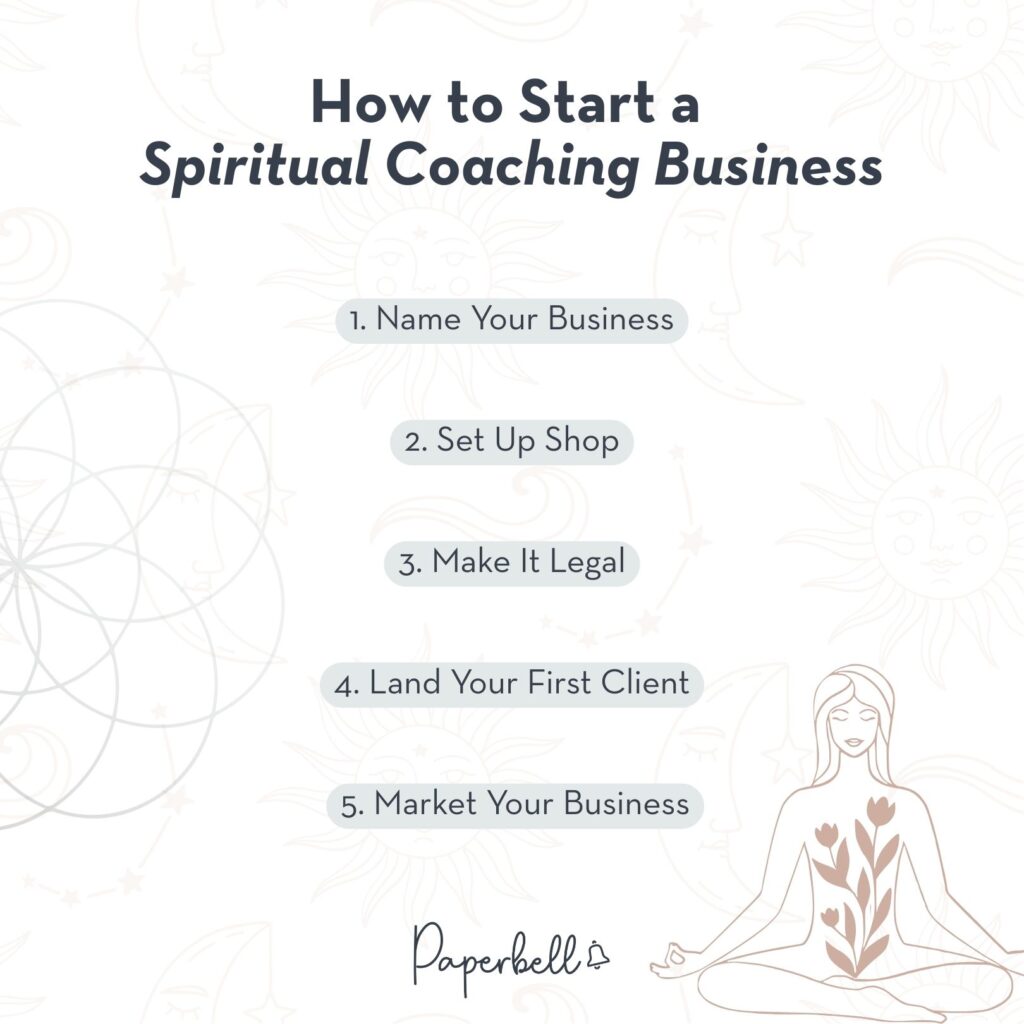
1. Name Your Business
You have two options: your own name (Jane Smith Coaching) or a brand name that reflects your niche (Soulful Direction, Grounded Path, something like that). Neither is wrong. Your name builds personal authority; a brand name can be more transferable if you ever want to develop a team.
Search your preferred name on Google, check social media handles, and verify the domain is available before you get attached to it. These are details, but they’re worth getting right from the start.
2. Build Your Practice Foundation
Your website doesn’t need to be perfect before you start coaching. It needs to be clear: who you help, what you help them with, and what working with you looks like. That’s it.
Beyond the website, the practical things you need to have in place early:
- A way for clients to book sessions with you without the back-and-forth email exchange
- A contract that outlines scope of practice, confidentiality, cancellation terms, and the fact that you’re a coach, not a licensed therapist
- A way to collect payment without chasing invoices
- A client onboarding process so new clients know exactly what to expect
Paperbell handles all of this in one place: scheduling, contracts, payments, and your client portal. If you want to see it before you commit, try Paperbell for free and see how much of the back-office busywork it takes off your plate.
3. Make It Legal
In most places, you can start a coaching practice as a sole proprietor without any formal business structure. But it’s worth talking to a local accountant or business attorney about whether forming an LLC makes sense for your situation. The primary benefit is personal liability protection, which matters if a client ever has a dispute.
A few other things to look into: whether you need a local business license, how you’ll handle taxes as a self-employed person, and whether you want professional liability insurance (also called errors and omissions insurance). This sounds dry, but it’s the kind of thing that saves you headaches later.
4. Land Your First Client
Most coaches get their first several clients through personal networks. Tell the people who know you what you’re doing. Offer a discounted or pro bono engagement to someone you trust to give you honest feedback.
The goal with early clients isn’t money. It’s reps. You learn more about your process from actual coaching conversations than from any amount of planning.
5. Market Your Practice
The marketing approach that works best for spiritual coaches tends to be content-led: writing, speaking, or creating that lets prospective clients get a sense of how you think before they ever reach out. Blog posts, podcast appearances, Instagram content, YouTube, email newsletters, local workshops. Any format that lets you share your perspective genuinely works here.
Pick one or two channels and commit to consistency rather than trying to be everywhere at once. Visibility takes time, but it compounds. The coaches who build strong practices aren’t the ones with the best sales funnels; they’re the ones who show up reliably and have something real to say.
How Much Do Spiritual Coaches Make?
Income varies a lot depending on experience, niche, client load, and how you structure your packages. Based on data from ZipRecruiter and Glassdoor, here’s a rough picture of what spiritual coaches report earning:
- Starting out: $40–$75 per hour for newer coaches building their client base
- Established practice: $100–$200+ per session, or $1,500–$5,000+ for package engagements
- Experienced or specialized coaches: Some coaches with strong positioning and a high-demand niche charge $300–$500+ per session
The coaching industry as a whole reported a global market value of over $6.25 billion in 2024, and the personal coaching segment continues to grow. That said, individual income depends entirely on how many clients you work with and what you charge. Two coaches with the same skills and credentials can earn very different amounts based on how they package and market their services.
The best way to grow your income over time: get better at coaching (so your results speak for themselves), get clearer about your niche (so your marketing attracts the right people), and price your packages to reflect the value you deliver, not your anxiety about charging too much.
FAQ
What do I need to become a spiritual coach?
There’s no mandatory license or government certification required to coach in most countries. What you do need: genuine coaching skills (which a good certification program will teach you), a clearly defined approach and niche, and the basic business infrastructure to manage clients professionally. Credibility matters in this space, so most coaches complete a reputable training program before working with paying clients.
Is spiritual coaching a legitimate career?
Yes. Spiritual coaching is practiced professionally by trained coaches around the world and falls under the broader coaching industry, which the ICF estimates employs over 100,000 coaches globally. Like any coaching specialty, its credibility depends on the individual coach’s training, ethics, and results. A certified coach with clear scope-of-practice boundaries and a results-oriented process is doing legitimate, valuable work. The presence of unqualified practitioners in the wellness space (in every niche, not just this one) is why credentials and transparency matter.
What’s the difference between a spiritual coach and a therapist?
A licensed therapist is a mental health professional trained and credentialed to diagnose and treat mental health conditions. A spiritual coach is not. Coaches work with clients who are generally functioning well and want to grow in a specific direction; therapists work with the full range of mental health needs, including conditions that require clinical treatment. If a client brings up trauma, active mental illness, or anything that suggests they need clinical support, a good spiritual coach refers out. That clarity is part of what makes a coaching relationship safe.
Do I need to share my own spiritual beliefs with clients?
No, and in most cases it’s better if you don’t lead with them. Good spiritual coaching is client-led. Your job is to help clients explore their own values, beliefs, and sense of purpose, not to guide them toward yours. That said, your personal experience with spiritual practice often informs the depth and quality of how you coach. You don’t need to hide who you are, but keep the focus on the client.
Can I become a spiritual coach without being religious?
Absolutely. Spirituality and religion are related but not the same thing. Many spiritual coaches draw on secular frameworks like mindfulness, positive psychology, or Jungian psychology, as well as non-religious wisdom traditions. What matters is that you can work respectfully and effectively within whatever framework your client brings, religious or otherwise.
How long does it take to become a certified spiritual life coach?
Most spiritual coaching certification programs take between three and twelve months, depending on the program’s structure and how much time you can commit. Some programs offer intensive formats that can be completed in a few months; others are designed as longer part-time tracks. Once you’ve completed a program, building the coaching hours needed for an ICF credential (starting at 100 hours for the ACC level) takes additional time. Many coaches start working with clients during or shortly after their training while still building toward a formal credential.
Do spiritual coaches make good money?
They can. Like most coaching specialties, income varies widely. Full-time coaches with established practices and clear niches often earn comfortably in the $60,000–$120,000+ range; coaches who’ve built premium positioning can earn more. Starting out, expect lower rates while you build experience and a client base. The income trajectory improves significantly once you have a clear niche, a defined process, and a track record of client results. Packaging your services (rather than selling individual sessions) is one of the most consistent ways to increase your income as a coach.
Build Your Spiritual Coaching Practice with Confidence
Spiritual coaching is a real career with real demand. The path forward isn’t one-size-fits-all, but the foundation is the same for everyone: strong coaching skills, a defined niche, the professional infrastructure to manage clients, and the persistence to show up consistently over time.
The business side doesn’t have to be complicated. Paperbell gives you everything you need to manage clients in one place: scheduling, contracts, payments, and a client portal that makes the whole experience feel professional from day one. Try Paperbell for free and take one thing off your list so you can focus on what actually matters: the coaching.